
[Paper Review] 1100 days in the life of the supernova 2018ibb -- The best pair-instability supernova candidate, to date
SN 2018ibb is identified as the best candidate for a pair-instability supernova to date, with a long diffusion time and nickel mass consistent with PISN predictions, and without evidence for a central engine powering.
Abridged - Stars with ZAMS masses between 140 and $260 M_\odot$ are thought to explode as pair-instability supernovae (PISNe). During their thermonuclear runaway, PISNe can produce up to several tens of solar masses of radioactive nickel, resulting in luminous transients similar to some superluminous supernovae (SLSNe). Yet, no unambiguous PISN has been discovered so far. SN2018ibb is a H-poor SLSN at $z=0.166$ that evolves extremely slowly compared to the hundreds of known SLSNe. Between mid 2018 and early 2022, we monitored its photometric and spectroscopic evolution from the UV to the NIR with 2-10m class telescopes. SN2018ibb radiated $>3 imes10^{51} m erg$ during its evolution, and its bolometric light curve reached $>2 imes10^{44} m erg\,s^{-1}$ at peak. The long-lasting rise of $>93$ rest-frame days implies a long diffusion time, which requires a very high total ejected mass. The PISN mechanism naturally provides both the energy source ($^{56}$Ni) and the long diffusion time. Theoretical models of PISNe make clear predictions for their photometric and spectroscopic properties. SN2018ibb complies with most tests on the light curves, nebular spectra and host galaxy, potentially all tests with the interpretation we propose. Both the light curve and the spectra require 25-44 $M_\odot$ of freshly nucleosynthesised $^{56}$Ni, pointing to the explosion of a metal-poor star with a He-core mass of 120-130 $M_\odot$ at the time of death. This interpretation is also supported by the tentative detection of [Co II]$λ$1.025$μ$m, which has never been observed in any other PISN candidate or SLSN before. Powering by a central engine, such as a magnetar or a black hole, can be excluded with high confidence. This makes SN2018ibb by far the best candidate for being a PISN, to date.
Motivation & Objective
- Motivate the search for unambiguous PISN identifications among hydrogen-poor SLSNe.
- Test PISN predictions against a long-term photometric and spectroscopic dataset for SN 2018ibb.
- Infer progenitor properties and nickel yield to assess the PISN nature of SN 2018ibb.
Proposed method
- Conduct multi-wavelength photometric and spectroscopic monitoring from UV to NIR over ~1100 rest-frame days.
- Apply s-corrections and cross-instrument calibration to homogenize data from many facilities.
- Perform host-galaxy subtraction and absolute flux calibration of spectra, integrating photometry for bolometric properties.
- Compare observed light curves and nebular spectra with PISN model predictions.
- Search for signatures of alternative power sources (central engine) and for evidence of circumstellar interaction.
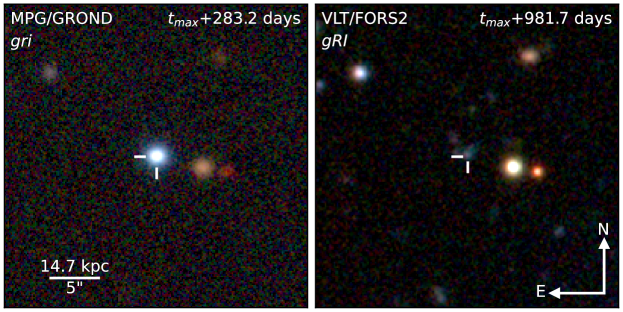
Experimental results
Research questions
- RQ1Is SN 2018ibb powered predominantly by a pair-instability supernova mechanism as predicted for very massive, metal-poor progenitors?
- RQ2What nickel-56 mass and ejecta/helium-core mass are required by the observations, and do these align with PISN expectations?
- RQ3Do the photometric and spectroscopic data show signatures of a central-engine energy source or ejecta interaction with circumstellar material that would challenge a pure PISN interpretation?
- RQ4How does the host galaxy environment (metallicity, mass) support or constrain the PISN scenario for SN 2018ibb?
Key findings
- SN 2018ibb radiated >3×10^51 erg and reached a bolometric peak >2×10^44 erg s^-1.
- The long rest-frame rise (>93 days) implies a very high total ejected mass and long diffusion time.
- Modeling indicates 25–44 M⊙ of freshly synthesized 56Ni is required to explain the light curve and spectra.
- The data point to a metal-poor progenitor with a helium-core mass of 120–130 M⊙ at death.
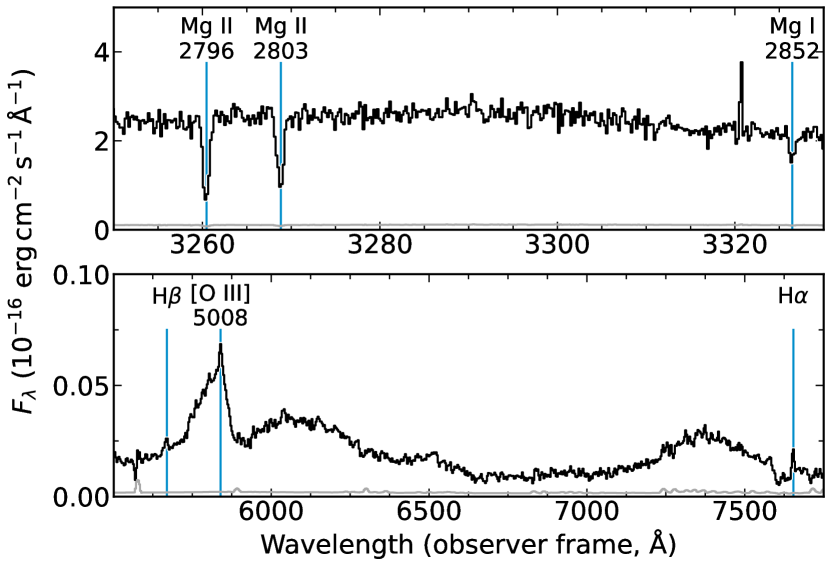
- Tentative detection of [Co II] 1.025 μm augments the PISN interpretation, a feature not seen in other PISN candidates or SLSNe.
- There is observational evidence for an eruptive mass-loss episode and subsequent ejecta-CSM interaction contributing to the emission, potentially explaining a discrepancy with some PISN models.
- Powering by a central engine (magnetar or black hole) is excluded with high confidence, strengthening the PISN case.
Better researchstarts right now
From reading papers to final review, dramatically reduce your research time.
No credit card · Free plan available
This review was created by AI and reviewed by human editors.