
[Paper Review] $ν^2$-Flows: Fast and improved neutrino reconstruction in multi-neutrino final states with conditional normalizing flows
This paper introduces $\nu^2$-Flows, a conditional normalizing flow method that enables fast, accurate reconstruction of multiple neutrino momenta in multi-neutrino final states—specifically $t\bar{t}$ dilepton events—by learning the full conditional probability distribution of neutrino momenta from observed objects. It achieves superior reconstruction accuracy and statistical precision over standard analytical methods, with inference times under 75 ms per event and improved sensitivity to top quark mass and spin correlations.
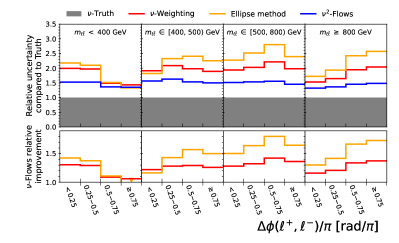
In this work we introduce $ν^2$-Flows, an extension of the $ν$-Flows method to final states containing multiple neutrinos. The architecture can natively scale for all combinations of object types and multiplicities in the final state for any desired neutrino multiplicities. In $t\bar{t}$ dilepton events, the momenta of both neutrinos and correlations between them are reconstructed more accurately than when using the most popular standard analytical techniques, and solutions are found for all events. Inference time is significantly faster than competing methods, and can be reduced further by evaluating in parallel on graphics processing units. We apply $ν^2$-Flows to $t\bar{t}$ dilepton events and show that the per-bin uncertainties in unfolded distributions is much closer to the limit of performance set by perfect neutrino reconstruction than standard techniques. For the chosen double differential observables $ν^2$-Flows results in improved statistical precision for each bin by a factor of 1.5 to 2 in comparison to the Neutrino Weighting method and up to a factor of four in comparison to the Ellipse approach.
Motivation & Objective
- Address the challenge of reconstructing multiple neutrinos in $t\bar{t}$ dilepton events where standard analytical methods face under-constrained solutions and bias.
- Overcome limitations of traditional approaches that rely on fixed invariant mass constraints (e.g., $W$ and top quark masses), which can introduce bias and fail to find solutions in some events.
- Develop a scalable, generalizable framework that natively handles arbitrary combinations of object types and multiplicities in the final state, including multiple neutrinos.
- Improve statistical precision in unfolded distributions by reducing uncertainties closer to the ideal limit of perfect neutrino reconstruction.
- Enable fast, per-event inference with GPU acceleration and provide probabilistic outputs for each reconstructed solution, enabling potential background separation.
Proposed method
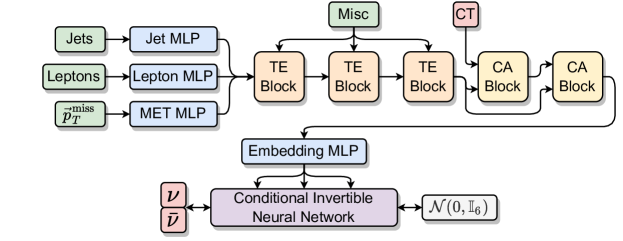
- Employ conditional normalizing flows to model the full conditional probability distribution $p(\vec{p}_{\nu_1}, \vec{p}_{\nu_2} \mid \mathcal{O})$ of neutrino momenta given observed objects $\mathcal{O}$ in an event.
- Use a transformer encoder with cross-attention and a learnable class token to create a permutation-invariant event representation from jets, leptons, and auxiliary information.
- Condition the normalizing flow on the event embedding to generate multi-neutrino momentum solutions while preserving physical consistency and kinematic correlations.
- Train the model end-to-end on simulated $t\bar{t}$ dilepton events with true neutrino momenta, learning the underlying kinematic structure without enforcing mass constraints.
- Enable fast inference (under 75 ms per event on a single CPU core) and support parallel evaluation on GPUs for further speedup.
- Sample multiple solutions per event using the learned flow and use the highest-probability solution or ensemble statistics for downstream analysis.
Experimental results
Research questions
- RQ1Can a normalizing flow-based method reconstruct multiple neutrino momenta in $t\bar{t}$ dilepton events with higher accuracy than standard analytical techniques?
- RQ2Does $\nu^2$-Flows reduce bias in neutrino reconstruction by avoiding strong assumptions on invariant masses (e.g., $m_W$, $m_t$) compared to traditional methods?
- RQ3To what extent does $\nu^2$-Flows improve statistical precision in unfolded distributions compared to the Neutrino Weighting and Ellipse methods?
- RQ4Can $\nu^2$-Flows achieve full event coverage (i.e., find solutions for all events) while maintaining high speed and accuracy?
- RQ5Does the model retain sensitivity to underlying physics parameters like the top quark mass even when trained only on a single $m_t$ value?
Key findings
- $\nu^2$-Flows reconstructs both neutrino momenta in $t\bar{t}$ dilepton events with significantly improved accuracy compared to standard analytical techniques, particularly in reconstructing the longitudinal momentum components.
- The method achieves per-bin uncertainties in unfolded distributions that are much closer to the theoretical limit of perfect neutrino reconstruction than competing methods.
- For double differential observables such as $m_{t\bar{t}}$ and $\Delta\phi(\ell^+\ell^-)$, $\nu^2$-Flows improves statistical precision by a factor of 1.5 to 2 over the Neutrino Weighting method and up to a factor of four over the Ellipse approach.
- All events are successfully reconstructed with solutions, unlike some standard methods that fail to find solutions in a subset of events.
- Inference time is under 75 ms per event on a single CPU core, and can be further reduced via GPU parallelization.
- Despite being trained only on events with a nominal top quark mass of 173 GeV, $\nu^2$-Flows shows measurable sensitivity to changes in the true $m_t$ (171 GeV and 175 GeV), indicating implicit learning of the mass dependence.
Better researchstarts right now
From reading papers to final review, dramatically reduce your research time.
No credit card · Free plan available
This review was created by AI and reviewed by human editors.