
[Paper Review] A Benchmark for Sparse Coding: When Group Sparsity Meets Rank Minimization
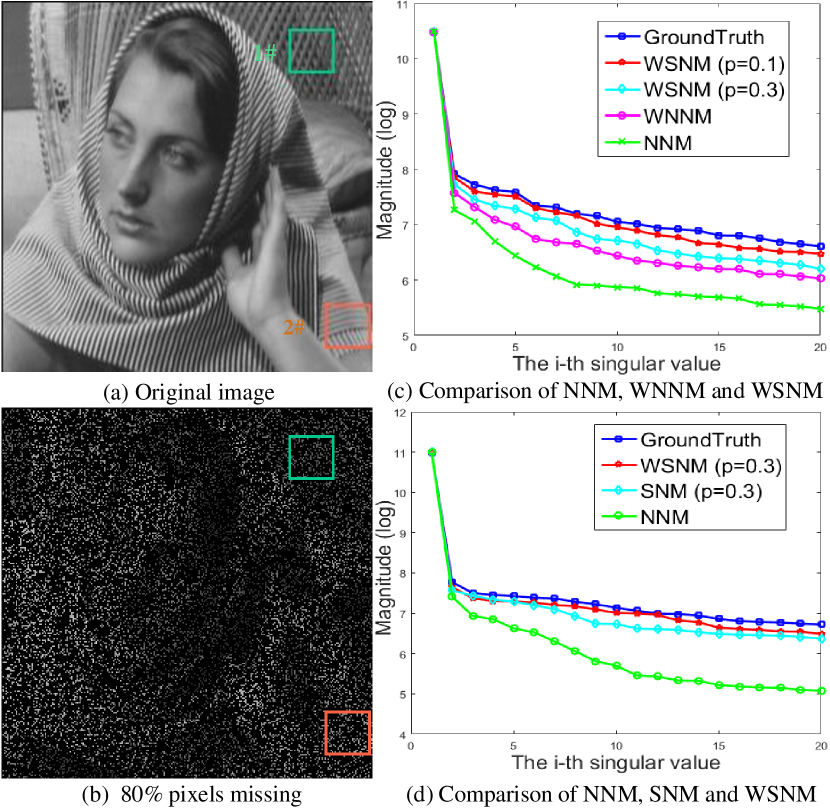
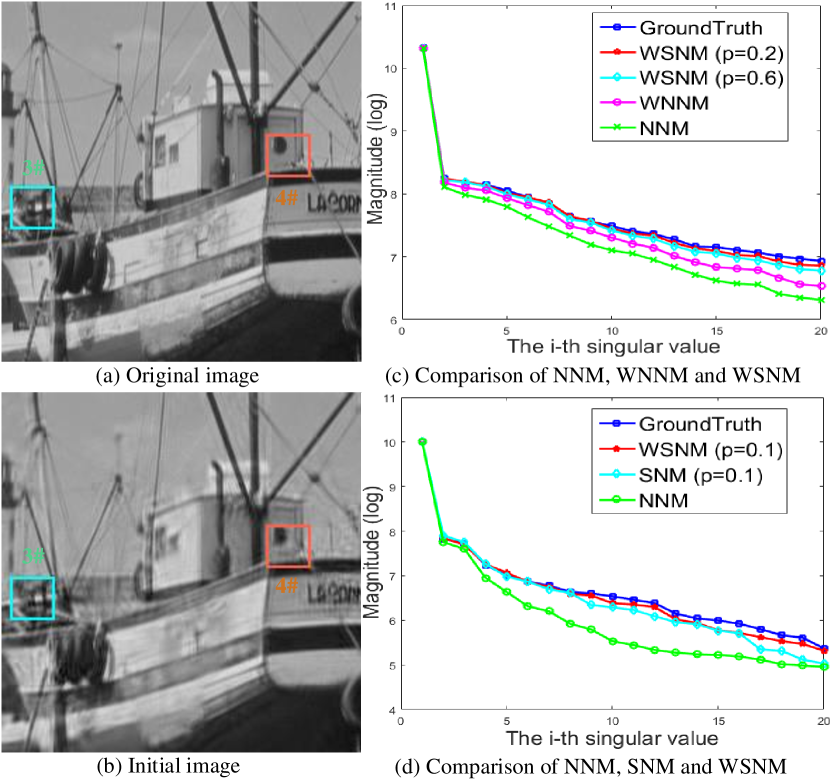
This paper introduces a novel benchmark for evaluating sparse coding sparsity by establishing an equivalence between group-based sparse coding (GSC) and rank minimization via an adaptive dictionary. It demonstrates that singular values from SVD of patch groups serve as a reliable sparsity measure, with weighted Schatten $p$-norm minimization (WSNM) closely approximating true low-rank structure, leading to superior performance in image inpainting and compressive sensing recovery.
Sparse coding has achieved a great success in various image processing tasks. However, a benchmark to measure the sparsity of image patch/group is missing since sparse coding is essentially an NP-hard problem. This work attempts to fill the gap from the perspective of rank minimization. More details please see the manuscript....
Motivation & Objective
- To address the lack of a standardized benchmark for measuring sparsity in sparse coding, particularly for group-based sparse coding (GSC).
- To establish a theoretical equivalence between GSC and rank minimization through an adaptive dictionary design.
- To enable performance evaluation of various norm minimization methods in sparse coding by leveraging their rank minimization counterparts.
- To identify the most effective norm minimization strategy for sparse coding by comparing its rank minimization equivalent.
Proposed method
- Design an adaptive dictionary that aligns GSC with rank minimization, enabling equivalence between sparse coefficient estimation and low-rank approximation.
- Prove that the $β$-norm minimization in GSC is mathematically equivalent to Schatten $p$-norm minimization (SNM) in low-rank matrix recovery under the designed dictionary.
- Use singular value decomposition (SVD) of patch groups to compute singular values as a direct, computable benchmark for sparsity.
- Apply four rank minimization methods—nuclear norm, Schatten $p$-norm, weighted Schatten $p$-norm (WSNM), and weighted nuclear norm—to evaluate sparsity fidelity.
- Translate the WSNM-based rank minimization into a non-convex weighted $\ell_p$-norm minimization problem in the GSC framework.
- Validate the benchmark by comparing weighted $\ell_p$-norm minimization against $\ell_1$, $\ell_p$, and weighted $\ell_1$ norms in image restoration tasks.
Experimental results
Research questions
- RQ1Can a reliable, computable benchmark for sparsity in group-based sparse coding be established using rank minimization principles?
- RQ2Is there a theoretical equivalence between group-based sparse coding and low-rank matrix recovery under a properly designed adaptive dictionary?
- RQ3Which norm minimization strategy in sparse coding most closely approximates the true low-rank structure of image patch groups?
- RQ4How does the performance of weighted $\ell_p$-norm minimization compare to other norm-based methods when evaluated via the proposed benchmark?
- RQ5Can the proposed benchmark enable improved performance in practical image restoration applications like inpainting and compressive sensing?
Key findings
- The proposed benchmark, based on singular values from SVD of patch groups, provides a reliable and computable measure of sparsity in group-based sparse coding.
- Weighted Schatten $p$-norm minimization (WSNM) is found to be the closest approximation to the true singular values of image patch groups among the tested rank minimization methods.
- The theoretical equivalence between weighted $\ell_p$-norm minimization in GSC and WSNM in rank minimization enables the use of WSNM's superior low-rank approximation in sparse coding.
- In image inpainting and compressive sensing recovery, the proposed weighted $\ell_p$-norm minimization scheme outperforms $\ell_1$, $\ell_p$, and weighted $\ell_1$ norm methods, achieving state-of-the-art results.
- The experimental results confirm the feasibility and effectiveness of the proposed benchmark in guiding the selection of optimal sparse coding strategies.
Better researchstarts right now
From reading papers to final review, dramatically reduce your research time.
No credit card · Free plan available
This review was created by AI and reviewed by human editors.