
[Paper Review] A collider test of nano-Hertz gravitational waves from pulsar timing arrays
This paper proposes that the nano-Hertz gravitational wave (GW) background detected by pulsar timing arrays (PTAs) could originate from a first-order phase transition (FOPT) in a MeV-scale hidden sector coupled to the Standard Model via the Higgs portal. It demonstrates that a sizable portal coupling—required to generate the observed GW signal—can be probed through Higgs invisible decays at the LHC and future lepton colliders like CEPC, ILC, and FCC-ee, offering a direct collider test for the origin of the stochastic GW background.
A cosmic first-order phase transition (FOPT) occurring at MeV-scale provides an attractive explanation for the nano-Hertz gravitational wave (GW) background indicated by the recent pulsar timing array data from the NANOGrav, CPTA, EPTA and PPTA collaborations. We propose this explanation can be further tested at the colliders if the hidden sector couples to the Standard Model sector via Higgs portal. Through a careful analysis of the thermal history of the hidden sector, we demonstrate that in order to successfully explain the observed GW signal, the portal coupling must be sizable that it can be probed through Higgs invisible decay at the LHC or future lepton colliders such as CEPC, ILC, and FCC-ee. Our research offers a promising avenue to uncover the physical origin of the nano-Hertz GWs through particle physics experiments.
Motivation & Objective
- To investigate whether the observed nano-Hertz gravitational wave (GW) background from pulsar timing arrays (PTAs) can be explained by a first-order phase transition (FOPT) in a MeV-scale hidden sector.
- To determine the implications of such a FOPT for particle physics experiments, particularly collider searches.
- To establish a connection between the amplitude of the GW signal and the strength of the Higgs portal coupling to the hidden sector.
- To evaluate the sensitivity of current and future colliders—such as the HL-LHC, CEPC, ILC, and FCC-ee—to the required portal coupling for explaining the PTA data.
Proposed method
- The study employs a minimal model with a gauged U(1)X dark sector containing a scalar and a dark gauge boson, coupled to the Standard Model via the Higgs portal.
- It calculates the effective potential of the dark scalar at finite temperature, including one-loop quantum corrections and daisy resummation for thermal effects.
- The thermal history of the hidden sector is analyzed to determine its temperature relative to the SM sector, accounting for early decoupling due to weak portal coupling.
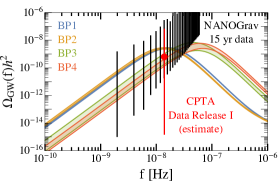
- The gravitational wave spectrum is computed from the FOPT dynamics using the standard framework of stochastic GW background generation from bubble collisions and sound waves.
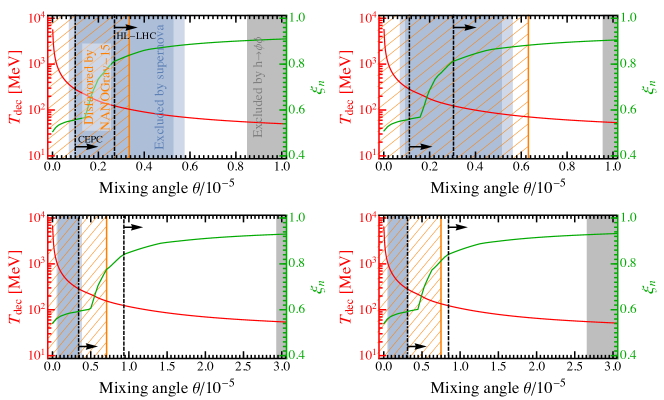
- The Higgs invisible decay width is derived as a function of the portal coupling, enabling direct collider sensitivity estimates.
- Benchmark points are numerically analyzed to compare the required portal coupling for GW production with the reach of HL-LHC and future lepton colliders.
Experimental results
Research questions
- RQ1Can the nano-Hertz gravitational wave background observed by PTAs be explained by a first-order phase transition in a MeV-scale hidden sector?
- RQ2What is the required strength of the Higgs portal coupling to produce the observed GW amplitude, and is it accessible at colliders?
- RQ3How does early thermal decoupling of the hidden sector affect the GW signal and the required portal coupling?
- RQ4To what extent can the HL-LHC and future lepton colliders like CEPC, ILC, and FCC-ee probe the parameter space needed to explain the PTA GW signal?
- RQ5Is there a direct link between the stochastic GW background and the invisible decay of the Higgs boson via Higgs portal coupling?
Key findings
- A sizable Higgs portal coupling is required to generate the observed nano-Hertz GW background, as smaller couplings lead to insufficient energy release during the FOPT.
- The required portal coupling results in a significant invisible branching fraction for the Higgs boson, making it detectable at the HL-LHC through Higgs invisible decays.
- The HL-LHC is expected to probe a large portion of the parameter space consistent with the PTA GW signal.
- Future lepton colliders such as CEPC, ILC, and FCC-ee can cover nearly all of the parameter space required to explain the GW background.
- The study establishes a direct, testable link between the astrophysical observation of a stochastic GW background and a specific particle physics process—Higgs invisible decay—via the Higgs portal.
Better researchstarts right now
From reading papers to final review, dramatically reduce your research time.
No credit card · Free plan available
This review was created by AI and reviewed by human editors.