
[Paper Review] A Comprehensive Review on Financial Explainable AI
A comparative survey of FinXAI methods in finance, detailing model and outcome explainability, audiences, and ethical goals, with a framework for audience-centric explanations.
The success of artificial intelligence (AI), and deep learning models in particular, has led to their widespread adoption across various industries due to their ability to process huge amounts of data and learn complex patterns. However, due to their lack of explainability, there are significant concerns regarding their use in critical sectors, such as finance and healthcare, where decision-making transparency is of paramount importance. In this paper, we provide a comparative survey of methods that aim to improve the explainability of deep learning models within the context of finance. We categorize the collection of explainable AI methods according to their corresponding characteristics, and we review the concerns and challenges of adopting explainable AI methods, together with future directions we deemed appropriate and important.
Motivation & Objective
- Define FinXAI and its relevance to finance.
- Categorize explainability methods by transparency, proximity, explanation procedure, and audience.
- Analyze ethical goals and stakeholder needs in financial explainability.
- Summarize the design workflow positions where explainability can be integrated.
- Discuss challenges and future directions for FinXAI adoption in finance.
Proposed method
- Conduct a targeted literature review of 69 papers on financial explainability.
- Classify methods using a taxonomy: transparency (intrinsic vs post-hoc), proximity (local vs global), explanation procedure (text, visual, by-example, simplification, feature relevance), audience, data analysis, and explanation type (factual, counterfactual).
- Differentiate applications across credit evaluation, financial prediction, and financial analytics.
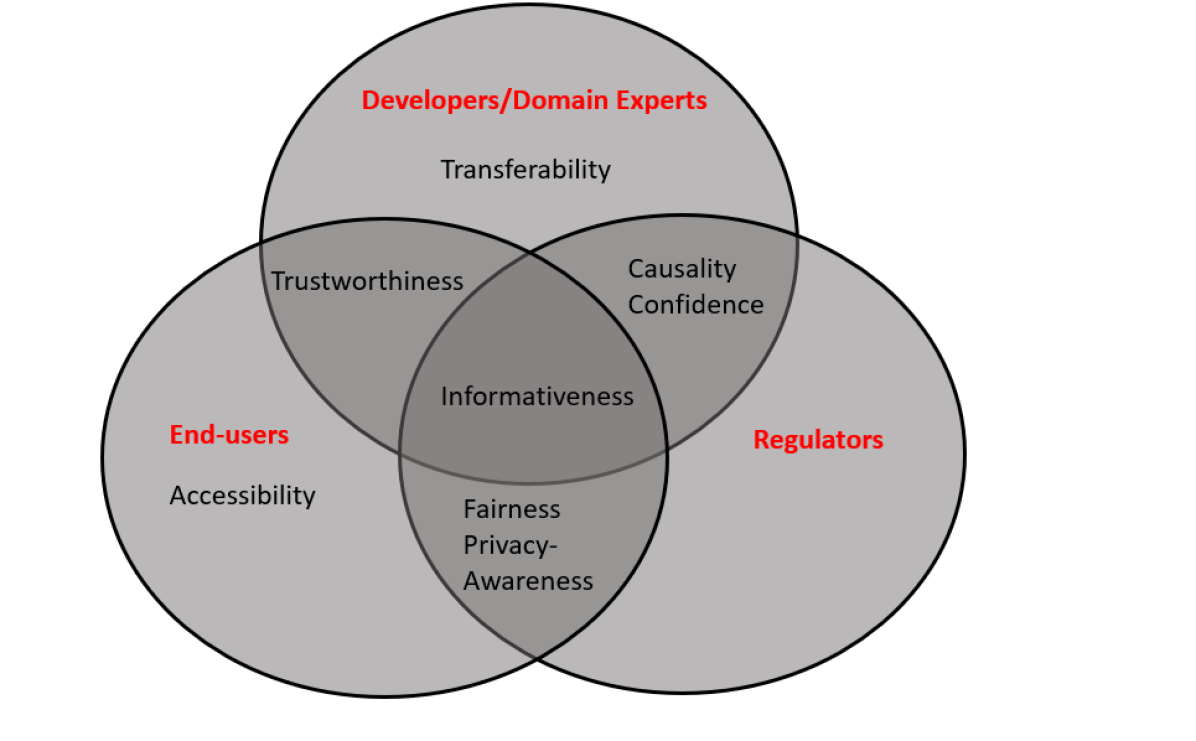
- Assess how explanations align with ethical goals (trust, fairness, informativeness, accessibility, privacy, confidence, causality, transferability).
- Propose a FinXAI process framework that aligns explanations with target audiences and use-cases.
Experimental results
Research questions
- RQ1What FinXAI methods have been proposed for finance, and how do they differ in transparency and explanation form?
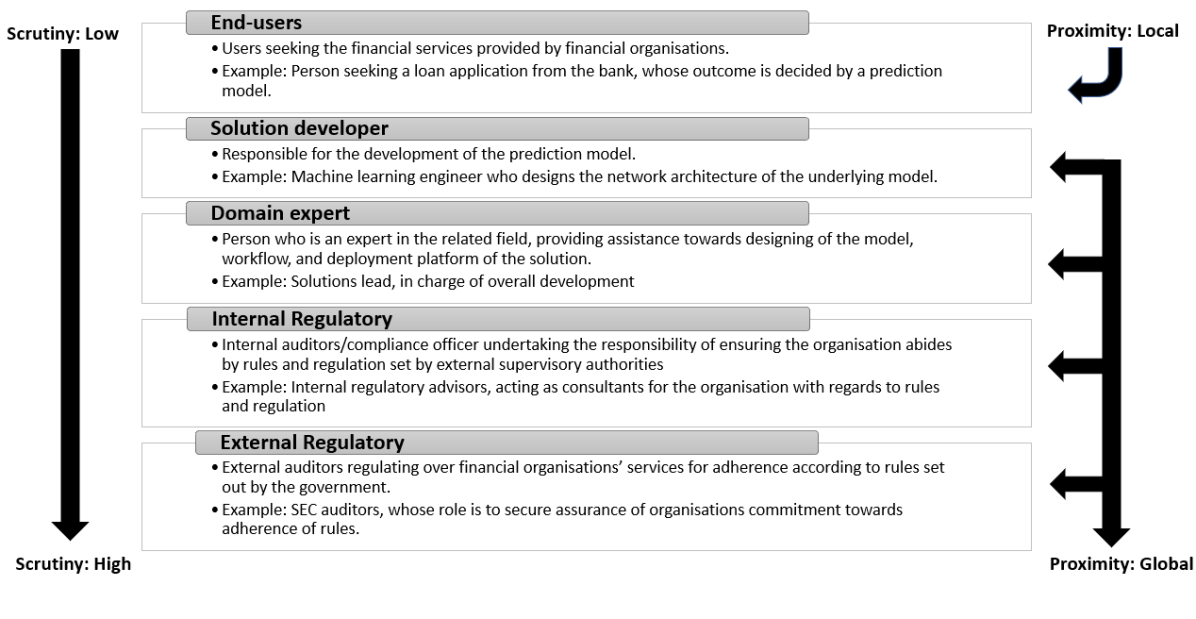
- RQ2How should explanations be tailored to different audiences (end-users, developers, regulators) in finance?
- RQ3What ethical goals do FinXAI techniques address, and what challenges remain for adoption?
- RQ4Where in the model development lifecycle can explainability be integrated for maximum impact?
- RQ5What are the prevalent tendencies (e.g., post-hoc vs intrinsic) and gaps in the current FinXAI literature?
Key findings
- Most reviewed papers focus on post-hoc explainability rather than intrinsic models.
- End-users prefer local explanations, while regulators and experts seek global explanations for a complete model understanding.
- Textual, visual, and example-based explanations coexist, with feature relevance explanations being prevalent.
- Counterfactual explanations are explicitly sought as desirable forms of explanation in finance.
- Explanations are aligned with ethical goals such as trustworthiness, fairness, informativeness, accessibility, privacy awareness, confidence, causality, and transferability.
- The paper provides a framework for aligning FinXAI techniques with audience-specific goals and discusses implementation challenges and future directions.
Better researchstarts right now
From reading papers to final review, dramatically reduce your research time.
No credit card · Free plan available
This review was created by AI and reviewed by human editors.