
[Paper Review] A Feasible Hybrid Quantum-Assisted Digital Signature for Arbitrary Message Length
This paper proposes a hybrid quantum-assisted digital signature protocol that enables secure signing of messages of arbitrary length using currently available quantum and classical technologies. By combining QKD-generated symmetric keys with hash functions and block-wise verification, the protocol achieves information-theoretic security and resists forgery, repudiation, and integrity attacks, with security parameters tunable via block size and error thresholds.
Currently used digital signatures based on asymmetric cryptography will be vulnerable to quantum computers running Shor's algorithm. In this work, we propose a new quantum-assisted digital signature protocol based on symmetric keys generated by QKD, that allows signing and verifying messages in a simple way implementing an integration of currently available classical and quantum technologies. The protocol is described for a three-user scenario composed of one sender and two receivers. In contrast to previous schemes, it is independent of the message length. The security of the protocol has been analyzed, as well as its integrity, authenticity and non-repudiation properties.
Motivation & Objective
- Address the vulnerability of classical digital signatures (e.g., RSA, ECC) to quantum attacks using Shor’s algorithm.
- Overcome limitations of prior quantum digital signature (QDS) schemes that require long-term quantum memory or are restricted to short messages.
- Develop a practical, hybrid protocol integrating existing quantum key distribution (QKD) and classical cryptography to ensure security against quantum and classical attacks.
- Enable message signing with arbitrary length while maintaining strong security guarantees including authenticity, integrity, and non-repudiation.
- Provide a deployable solution using commercially available QKD hardware and standardized hash functions (SHA-2, SHA-3, XOFs).
Proposed method
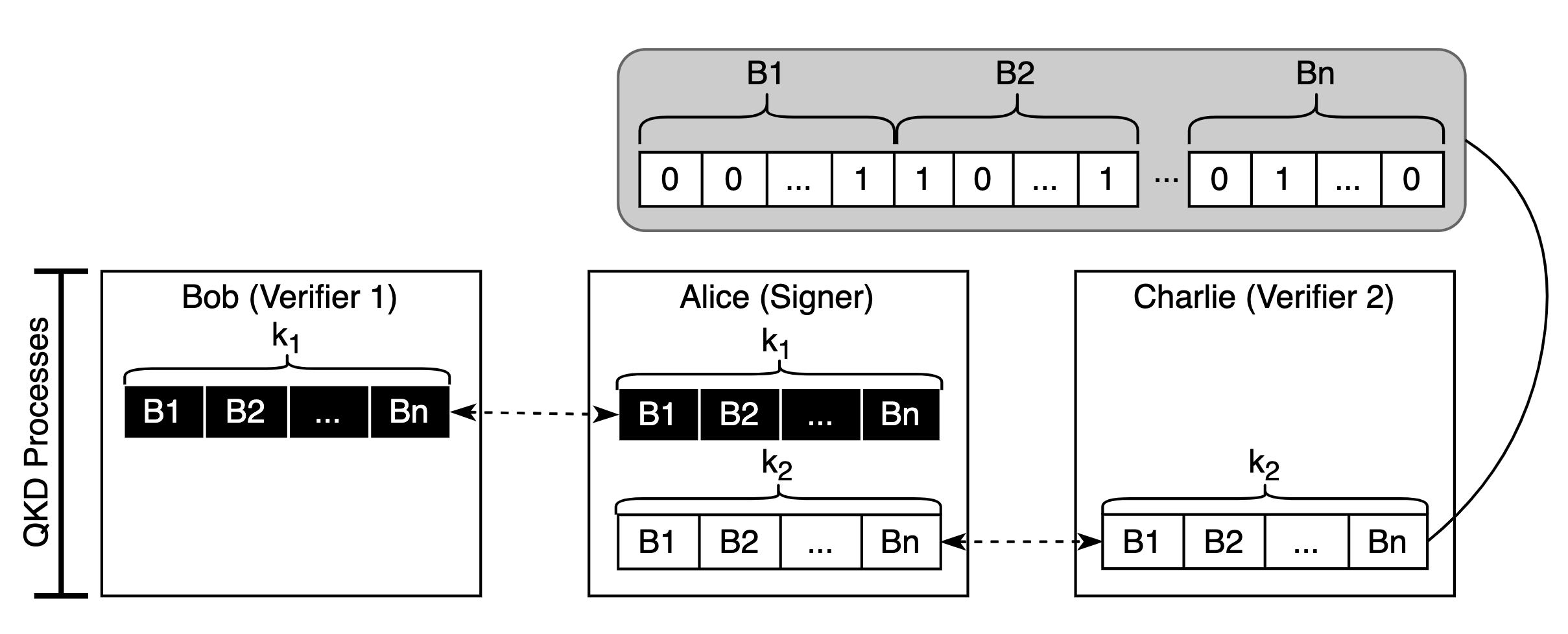
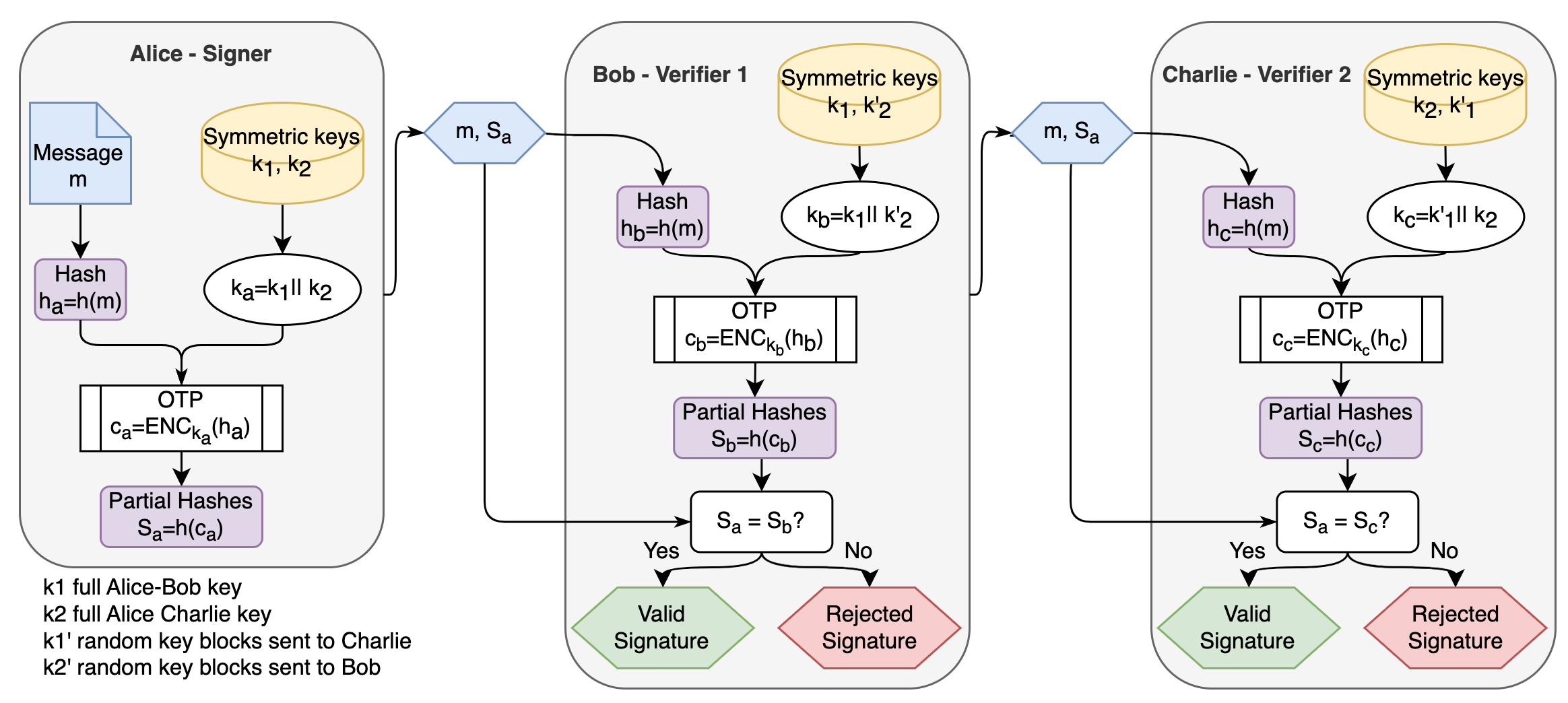
- Use QKD-generated symmetric keys (k₁, k₂) between the signer and two verifiers (Bob, Charlie) to eliminate reliance on classical public-key cryptography.
- Apply a hash function (e.g., SHAKE-256) to extend the key length to δ bits, enabling arbitrary message length support via message pre-processing.
- Divide the message into fixed-size blocks (e.g., 64 bits for n=32 blocks) and compute a digest for each block using a secure hash (e.g., SHA2-256).
- Implement a block-wise verification process where verifiers compare their received blocks with expected values, detecting message tampering through error propagation.
- Introduce a partial key exchange between verifiers (Bob and Charlie) to detect repudiation attempts by the signer.
- Set verification thresholds (e.g., V_B = 25%) to control the probability of successful repudiation attacks, with P_rep = 0.05 under specified parameters.
Experimental results
Research questions
- RQ1Can a quantum-assisted digital signature be designed to support messages of arbitrary length using only currently available quantum and classical technologies?
- RQ2How can information-theoretic security be maintained in a digital signature scheme that avoids the need for long-term quantum memory?
- RQ3What is the impact of block size and error threshold on the resistance to repudiation attacks in a hybrid quantum-classical signature protocol?
- RQ4How can hash functions and key extension techniques (e.g., XOFs) improve security against preimage and dictionary attacks?
- RQ5To what extent can existing QKD hardware and standardized classical hash functions be integrated into a practical, secure digital signature scheme?
Key findings
- The protocol supports messages of arbitrary length by using XOFs (e.g., SHAKE-256) to extend key and message blocks, enabling secure hashing regardless of input size.
- The minimum work required to find a preimage is 2^64 for 64-bit blocks, and 2^256 for SHAKE-256 with δ > 256, ensuring strong resistance to preimage attacks.
- The probability of a successful repudiation attack is P_rep = 0.05 when using 32 blocks and a 25% error threshold, which can be reduced by increasing block count.
- The use of XOFs to expand k₁ and k₂ before block hashing enhances privacy and protects against dictionary attacks by increasing the effective key space.
- The protocol achieves information-theoretic security for key exchange via QKD and ensures message integrity through error propagation in block verification.
- The scheme is implementable with current technology, using commercial QKD devices and standard hash functions like SHA2-256, which are optimized via Intel’s native instructions for performance.
Better researchstarts right now
From reading papers to final review, dramatically reduce your research time.
No credit card · Free plan available
This review was created by AI and reviewed by human editors.