
[Paper Review] A guided light system for agile individual addressing of Ba$^+$ qubits with $10^{-4}$ level intensity crosstalk
This paper presents a guided-light individual addressing system (GLIAS) for Ba⁺ qubits using laser-written waveguides and fiber-coupled acousto-optic modulators (AOMs), enabling independent, agile control over intensity, frequency, and phase of 16 beams. The system achieves 10⁻⁴ level relative intensity crosstalk between nearest-neighbor ions, significantly reducing crosstalk-induced gate errors for scalable trapped-ion quantum computing.
Trapped ions are one of the leading platforms for quantum information processing, exhibiting the highest gate and measurement fidelities of all contending hardware. In order to realize a universal quantum computer with trapped ions, independent and parallel control over the state of each qubit is necessary. The manipulation of individual qubit states in an ion chain via stimulated Raman transitions generally requires light focused on individual ions. In this manuscript, we present a novel, guided-light individual addressing system for hyperfine Ba$^+$ qubits. The system takes advantage of laser-written waveguide technology, enabled by the atomic structure of Ba$^+$, allowing the use of visible light to drive Raman transitions. Such waveguides define the spatial mode of light, suppressing aberrations that would have otherwise accumulated in a free-space optics set up. As a result, we demonstrate a nearest neighbour relative intensity crosstalk on the order of 10$^{-4}$, without any active aberration compensation. This is comparable to or better than other previous demonstrations of individual addressing. At the same time, our modular approach provides independent and agile control over the amplitude, frequency, and phase of each channel; combining the strengths of previous implementations.
Motivation & Objective
- To develop a scalable, modular optical system for individual addressing of long chains of Ba⁺ ions with low crosstalk.
- To achieve independent and agile control over intensity, frequency, and phase of each addressing beam for universal quantum control.
- To reduce intensity crosstalk between neighboring ions below 10⁻⁴, approaching fault-tolerant quantum computing thresholds.
- To leverage visible-wavelength Raman transitions in Ba⁺ for compatibility with laser-written waveguide and fiber-optic technologies.
- To enable mid-circuit measurement and high-fidelity quantum error correction through compatible state detection at 493 nm.
Proposed method
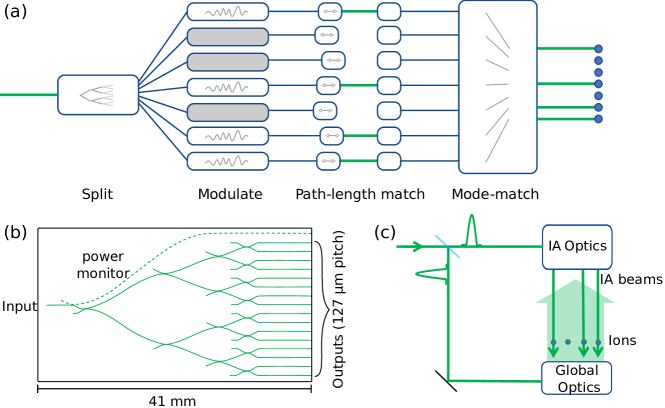
- The system uses femtosecond laser direct-write (FLDW) technology to fabricate laser-written waveguide splitters that define the spatial mode of light, suppressing aberrations.
- Fiber-coupled acousto-optic modulators (AOMs) provide independent, agile control over amplitude, frequency, and phase of each beam channel.
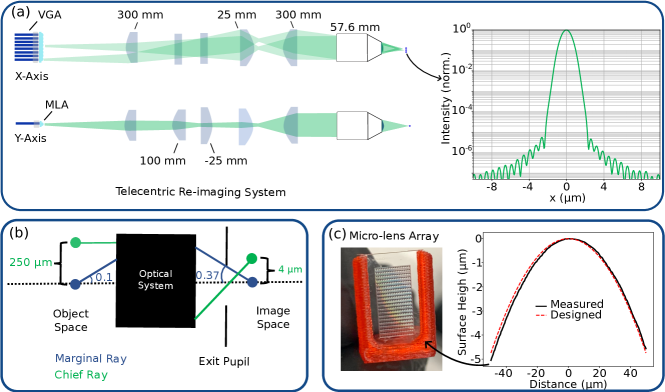
- A 62.5× demagnification system focuses the beams to a 0.9 µm waist at the ion plane, matching ion spacing in typical chains.
- A micro-lens array (MLA) is used to couple light from the waveguide to the objective lens, though it introduces asymmetry in crosstalk.
- Intensity crosstalk is measured using a Raspberry Pi Noir V2 camera with 1.12 µm pixels, capturing beam profiles at the ion plane.
- The system is designed to be modular, allowing replacement of the waveguide chip without realignment, and compatible with future high-contrast integrated waveguides.
Experimental results
Research questions
- RQ1Can a guided-light system using laser-written waveguides achieve sub-10⁻⁴ intensity crosstalk in individual addressing of Ba⁺ qubits?
- RQ2Can fiber-coupled AOMs provide independent, agile control over intensity, frequency, and phase across multiple beams in a trapped-ion system?
- RQ3Does the use of visible-wavelength Raman transitions in Ba⁺ enable better integration with waveguide and fiber-optic technologies than UV-based systems?
- RQ4Can the crosstalk level be reduced to 10⁻⁴ without active aberration compensation, ensuring high-fidelity single-qubit gates?
- RQ5Can the system support mid-circuit measurement and quantum error correction through compatibility with 493 nm state detection?
Key findings
- The system achieves a nearest-neighbor relative intensity crosstalk of approximately 10⁻⁴, without active aberration compensation.
- Crosstalk is on the order of 10⁻³ for the first three channels and 10⁻⁴ for the remaining channels, indicating asymmetry likely due to MLA manufacturing imperfections.
- At 4 µm from the beam peak, crosstalk is slightly above 10⁻⁴, consistent with measurements at the ion plane.
- The crosstalk-induced Rabi rate error is estimated at 1%, which is comparable to state-of-the-art performance.
- Using individual addressing for both Raman beams reduces the crosstalk error in Rabi rate to 0.01%, meeting requirements for fault-tolerant quantum error correction.
- The modular design allows for system upgrades and waveguide chip replacement without realignment, supporting scalability to larger ion chains.
Better researchstarts right now
From reading papers to final review, dramatically reduce your research time.
No credit card · Free plan available
This review was created by AI and reviewed by human editors.