
[Paper Review] A Hitchhiker's Guide to Geometric GNNs for 3D Atomic Systems
A comprehensive, self-contained survey of Geometric Graph Neural Networks (GNNs) for 3D atomic systems, detailing architectures, input pipelines, symmetries, and applications. It presents a fourfold taxonomy (invariant, Cartesian-equivariant, spherical-equivariant, unconstrained) and discusses datasets, tasks, and future directions.
Recent advances in computational modelling of atomic systems, spanning molecules, proteins, and materials, represent them as geometric graphs with atoms embedded as nodes in 3D Euclidean space. In these graphs, the geometric attributes transform according to the inherent physical symmetries of 3D atomic systems, including rotations and translations in Euclidean space, as well as node permutations. In recent years, Geometric Graph Neural Networks have emerged as the preferred machine learning architecture powering applications ranging from protein structure prediction to molecular simulations and material generation. Their specificity lies in the inductive biases they leverage - such as physical symmetries and chemical properties - to learn informative representations of these geometric graphs. In this opinionated paper, we provide a comprehensive and self-contained overview of the field of Geometric GNNs for 3D atomic systems. We cover fundamental background material and introduce a pedagogical taxonomy of Geometric GNN architectures: (1) invariant networks, (2) equivariant networks in Cartesian basis, (3) equivariant networks in spherical basis, and (4) unconstrained networks. Additionally, we outline key datasets and application areas and suggest future research directions. The objective of this work is to present a structured perspective on the field, making it accessible to newcomers and aiding practitioners in gaining an intuition for its mathematical abstractions.
Motivation & Objective
- Provide a structured, pedagogical overview of Geometric GNNs for 3D atomic systems.
- Explain the role of physical symmetries and inductive biases in geometric graph learning.
- Propose a taxonomy of Geometric GNN architectures and relate design choices to applications.
- Summarize datasets, tasks, and avenues for future research in the field.
Proposed method
- Introduce geometric graphs with 3D coordinates and vector/tensor features.
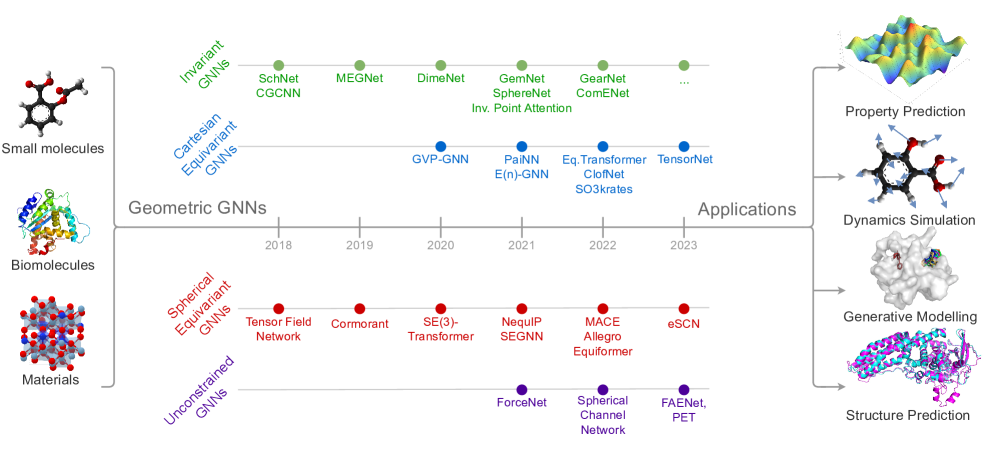
- Classify Geometric GNNs into invariant, equivariant (Cartesian and spherical), and unconstrained families.
- Describe input preparation, embedding, interaction (message passing), and output blocks within Geometric GNNs.
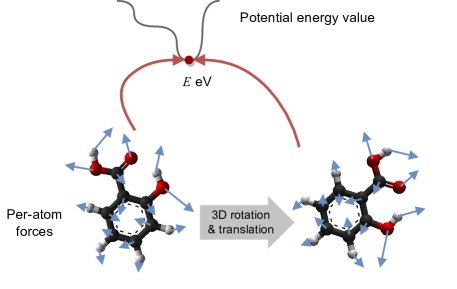
- Explain how Euclidean symmetries (permutation, rotation, translation) shape invariant/equivariant design.
- Discuss graph construction strategies (cutoff, complete, long-range, periodic boundary conditions) and preprocessing.
Experimental results
Research questions
- RQ1What architectural choices in Geometric GNNs best enforce physical symmetries for 3D atomic systems?
- RQ2How do invariant, Cartesian-equivariant, spherical-equivariant, and unconstrained GNNs differ in expressiveness and application fit?
- RQ3What are effective graph construction strategies (cutoff, long-range, periodic) for modeling atomic interactions?
- RQ4What datasets and tasks drive the evaluation and progress of Geometric GNNs in chemistry and materials science?
Key findings
- Geometric GNNs explicitly encode physical symmetries to produce meaningful, frame-invariant or equivariant predictions.
- A four-way taxonomy (invariant, Cartesian-equivariant, spherical-equivariant, unconstrained) organizes core architectures and guides design choices.
- Input pipelines comprising graph construction, embedding, interaction blocks, and outputs underpin effective 3D atomic system modelling.
- Different graph construction strategies (cutoff, smooth cutoff, long-range, periodic boundaries) balance locality, accuracy, and computational efficiency.
- The paper surveys applications across property prediction, interatomic potentials, generative design, and structure prediction.
Better researchstarts right now
From reading papers to final review, dramatically reduce your research time.
No credit card · Free plan available
This review was created by AI and reviewed by human editors.