
[Paper Review] A hybrid discrete-continuum modelling approach for the interactions of the immune system with oncolytic viral infections
This study presents a hybrid discrete-continuum model that couples stochastic agent-based dynamics of immune cells, infected and uninfected cancer cells with a continuum PDE for chemoattractant-driven immune cell recruitment. The model reveals that overly rapid immune activation can impair oncolytic virotherapy efficacy, highlighting the need for immune response modulation tailored to tumor and patient-specific factors.
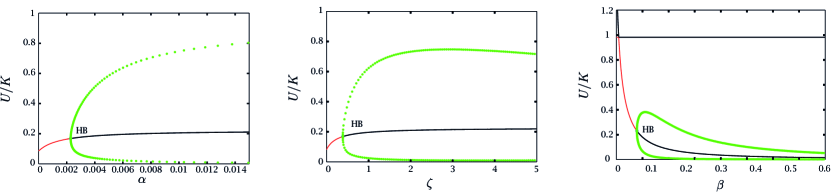
Oncolytic virotherapy, utilizing genetically modified viruses to combat cancer and trigger anti-cancer immune responses, has garnered significant attention in recent years. In our previous work arXiv:2305.12386, we developed a stochastic agent-based model elucidating the spatial dynamics of infected and uninfected cells within solid tumours. Building upon this foundation, we present a novel stochastic agent-based model to describe the intricate interplay between the virus and the immune system; the agents' dynamics are coupled with a balance equation for the concentration of the chemoattractant that guides the movement of immune cells. We formally derive the continuum limit of the model and carry out a systematic quantitative comparison between this system of PDEs and the individual-based model in two spatial dimensions. Furthermore, we describe the traveling waves of the three populations, with the uninfected proliferative cells trying to escape from the infected cells while immune cells infiltrate the tumour. Simulations show a good agreement between agent-based approaches and numerical results for the continuum model. Some parameter ranges give rise to oscillations of cell number in both models, in line with the behaviour of the corresponding nonspatial model, which presents Hopf bifurcations. Nevertheless, in some situations the behaviours of the two models may differ significantly, suggesting that stochasticity plays a key role in the dynamics. Our results highlight that a too rapid immune response, before the infection is well-established, appears to decrease the efficacy of the therapy and thus some care is needed when oncolytic virotherapy is combined with immunotherapy. This further suggests the importance of clinically improving the modulation of the immune response according to the tumour's characteristics and to the immune capabilities of the patients.
Motivation & Objective
- To develop a hybrid modeling framework that captures spatial and stochastic interactions between oncolytic viruses, tumor cells, and immune cells.
- To investigate how immune cell recruitment via chemoattractants influences oncolytic virus therapy outcomes in solid tumors.
- To compare agent-based simulations with their continuum PDE limits to validate model behavior and identify discrepancies due to stochasticity.
- To explore the impact of immune response timing and strength on therapeutic efficacy, particularly in the context of combination virotherapy and immunotherapy.
- To inform optimal treatment scheduling by identifying conditions under which immune activation enhances or hinders viral oncolysis.
Proposed method
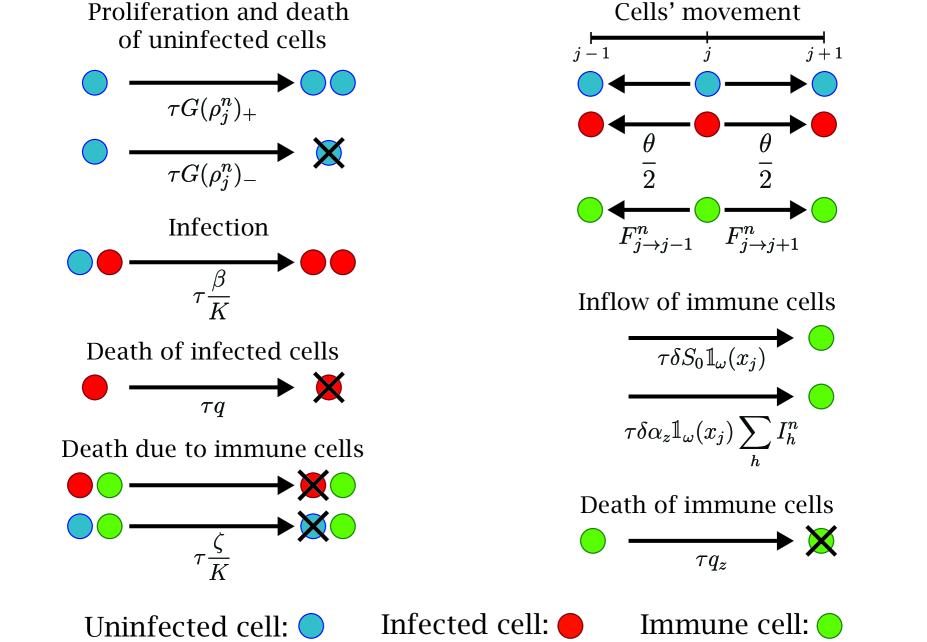
- A stochastic agent-based model simulates individual immune cells, infected and uninfected cancer cells with movement, proliferation, death, infection, and chemoattractant production.
- Immune cell chemotaxis is driven by a PDE-based chemoattractant field, with Neumann boundary conditions and upwind finite difference schemes for stability.
- The continuum limit of the agent-based model is formally derived, resulting in a system of coupled PDEs for cell densities and chemoattractant concentration.
- Numerical simulations use explicit finite differences with small time steps (Δt = 10⁻⁴ h) and spatial resolution (Δx = 0.01 mm) to resolve sharp immune cell waves.
- Parameter values are calibrated using experimental data, including immune cell speed (χ = 0.165 mm²/h), inflow rate (S₀ = 5.00×10⁻² cells/(mm²·h)), and immune killing rates (ζ = 0.50 or 5.00 h⁻¹).
- Model validation involves direct comparison between agent-based and continuum model outputs across multiple simulation runs and spatial configurations.
Experimental results
Research questions
- RQ1How does the spatial dynamics of immune cell infiltration, driven by chemoattractants, affect the outcome of oncolytic virotherapy in solid tumors?
- RQ2In what parameter regimes do the agent-based and continuum models diverge, and what does this imply about the role of stochasticity in immune response dynamics?
- RQ3How does the timing and strength of the immune response influence the success of oncolytic virus spread and tumor control?
- RQ4What are the conditions under which traveling waves of uninfected, infected, and immune cells emerge in the tumor microenvironment?
- RQ5Can the continuum limit accurately represent the stochastic behavior of individual immune cells and infected cells in the presence of high spatial heterogeneity?
Key findings
- The agent-based and continuum models show strong quantitative agreement in most parameter regimes, validating the PDE approximation for large-scale dynamics.
- In some parameter ranges, particularly with high immune killing rates (ζ = 5.00 h⁻¹), both models exhibit oscillatory dynamics consistent with Hopf bifurcations observed in non-spatial models.
- A too rapid immune response—before viral infection is well-established—significantly reduces therapy efficacy, suggesting a detrimental timing effect.
- Immune cell speed is estimated at ~0.06 mm/h under realistic conditions (χ = 0.165 mm²/h), consistent with physical barriers in the tumor microenvironment.
- The model predicts that immune cell inflow is enhanced by infection (α_z = 3.75×10⁻⁵ (mm²·h)⁻¹), which helps recruit immune cells to the tumor site.
- Wavefront analysis shows that uninfected cells attempt to escape infected regions, while immune cells infiltrate from the periphery, forming distinct traveling wave patterns.
Better researchstarts right now
From reading papers to final review, dramatically reduce your research time.
No credit card · Free plan available
This review was created by AI and reviewed by human editors.