
[Paper Review] A JWST/NIRSpec First Census of Broad-Line AGNs at z=4-7: Detection of 10 Faint AGNs with M_BH~10^6-10^8 M_sun and Their Host Galaxy Properties
JWST/NIRSpec identifies 10 faint broad-line AGNs at z=4-7 with low-mass black holes (~10^6–10^8 Msun) and analyzes their host galaxies, morphologies, and contribution to reionization.
We present a first statistical sample of faint type-1 AGNs at $z>4$ identified by JWST/NIRSpec deep spectroscopy. Among the 185 galaxies at $z_\mathrm{spec}=3.8-8.9$ confirmed with NIRSpec, our systematic search for broad-line emission reveals 10 type-1 AGNs at $z=4.015-6.936$ whose broad component is only seen in the permitted H$α$ line and not in the forbidden [OIII]$λ$5007 line that is detected with greater significance than H$α$. The broad H$α$ line widths of $\mathrm{FWHM}\simeq1000-6000\ \mathrm{km\ s^{-1}}$ suggest that the AGNs have low-mass black holes with $M_\mathrm{BH}\sim10^6-10^8\ M_\odot$, remarkably lower than those of low-luminosity quasars previously identified at $z>4$ with ground-based telescopes. JWST and HST high-resolution images reveal that the majority of them show extended morphologies indicating significant contribution to the total lights from their host galaxies, except for three compact objects two of which show red SEDs, probably in a transition phase from faint AGNs to low luminosity quasars. Careful AGN-host decomposition analyses show that their host's stellar masses are systematically lower than the local relation between the black hole mass and the stellar mass, implying a fast black hole growth consistent with predictions from theoretical simulations. A high fraction of the broad-line AGNs ($\sim5\%$), higher than $z\sim0$, indicates that a number density of such faint AGNs is higher than an extrapolation of the quasar luminosity function, implying a large population of AGNs including type 1 and type 2 in the early universe. Such faint AGNs contribute to cosmic reionization, while the total contribution is not large, up to $\sim50\%$ at $z\sim6$, because of their faint nature.
Motivation & Objective
- Investigate the population of faint broad-line (type-1) AGNs at z>4 identified via JWST/NIRSpec spectroscopy.
- Characterize black hole masses, bolometric luminosities, and Eddington ratios for these low-mass SMBHs.
- Examine host galaxy properties including stellar masses, morphologies, and dust attenuation.
- Assess the contribution of faint AGNs to cosmic reionization and compare to local and high-z AGN populations.
Proposed method
- Systematic search for broad-line emission in 185 z-spec 3.8-8.9 galaxies with JWST/NIRSpec spectra from ERO GLASS, CEERS, and related programs.
- Decompose emission lines by fitting Hβ, [OIII], Hα, and [NII] with narrow and broad components; require broad Hα or Hβ with FWHM > 1000 km/s and SNR > 5.
- Apply [OIII], [NII] narrow-component criteria to distinguish AGN broad-line signatures from outflows or mergers.
- Estimate M_BH using the broad Hα-based relation calibrated at z~0 (Greene & Ho 2005) and derive L_bol and Eddington ratios.
- Assess host-galaxy properties via high-resolution JWST/HST imaging and perform AGN-host decomposition.
- Use Balmer decrement and Calzetti dust law to evaluate E(B-V) and dust attenuation of AGNs.
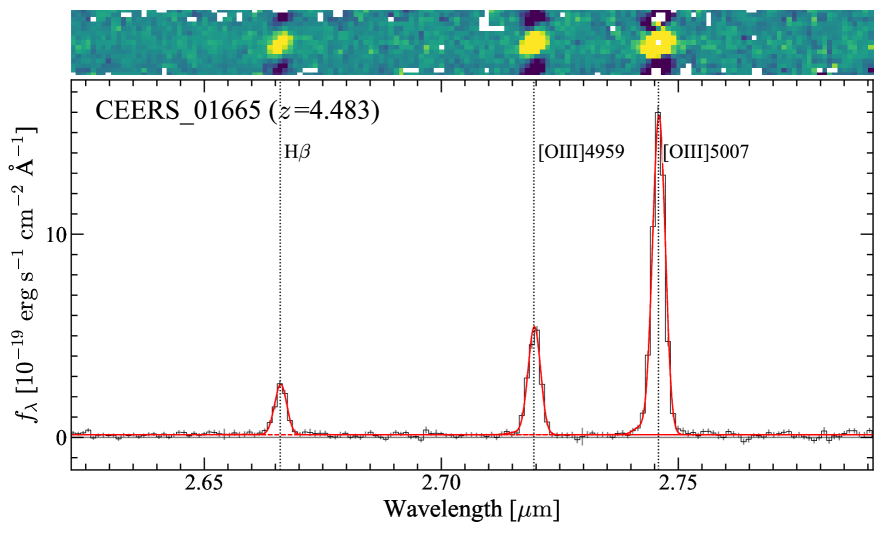
![Figure 1: NIRSpec spectra of CEERS_01244, GLASS_160133, GLASS_150029, and CEERS_00746. For each object, the left and middle panels show spectra around H $\beta$ +[ Oiii ] $\lambda\lambda$ 4959,5007 and H $\alpha$ +[ Nii ] $\lambda\lambda$ 6548,6584, respectively. The 2D and 1D spectra are shown in t](https://ar5iv.labs.arxiv.org/html/2303.11946/assets/x1.png)
Experimental results
Research questions
- RQ1What is the incidence and properties of faint broad-line AGNs at z=4-7 in JWST/NIRSpec samples?
- RQ2What are the black hole masses, bolometric luminosities, and Eddington ratios of these low-mass SMBHs?
- RQ3What are the host-galaxy stellar masses, morphologies, and dust contents of these AGN hosts?
- RQ4Do these faint AGNs populate the M_BH–M_* relation observed locally, or do they show early SMBH growth?
Key findings
- Identified 10 type-1 AGNs at z=4.015-6.936 with broad Hα emission and no broad component in [OIII], indicating low-mass black holes M_BH ~ 10^6–10^8 M_sun.
- Broad Hα line widths span FWHM ~ 1000–6000 km/s, implying relatively low-mass SMBHs compared to high-z quasars identified from ground-based surveys.
- Most hosts appear extended in JWST/HST imaging, suggesting significant host-galaxy light; three compact objects with dusty red SEDs indicate diverse host environments.
- AGN-host decomposition shows host stellar masses systematically below the local M_BH–M_* relation, implying fast black-hole growth relative to their hosts.
- AGNs constitute ~5% of the z=4-7 galaxy sample with -22 < M_UV < -17, higher than z~0 AGN fractions, suggesting a larger faint AGN population in the early universe.
- Rest-UV line diagnostics for a subset show composite features; some objects exhibit redder continua and notable dust attenuation (E(B-V) up to ~1.4) indicating dusty AGNs.
Better researchstarts right now
From reading papers to final review, dramatically reduce your research time.
No credit card · Free plan available
This review was created by AI and reviewed by human editors.