
[Paper Review] A nebular origin for the persistent radio emission of fast radio bursts
This paper presents the detection of a persistent radio source (PRS) associated with the nearby repeating fast radio burst FRB 20201124A, exhibiting an inverted radio spectrum and low rotation measure (RM < 1000 rad/m²), supporting a nebular origin for the emission. The PRS is consistent with synchrotron radiation from a magnetized, ionized nebula surrounding a young magnetar, expanding the observed RM–luminosity relation into the low-luminosity regime and suggesting most FRBs lack detectable PRSs due to weaker surrounding media.
Fast radio bursts (FRBs) are millisecond-duration, bright ($\sim$Jy) extragalactic bursts, whose production mechanism is still unclear. Recently, two repeating FRBs were found to have a physically associated persistent radio source of non-thermal origin. These two FRBs have unusually large Faraday rotation measure values likely tracing a dense magneto-ionic medium, consistent with synchrotron radiation originating from a nebula surrounding the FRB source. Recent theoretical arguments predict that, if the observed Faraday rotation measure mostly arises from the persistent radio source region, there should be a simple relation between the luminosity of the latter and the first. We report here the detection of a third, less luminous persistent radio source associated with the repeating FRB source FRB20201124A at a distance of 413 Mpc, significantly expanding the predicted relation into the low luminosity - low Faraday rotation measure regime ($<$1000 rad m-2). At lower values of the Faraday rotation measure, the expected radio luminosity falls below the limit of detection threshold for present-day radio telescopes. These findings support the idea that the persistent radio sources observed so far are generated by a nebula in the FRB environment, and that FRBs with low Faraday rotation measure may not show a persistent radio source because of a weaker magneto-ionic medium. This is generally consistent with models invoking a young magnetar as the central engine of the FRB, where the surrounding ionized nebula - or the interacting shock in a binary system - powers the persistent radio source.
Motivation & Objective
- To investigate the physical origin of persistent radio emission (PRS) associated with fast radio bursts (FRBs), particularly in the context of repeating sources.
- To determine whether the PRS arises from a nebular environment surrounding the FRB, based on radio spectral properties and magnetic field diagnostics.
- To test theoretical predictions linking radio luminosity and rotation measure (RM) in the context of synchrotron emission from ionized nebulae.
- To assess why only a subset of FRBs show detectable PRSs, exploring the role of environmental density and magnetic field strength.
- To constrain the nature of the central engine of FRBs by analyzing multi-frequency radio data and dust emission limits.
Proposed method
- Conducted deep Very Large Array (VLA) observations at 15 GHz and 22 GHz with sub-arcsecond resolution to detect compact radio sources in the FRB 20201124A field.
- Re-analyzed archival 6 GHz VLA data to disentangle the compact PRS from diffuse star-formation emission in the host galaxy.
- Constructed a multi-frequency radio spectrum (6–22 GHz) to determine the spectral index of the compact source, finding $ F_{\nu} \propto \nu^{1} $, indicating an inverted spectrum.
- Used Very Long Baseline Interferometry (VLBI) data to precisely localize the FRB at 413 Mpc (z = 0.098), enabling accurate source association.
- Performed deep NOEMA observations at 236 GHz and 250 GHz to set upper limits on cold dust emission, constraining star formation and dust content.
- Applied Balmer decrement (Hα/Hβ) analysis using GTC/MEGARA integral field unit data to estimate intrinsic dust extinction and confirm low star formation activity near the FRB.
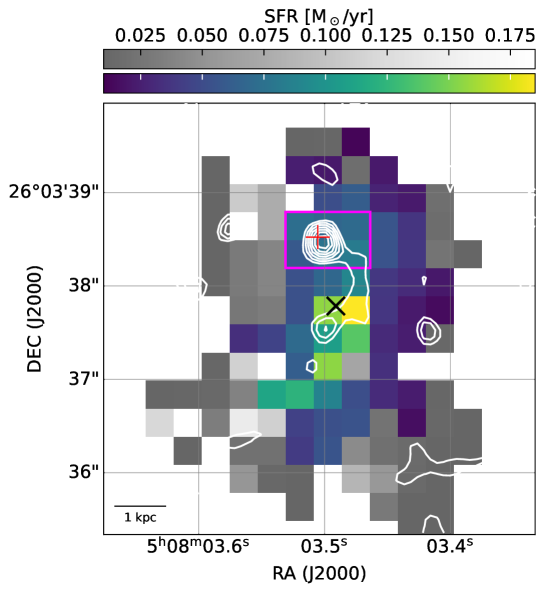
![Figure 1: Top Panel: VLA image at 15 GHz of the host galaxy of FRB 20201124A from this work. Black contours indicate 3, 4, 5, 7, 9 $\times\sigma$ levels. The white contours are from the 6 GHz VLA image by [ 13 ] at similar resolution. The red contours are from the previous 22 GHz VLA image by [ 12 ]](https://ar5iv.labs.arxiv.org/html/2312.15296/assets/x1.png)
Experimental results
Research questions
- RQ1Is the persistent radio emission from FRB 20201124A consistent with a nebular origin, as suggested by its spectral and magnetic field properties?
- RQ2Does the observed radio luminosity and rotation measure (RM) of the PRS in FRB 20201124A follow the predicted RM–luminosity relation for synchrotron-emitting nebulae?
- RQ3Why is the PRS in FRB 20201124A less luminous and at a lower RM than previously detected PRSs, and what does this imply about the surrounding medium?
- RQ4Can the absence of detectable star formation or dust emission in the FRB environment rule out a star-forming origin for the PRS?
- RQ5What does the detection of a PRS with an inverted spectrum imply about the central engine and the presence of a young magnetar?
Key findings
- A compact, unresolved persistent radio source (PRS) was detected at 15 GHz with a flux density of 20.0 ± 3.5 μJy, consistent with the FRB position and significantly brighter than the diffuse 3–4 kpc-scale emission.
- The PRS exhibits an inverted radio spectrum ($ F_{\nu} \propto \nu^{1} $) across 6–22 GHz, inconsistent with thermal or star-formation-related emission, supporting a non-thermal origin.
- The PRS has a rotation measure (RM) of approximately 100–200 rad/m², placing it in the low-RM, low-luminosity regime and extending the observed RM–luminosity relation to previously uncharted parameter space.
- NOEMA upper limits at 236 GHz and 250 GHz (≤130 μJy and ≤160 μJy, respectively) rule out significant cold dust emission, indicating minimal star formation activity in the FRB region.
- The GTC/MEGARA data show low intrinsic E(B-V) extinction and no significant Hα emission, further excluding a star-forming origin for the PRS.
- The PRS is undetected in previous VLBI observations due to its low flux density (≈10 μJy/beam), below the noise threshold of ~10 μJy/beam, highlighting the need for deeper, high-resolution surveys.
Better researchstarts right now
From reading papers to final review, dramatically reduce your research time.
No credit card · Free plan available
This review was created by AI and reviewed by human editors.