
[Paper Review] A new sociology of humans and machines
This paper proposes a new sociological framework—human-machine social systems—to study collective behaviors in environments where multiple autonomous humans and machines coexist and interact. By synthesizing interdisciplinary research on competition, cooperation, and emergent dynamics in platforms like Twitter, Reddit, Wikipedia, and high-frequency trading, it identifies systemic risks such as flash crashes and misinformation, and advocates for diverse, adaptive, and ethically governed human-machine ecologies to ensure societal resilience and safety.
From fake social media accounts and generative artificial intelligence chatbots to trading algorithms and self-driving vehicles, robots, bots and algorithms are proliferating and permeating our communication channels, social interactions, economic transactions and transportation arteries. Networks of multiple interdependent and interacting humans and intelligent machines constitute complex social systems for which the collective outcomes cannot be deduced from either human or machine behaviour alone. Under this paradigm, we review recent research and identify general dynamics and patterns in situations of competition, coordination, cooperation, contagion and collective decision-making, with context-rich examples from high-frequency trading markets, a social media platform, an open collaboration community and a discussion forum. To ensure more robust and resilient human-machine communities, we require a new sociology of humans and machines. Researchers should study these communities using complex system methods; engineers should explicitly design artificial intelligence for human-machine and machine-machine interactions; and regulators should govern the ecological diversity and social co-development of humans and machines.
Motivation & Objective
- Address the growing societal risks posed by uncoordinated, interdependent human-machine systems in digital and physical domains.
- Overcome limitations of existing frameworks that treat machines as passive tools or single entities, rather than autonomous, interacting agents.
- Develop a systemic, mechanism-focused approach to understanding emergent behaviors in human-machine collectives across diverse contexts.
- Synthesize interdisciplinary research from computational social science, AI, robotics, and economics to identify recurring dynamics in human-machine interactions.
- Inform policy and design by highlighting the importance of diversity, adaptability, and co-evolution in human-machine systems to prevent systemic failures.
Proposed method
- Conduct an integrative narrative review using expansive keyword searches (e.g., bots + Twitter, algorithmic trading) across Google Scholar to capture recent, publicly available working papers.
- Employ backward and forward citation chaining to identify foundational and emerging literature, focusing on studies with three or more interacting agents (humans and bots).
- Group studies thematically by context (e.g., financial markets, social media, Wikipedia, Reddit) and by interaction type (competition, coordination, cooperation).
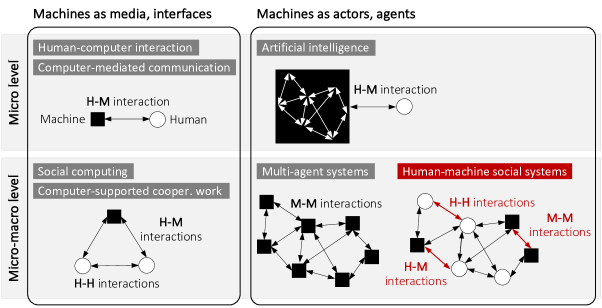
- Apply a systems perspective to analyze interactions across human-human, human-machine, and machine-machine levels, emphasizing emergent collective outcomes.
- Use the hybrid collective intelligence framework to analyze multi-agent systems where humans and autonomous agents co-evolve and co-create social outcomes.
- Integrate findings from experimental, theoretical, and observational studies across robotics, web science, complexity science, and computational social science.
Experimental results
Research questions
- RQ1What general dynamics and patterns emerge in human-machine social systems across contexts such as financial markets, social media, and collaborative platforms?
- RQ2How do interactions between multiple autonomous machines and humans lead to emergent collective behaviors that cannot be predicted from individual actions alone?
- RQ3In what ways do similarities in machine design—such as optimization goals, speed, and information sources—amplify systemic risks like flash crashes or misinformation cascades?
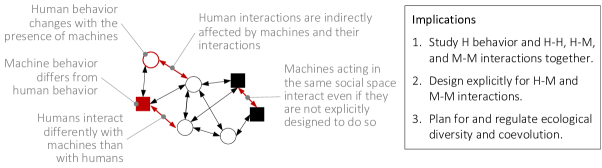
- RQ4How do human behaviors shift when interacting with autonomous agents, and what are the long-term implications for empathy, social learning, and cultural transmission?
- RQ5What governance and design principles are necessary to ensure diversity, resilience, and equity in human-machine social systems?
Key findings
- Flash crashes in financial markets, such as the 2010 Dow Jones plunge, result from high-frequency trading algorithms collectively reinforcing a single large sell order, demonstrating machine-driven systemic risk.
- On social media platforms like Twitter and Reddit, bots and algorithms can amplify misinformation and manipulate public discourse by mimicking human behavior at scale.
- In collaborative systems like Wikipedia, human-machine interactions can improve content quality and efficiency, but only when bots are diverse and aligned with community norms.
- High-speed, homogeneous machine interactions—especially when optimized for similar objectives—can lead to catastrophic outcomes, such as market instability or traffic gridlock in autonomous vehicle networks.
- Diversity in machine objectives, speeds, and information sources reduces systemic risk and enhances resilience, suggesting that policy should prioritize heterogeneous machine ecologies.
- Human-machine co-evolution alters social dynamics, including reduced empathy in caregiving roles when robots outsource emotional labor, and transforms cultural transmission through AI-generated content and novel game strategies.
Better researchstarts right now
From reading papers to final review, dramatically reduce your research time.
No credit card · Free plan available
This review was created by AI and reviewed by human editors.