
[Paper Review] A Note on Islands in Schwarzschild Black Holes
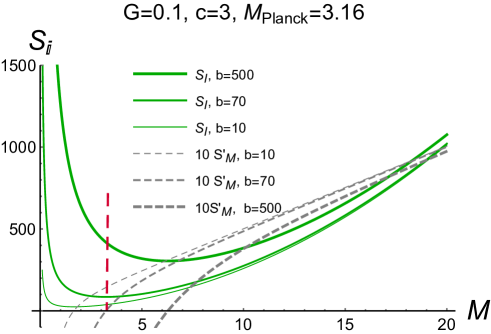
This paper demonstrates that island configurations in Schwarzschild black holes fail to bound entanglement entropy during evaporation due to a divergent term $ \frac{c b}{6 r_h} $, which grows as the black hole mass decreases. Despite extremization stabilizing entropy in eternal black holes, the entropy increases unboundedly near the end of evaporation, challenging the unitarity of the island proposal in asymptotically flat spacetime.
We consider evaporation of the Schwarzschild black hole and note that island configurations do not provide a bounded entanglement entropy. The same remark is valid also for some other static black holes. A proposal for improving the situation is discussed
Motivation & Objective
- To investigate whether island configurations in Schwarzschild black holes provide a bounded entanglement entropy during evaporation.
- To identify the origin of the unbounded entropy growth in the island formula when applied to evaporating black holes.
- To assess the validity of the quantum extremal surface prescription in the limit of small black hole mass ($ r_h \to 0 $).
- To propose regularization using thermal coordinates to resolve the singularity in Kruskal coordinates at small $ r_h $.
- To extend the analysis to other static black holes, including Reissner-Nordström and dS black holes, to assess generality of the issue.
Proposed method
- Analyzing the island formula $ S(R) = \min_\mathcal{I} \left[ \frac{\text{Area}(\partial\mathcal{I})}{4G} + S_{\text{matter}}(R \cup \mathcal{I}) \right] $ in the context of Schwarzschild black holes.
- Examining the entropy expression $ S_\mathcal{I} = \frac{2\pi r_h^2}{G} + \frac{c}{6} \frac{b - r_h}{r_h} + \frac{c}{6} \log \left( \frac{16 r_h^3 (b - r_h)^2}{G^2 b} \right) $, particularly the $ \frac{c b}{6 r_h} $ term.
- Identifying that the $ \frac{c b}{6 r_h} $ term dominates for small $ r_h $, causing entropy to grow unboundedly as $ r_h \to 0 $, despite extremization.
- Using a $ G $-expansion of the path integral and the replica trick to derive the island formula, noting that the background metric depends on $ G $, leading to singular behavior at small $ G $.
- Applying regularization via thermal coordinates to avoid the singularity of Kruskal coordinates at $ r_h \to 0 $, enabling finite evaluation of entropy in the final stages of evaporation.
- Numerically solving the extremization condition $ \frac{dS}{da} = 0 $ for the island location $ a $, showing that the entropy remains singular as $ \mu \to 0 $ in the regularization scheme.
![Figure 2 : The island configuration for two-sided black hole considered in [ 41 ] .](https://ar5iv.labs.arxiv.org/html/2110.04233/assets/x4.png)
Experimental results
Research questions
- RQ1Does the island formula yield a bounded entanglement entropy for evaporating Schwarzschild black holes?
- RQ2What is the origin of the $ \frac{c b}{6 r_h} $ term in the island entropy formula, and why does it lead to unbounded growth?
- RQ3Why does the standard quantum extremal surface prescription fail at small black hole masses, particularly in Kruskal coordinates?
- RQ4Can regularization using thermal coordinates resolve the singularity in the island entropy at $ r_h \to 0 $?
- RQ5Does the unbounded entropy behavior generalize to other static black holes such as Reissner-Nordström or dS black holes?
Key findings
- The entanglement entropy in the island configuration grows unboundedly as the black hole mass decreases, due to the $ \frac{c b}{6 r_h} $ term dominating at small $ r_h $.
- The $ \frac{c b}{6 r_h} $ term arises from the matter entropy contribution in the island formula and is singular in the $ r_h \to 0 $ limit, invalidating the assumption of bounded entropy.
- The Kruskal coordinate system used in the derivation becomes singular at small $ G $ or $ r_h $, leading to unphysical behavior in the entropy calculation.
- Extremization of the island location $ a $ leads to $ a \approx r_h $, but this does not suppress the $ 1/r_h $ divergence in the matter entropy term.
- Regularization using thermal coordinates removes the singularity and allows finite evaluation of the entropy in the $ r_h \to 0 $ limit, suggesting a path to consistent entropy computation.
- The unbounded entropy behavior is not unique to Schwarzschild black holes; similar issues arise in Reissner-Nordström, dS, and other static black holes, indicating a broader problem in the island program.
Better researchstarts right now
From reading papers to final review, dramatically reduce your research time.
No credit card · Free plan available
This review was created by AI and reviewed by human editors.