
[Paper Review] A photonic source of heralded GHZ states
This paper demonstrates a high-rate, heralded three-photon polarization-encoded Greenberger-Horne-Zeilinger (GHZ) state using a solid-state quantum dot source and a stable polarisation interferometer. By detecting three ancillary photons, the system heralds the successful generation of GHZ states with a fidelity of up to 0.7278 ± 0.0106 at a rate of 0.914 ± 0.006 Hz, enabling scalable photonic quantum computing via fusion-based protocols.
Generating large multiphoton entangled states is of main interest due to enabling universal photonic quantum computing and all-optical quantum repeater nodes. These applications exploit measurement-based quantum computation using cluster states. Remarkably, it was shown that photonic cluster states of arbitrary size can be generated by using feasible heralded linear optics fusion gates that act on heralded three-photon Greenberger-Horne-Zeilinger (GHZ) states as the initial resource state. Thus, the capability of generating heralded GHZ states is of great importance for scaling up photonic quantum computing. Here, we experimentally demonstrate this required building block by reporting a polarisation-encoded heralded GHZ state of three photons, for which we build a high-rate six-photon source ($547{\pm}2$ Hz) from a solid-state quantum emitter and a stable polarisation-based interferometer. The detection of three ancillary photons heralds the generation of three-photon GHZ states among the remaining particles with fidelities up to $\mathcal{F}=0.7278{\pm}0.0106$. Our results initiate a path for scalable entangling operations using heralded linear-optics implementations.
Motivation & Objective
- To develop a scalable, high-rate source of heralded multiphoton entangled states for photonic quantum computing.
- To demonstrate a practical, loss-tolerant route to universal quantum computation using only linear optics and heralded operations.
- To achieve high-fidelity three-photon GHZ states via deterministic multiphoton interference and pseudo number-resolved detection.
- To enable future fusion-based quantum computing protocols by providing a reliable, high-quality resource state.
- To push the limits of multiphoton entanglement generation with solid-state emitters and integrated photonic circuits.
Proposed method
- A fibre-efficient quantum dot single-photon source with 28.7% efficiency was used to generate six indistinguishable photons at a rate of 547 ± 2 Hz.
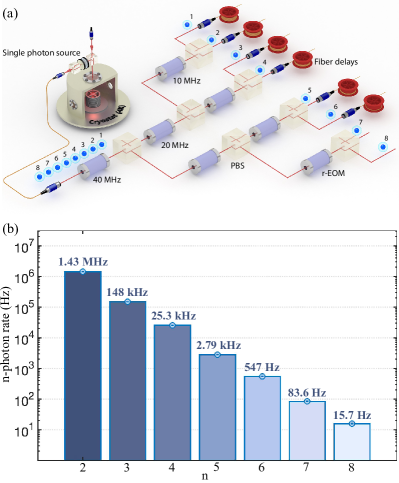
- Active demultiplexing via seven synchronized electro-optic modulators (r-EOMs) at multiple frequencies (10, 20, 40 MHz) enabled deterministic time-bin multiplexing of eight consecutive time bins.
- A stable, fibre-based polarisation interferometer was employed to coherently superpose the six photons, enabling high-visibility quantum interference.
- Pseudo number-resolved detection of three heralding photons was used to herald the remaining three photons in a GHZ state, with detection performed using 18 superconducting nanowire single-photon detectors (SNSPDs).
- Overcomplete quantum state tomography was performed on both |GHZ⁺⟩ and |GHZ⁻⟩ states by measuring all 27 combinations of Pauli operators (X, Y, Z) on the three signal qubits.
- Fidelity was calculated relative to ideal GHZ states, with phase corrections applied to account for small imaginary components in the reconstructed density matrices.
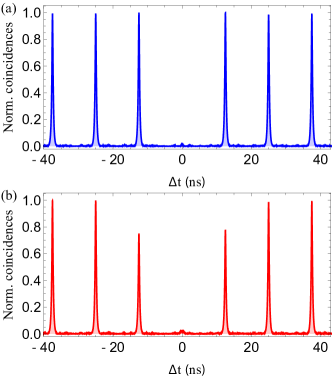
Experimental results
Research questions
- RQ1Can a high-rate, heralded three-photon GHZ state be generated using a solid-state quantum dot source and linear optics?
- RQ2What is the achievable fidelity and generation rate of heralded GHZ states using this source and interferometric setup?
- RQ3Can overcomplete quantum state tomography be performed simultaneously on both |GHZ⁺⟩ and |GHZ⁻⟩ states using a single multiphoton source?
- RQ4To what extent does the system's performance support scalable fusion-based quantum computing protocols?
- RQ5How do losses and inefficiencies in the optical path affect the overall heralded state generation rate and fidelity?
Key findings
- The six-photon source achieved a detection rate of 547 ± 2 Hz, enabling high-count-rate experiments.
- The heralded three-photon GHZ state was generated at a rate of 0.914 ± 0.006 Hz, consistent with theoretical expectations considering optical losses and detection inefficiencies.
- The fidelity to the ideal |GHZ⁺⟩ state was measured as 0.7278 ± 0.0106 after phase correction, confirming high-quality entanglement.
- The fidelity to the |GHZ⁻⟩ state was 0.7083 ± 0.0120, with small imaginary components in the density matrix indicating a small phase offset.
- The system demonstrated genuine three-partite entanglement with a witness value of ⟨W_GHZ⟩ = -0.2613 ± 0.0335, exceeding seven standard deviations.
- The eight-photon rate reached 15.7 ± 0.4 Hz, indicating scalability toward ten-photon-level protocols.
Better researchstarts right now
From reading papers to final review, dramatically reduce your research time.
No credit card · Free plan available
This review was created by AI and reviewed by human editors.