
[Paper Review] A Posteriori Evaluation of a Physics-Constrained Neural Ordinary Differential Equations Approach Coupled with CFD Solver for Modeling Stiff Chemical Kinetics
This paper introduces a physics-constrained neural ordinary differential equation (PC-NODE) framework that enforces elemental mass conservation directly in the loss function during training, significantly improving physical consistency and accuracy in modeling stiff chemical kinetics. When coupled with a CFD solver, PC-NODE outperforms purely data-driven NODE models in predicting thermochemical states and maintains robust generalization to unseen conditions with minimal error accumulation.
The high computational cost associated with solving for detailed chemistry poses a significant challenge for predictive computational fluid dynamics (CFD) simulations of turbulent reacting flows. These models often require solving a system of coupled stiff ordinary differential equations (ODEs). While deep learning techniques have been experimented with to develop faster surrogate models, they often fail to integrate reliably with CFD solvers. This instability arises because deep learning methods optimize for training error without ensuring compatibility with ODE solvers, leading to accumulation of errors over time. Recently, NeuralODE-based techniques have offered a promising solution by effectively modeling chemical kinetics. In this study, we extend the NeuralODE framework for stiff chemical kinetics by incorporating mass conservation constraints directly into the loss function during training. This ensures that the total mass and the elemental mass are conserved, a critical requirement for reliable downstream integration with CFD solvers. Proof-of-concept studies are performed with physics-constrained neuralODE (PC-NODE) approach for homogeneous autoignition of hydrogen-air mixture over a range of composition and thermodynamic conditions. Our results demonstrate that this enhancement not only improves the physical consistency with respect to mass conservation criteria but also ensures better robustness. Lastly, a posteriori studies are performed wherein the trained PC-NODE model is coupled with a 3D CFD solver for computing the chemical source terms. PC-NODE is shown to be more accurate relative to the purely data-driven neuralODE approach. Moreover, PC-NODE also exhibits robustness and generalizability to unseen initial conditions from within (interpolative capability) as well as outside (extrapolative capability) the training regime.
Motivation & Objective
- To address the instability and lack of physical consistency in data-driven surrogate models for stiff chemical kinetics when coupled with CFD solvers.
- To improve training efficiency and physical fidelity by embedding elemental mass conservation constraints into the neural ODE training process.
- To enable robust and generalizable predictions of thermochemical state evolution across a range of initial conditions, including out-of-distribution scenarios.
- To demonstrate the feasibility and superiority of the physics-constrained approach in a 3D CFD environment using a hydrogen-air autoignition case.
Proposed method
- Incorporate elemental mass conservation as a regularization term in the loss function during neural ODE training, ensuring that total and elemental mass are conserved.
- Use a neural network to parameterize the chemical source terms in a stiff ODE system, which are then integrated via a stiff ODE solver during training.
- Train the model end-to-end using ground-truth solutions from detailed chemical mechanisms, minimizing the difference between predicted and true thermochemical trajectories.
- Integrate the trained PC-NODE model as a surrogate for chemical source terms within the CONVERGE CFD solver for 3D simulations.
- Apply the framework to homogeneous autoignition of hydrogen-air mixtures under varying equivalence ratios and initial temperatures.
- Validate performance using a posteriori CFD simulations and compare against a purely data-driven NODE model (NO-CONS) and ground-truth mechanisms.
Experimental results
Research questions
- RQ1Can enforcing elemental mass conservation in the loss function improve the physical consistency of neural ODE models for stiff chemical kinetics?
- RQ2How does the physics-constrained PC-NODE model compare to a purely data-driven NODE model in terms of accuracy and error accumulation over time?
- RQ3To what extent can the PC-NODE model generalize to initial conditions outside the training distribution, including extrapolative regimes?
- RQ4Does the inclusion of mass conservation constraints enhance training efficiency and convergence in the context of stiff ODE systems?
Key findings
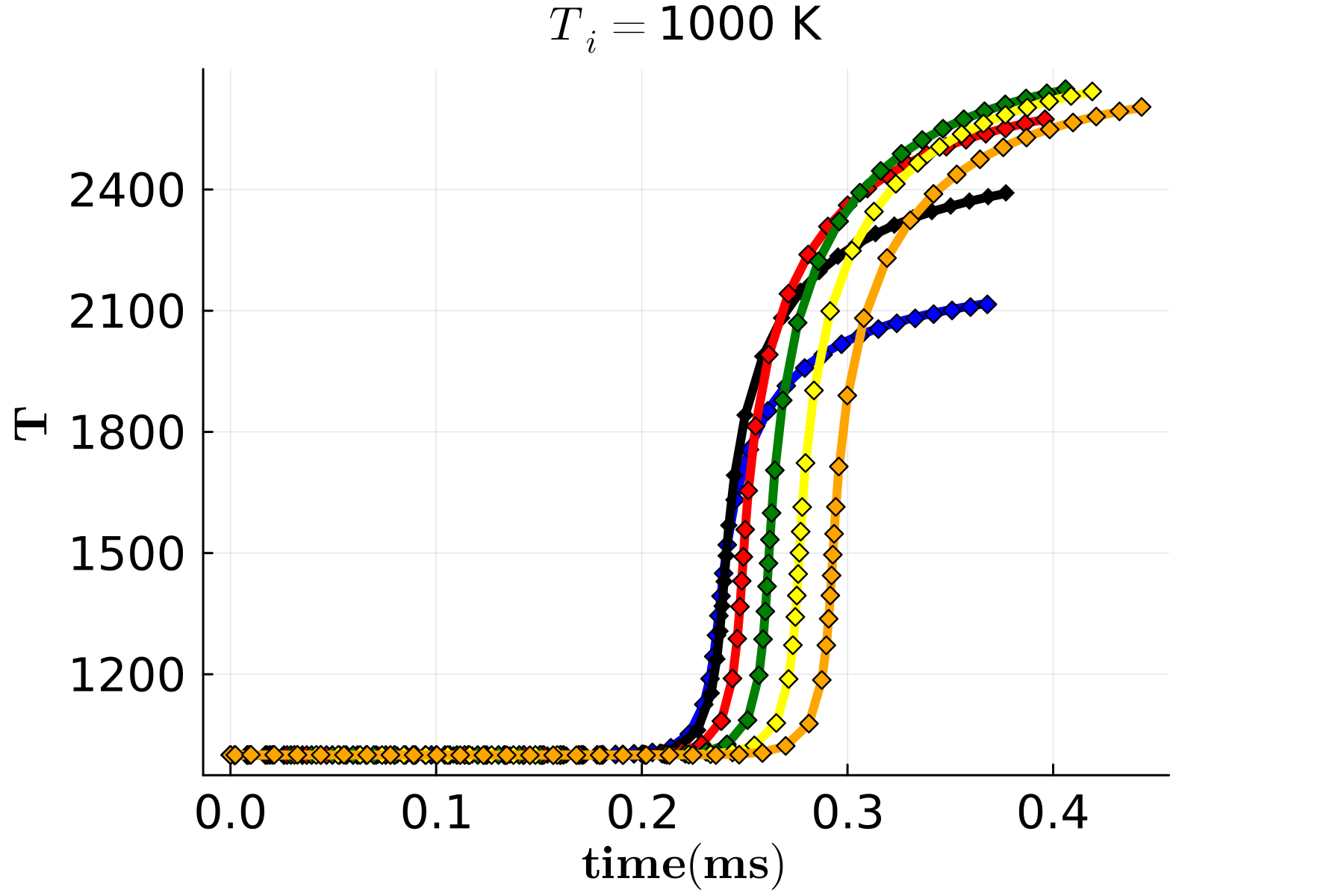
- The PC-NODE model with elemental mass constraints (ELE-CONS) showed excellent agreement with ground truth for temperature and species mass fractions, while the unconstrained model (NO-CONS) exhibited significant deviations.
- Elemental mass fractions of hydrogen and oxygen were conserved within numerical tolerance in PC-NODE predictions, even under out-of-sample conditions, confirming physical consistency.
- The PC-NODE model demonstrated robust extrapolative generalization to initial temperatures of 1200 K and equivalence ratios of φ=0.4 and φ=1.6, which were outside the training range.
- PC-NODE predictions showed significantly lower errors in the temporal evolution of thermochemical scalars compared to the purely data-driven NODE approach.
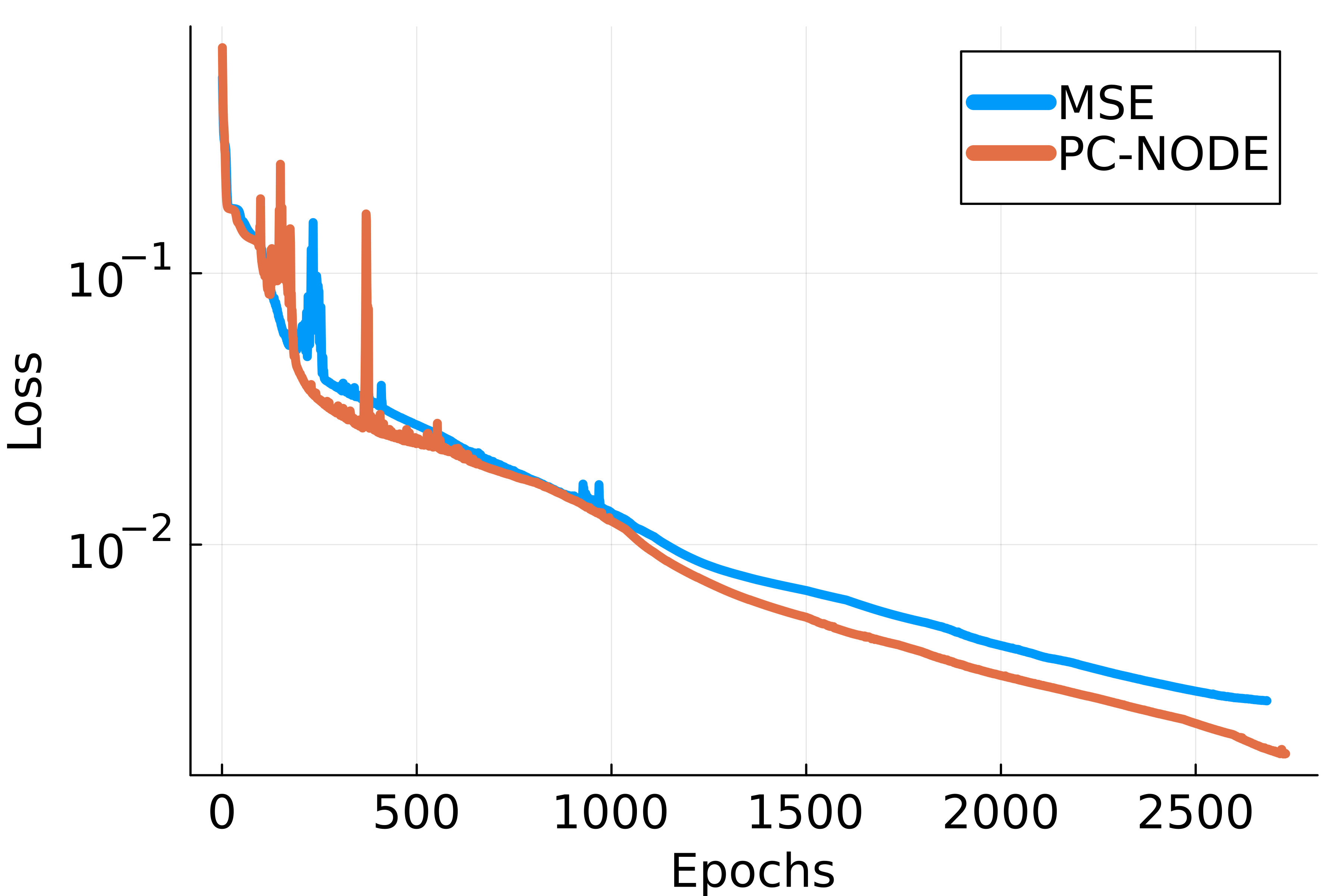
- The physics-constrained model achieved improved training efficiency and better convergence behavior due to the regularization of physical laws in the loss function.
- When coupled with the CONVERGE CFD solver, PC-NODE maintained low deviation from mass conservation and produced accurate, stable solutions across 3D unit cell simulations.
Better researchstarts right now
From reading papers to final review, dramatically reduce your research time.
No credit card · Free plan available
This review was created by AI and reviewed by human editors.