
[论文解读] A review of codebooks for CSI feedback in 5G new radio and beyond
对 CSI 反馈的 5G NR 码本的全面综述,详述演进、PMI 格式、预编码矩阵映射,以及面向未来 6G 方向的开放挑战。
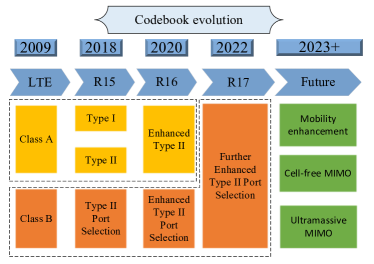
Codebooks have been indispensable for wireless communication standard since the first release of the Long-Term Evolution in 2009. They offer an efficient way to acquire the channel state information (CSI) for multiple antenna systems. Nowadays, a codebook is not limited to a set of pre-defined precoders, it refers to a CSI feedback framework, which is more and more sophisticated. In this paper, we review the codebooks in 5G New Radio (NR) standards. The codebook timeline and the evolution trend are shown. Each codebook is elaborated with its motivation, the corresponding feedback mechanism, and the format of the precoding matrix indicator. Some insights are given to help grasp the underlying reasons and intuitions of these codebooks. Finally, we point out some unresolved challenges of the codebooks for future evolution of the standards. In general, this paper provides a comprehensive review of the codebooks in 5G NR and aims to help researchers understand the CSI feedback schemes from a standard and industrial perspective.
研究动机与目标
- 解释 CSI 反馈码本从 LTE 到 5G NR 及更高版本的发展演变。
- 描述每个码本中 PMI 格式如何映射到预编码矩阵。
- 分析各码本的反馈开销与性能权衡。
- 强调面向 6G/大规模 MIMO 与移动性的开放挑战和方向。
- 在实际 CSI 反馈机制方面连接行业与学术界的视角。
提出的方法
- 调研从 LTE 到 5G NR R17 及更高版本的码本分类与演进时间线。
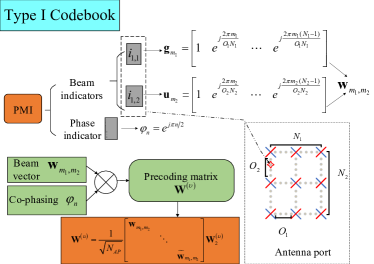
- 详细介绍 Type I、Type II 以及 Enhanced Type II 码本中的 PMI 格式与预编码矩阵计算。
- 解释降低反馈开销的压缩与映射机制。
- 比较每个码本如何支持 MU-MIMO 与宽带/多子带场景。
实验结果
研究问题
- RQ1CSI 码本如何从 LTE 演进到 5G NR 以更好地捕获通道特性?
- RQ2Type I、Type II 与 Enhanced Type II 码本的 PMI 格式及预编码矩阵映射是什么?
- RQ3压缩技术如何影响不同码本的反馈开销与 MU-MIMO 性能?
- RQ4关于未来标准(5G Advanced 与 6G)在高移动性、无小区大规模 MIMO 与超大规模 MIMO 方面存在哪些开放问题?
主要发现
- Type I 码本提供具有同相的波束信息,但仅限于单束,在多径场景下的性能较差。
- Type II 码本支持多束波束并支持 MU-MIMO,但代价是更高的反馈开销。
- 增强型 Type II 码本引入空间域和频域压缩,使得子带处理成为可能,在提升通道表征的同时降低开销。
- 增强型 Type II 码本通过使用基于离散傅里叶变换的频域压缩和角度-时延域映射来进一步提高精度,但增加了复杂性。
- 总体而言,更新的码本提高了频谱效率和多用户性能,但反馈开销仍然是一个核心挑战,尤其是在大规模天线阵列和宽带条件下。
- 本文讨论了 6G 的开放问题,包括对高移动性的支持和超大规模 MIMO。
阅读本论文
在 Nubint 阅读器中打开原文,边读边就任意段落提问。
在 Nubint 中阅读本论文本解读由 AI 根据论文原文生成,引用前请核对原文。