
[Paper Review] A Robust Study of High-Redshift Galaxies: Unsupervised Machine Learning for Characterising morphology with JWST up to z ~ 8
This study introduces an unsupervised machine learning framework using variational auto-encoders on JWST/NIRCam images to extract intrinsic morphological features from 6,869 high-redshift galaxies (z > 2), identifying 11 distinct, physically meaningful morphological classes. The method removes observational biases, reveals a decline in spheroidal galaxies with increasing redshift, and demonstrates that traditional visual classification fails to capture the complexity of early-universe morphologies, advocating for a refined, data-driven classification system.
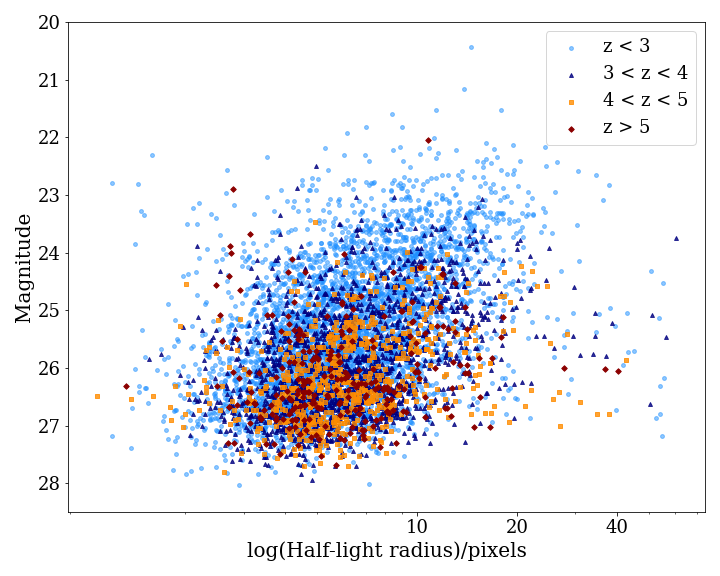
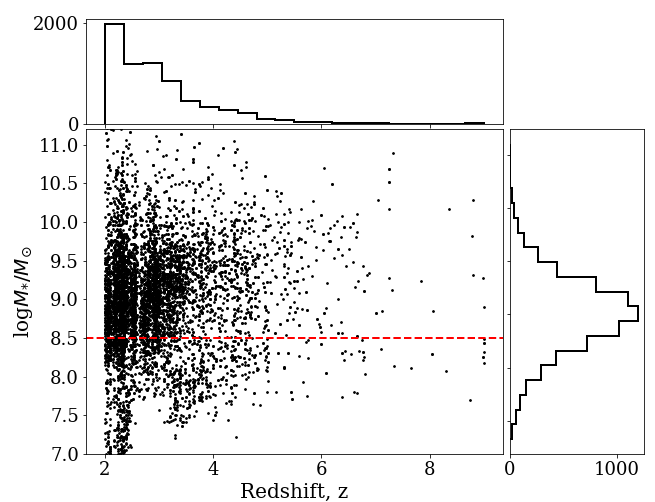
Galaxy morphologies provide valuable insights into their formation processes, tracing the spatial distribution of ongoing star formation and encoding signatures of dynamical interactions. While such information has been extensively investigated at low redshift, it is crucial to develop a robust system for characterising galaxy morphologies at earlier cosmic epochs. Relying solely on the nomenclature established for low-redshift galaxies risks introducing biases that hinder our understanding of this new regime. In this paper, we employ variational auto-encoders to perform feature extraction on galaxies at z $>$ 2 using JWST/NIRCam data. Our sample comprises 6869 galaxies at z $>$ 2, including 255 galaxies z $>$ 5, which have been detected in both the CANDELS/HST fields and CEERS/JWST, ensuring reliable measurements of redshift, mass, and star formation rates. To address potential biases, we eliminate galaxy orientation and background sources prior to encoding the galaxy features, thereby constructing a physically meaningful feature space. We identify 11 distinct morphological classes that exhibit clear separation in various structural parameters, such as CAS-$M_{20}$, Sérsic indices, specific star formation rates, and axis ratios. We observe a decline in the presence of spheroidal-type galaxies with increasing redshift, indicating a dominance of disk-like galaxies in the early universe. We demonstrate that conventional visual classification systems are inadequate for high-redshift morphology classification and advocate the need for a more detailed and refined classification scheme. Leveraging machine-extracted features, we propose a solution to this challenge and illustrate how our extracted clusters align with measured parameters, offering greater physical relevance compared to traditional methods.
Motivation & Objective
- To develop a robust, bias-free classification system for galaxy morphology at high redshift (z > 2), where traditional visual schemes fail due to clumpy, irregular, and disturbed morphologies.
- To overcome biases from galaxy orientation, background sources, and image noise by standardizing input data before feature extraction.
- To identify intrinsic morphological classes using unsupervised learning that reflect physical properties such as star formation rate, structural parameters, and Sersic indices.
- To provide a scalable, physically meaningful alternative to conventional nomenclature for high-redshift galaxies, especially given the increasing data volume from JWST.
- To enable future studies of galaxy evolution by linking morphological types to physical parameters across cosmic time.
Proposed method
- Employ variational auto-encoders (VAEs) to extract low-dimensional, disentangled features from rest-frame optical images of high-redshift galaxies in the CEERS and CANDELS fields.
- Preprocess images by removing orientation, background sources, and noise to ensure the learned features reflect intrinsic morphology rather than observational artifacts.
- Apply hierarchical clustering to the VAE-embedded features to identify 11 distinct, self-similar morphological classes without prior labeling.
- Use structural parameters—CAS-M20, Sersic index, axis ratio, and specific star formation rate (sSFR)—to validate and interpret the clusters.
- Compare the unsupervised clusters with traditional visual classifications to assess their physical relevance and separation.
- Utilize rest-frame optical imaging from JWST/NIRCam to avoid biases from UV morphology, ensuring consistency across redshifts.
Experimental results
Research questions
- RQ1Can unsupervised machine learning extract physically meaningful morphological classes from high-redshift galaxies without relying on pre-defined visual categories?
- RQ2How do the morphological distributions of galaxies at z > 2, particularly spheroids and disks, evolve with cosmic time?
- RQ3To what extent do conventional visual classification systems fail to distinguish complex high-redshift morphologies such as clumpy or disturbed disks?
- RQ4Which structural and physical parameters best characterize the distinct morphological classes identified by the unsupervised method?
- RQ5Can the extracted morphological features be reliably linked to physical properties like star formation rate and Sersic index?
Key findings
- The study identifies 11 distinct morphological classes in a sample of 6,869 high-redshift galaxies (z > 2), with 255 galaxies at z > 5, using unsupervised learning on JWST/NIRCam data.
- The morphological classes are well-separated in physical parameter space, including CAS-M20, Sersic indices, axis ratios, and sSFR, indicating strong physical coherence.
- There is a clear decline in the fraction of spheroidal-type galaxies with increasing redshift, confirming earlier findings and supporting a dominance of disk-like, clumpy, and disturbed morphologies in the early universe.
- Traditional visual classification systems poorly separate non-spheroidal types—especially disks and peculiar galaxies—highlighting the need for a more detailed, data-driven classification scheme.
- The unsupervised method produces fewer, better-separated, and more physically interpretable clusters than previous studies, which often yielded hundreds of ill-defined classes.
- The feature space is physically meaningful, as it excludes orientation and background contamination, allowing the model to focus on intrinsic morphological structure.
Better researchstarts right now
From reading papers to final review, dramatically reduce your research time.
No credit card · Free plan available
This review was created by AI and reviewed by human editors.