
[Paper Review] A Run on Fossil Fuel? Climate Change and Transition Risk
The paper develops a dynamic general equilibrium model linking climate-change–driven transition risk to macroeconomic outcomes and asset prices, producing a “run on fossil fuels” or a “reverse run” depending on the nature of the transition shock, and provides empirical tests using a climate-transition risk index.
I study the dynamic, general equilibrium implications of climate-change-linked transition risk on macroeconomic outcomes and asset prices. Climate-change-linked expectations of fossil fuel restrictions can produce a ``run on fossil fuels'' with accelerated production and decreasing spot prices, or a ``reverse run'' with restrained production and increased spot prices. The response depends on the expected economic consequences of the anticipated transition shock, and existing climate policies. Fossil fuel firm prices decrease in each case. I use a novel empirical measure of innovations in climate-related transition risk likelihood to show that dynamic empirical responses are consistent with a ``run on fossil fuel.''
Motivation & Objective
- Understand how climate-change–linked transition risk affects macroeconomic outcomes and asset prices.
- Characterize endogenous feedback between fossil fuel production, climate damages, and transition risk.
- Explore how different transition shocks (technology vs taxation) drive distinct market responses.
- Calibrate and test the model using empirical evidence from fossil fuel markets and transition events.
Proposed method
- Construct a dynamic, general-equilibrium model with two fossil fuel inputs (oil with limited reserves and coal with unlimited reserves), labor, and green energy.
- Incorporate climate change via a damage function that reduces consumption as temperature rises.
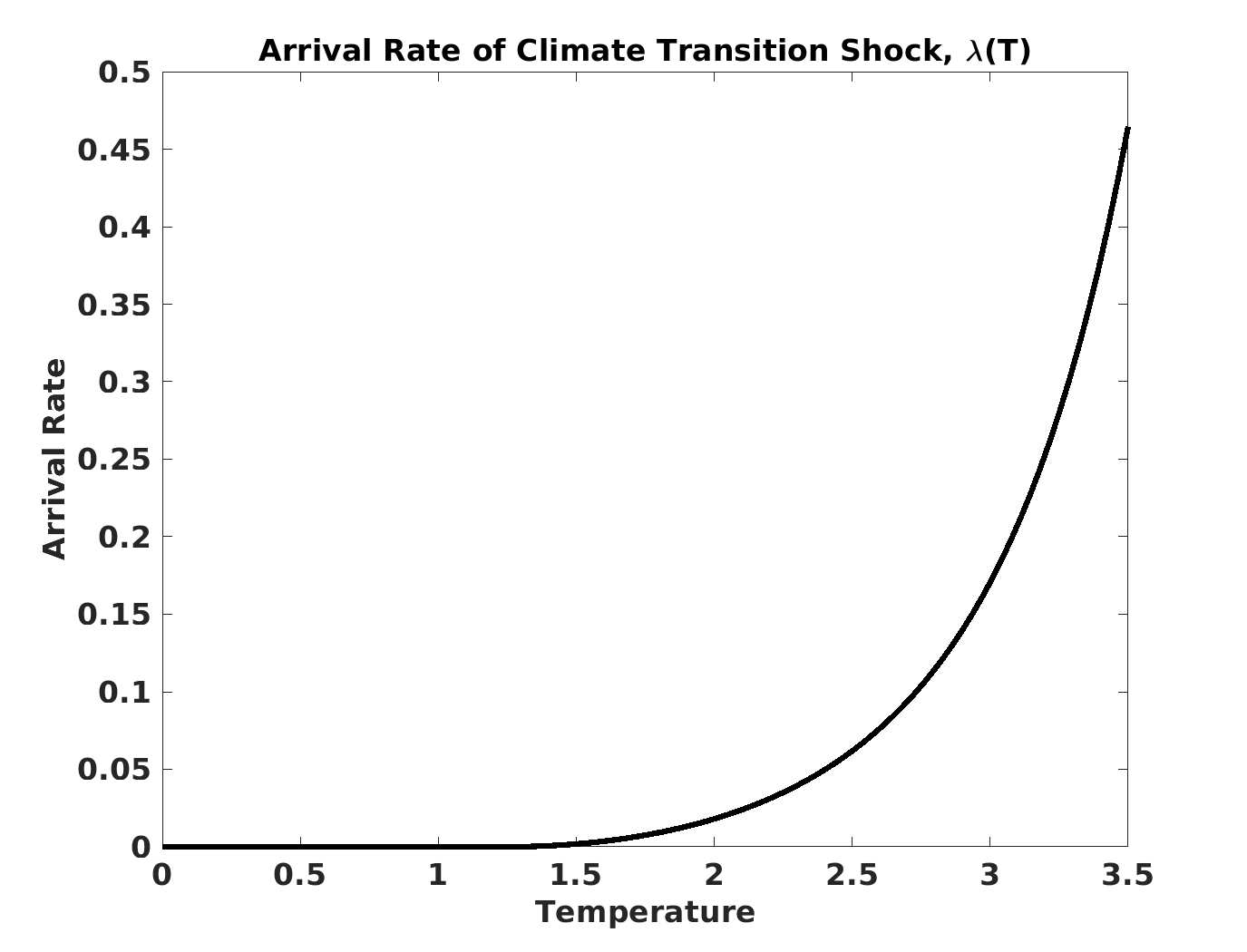
- Model a climate-change–linked transition risk shock with a Poisson arrival process whose intensity depends on climate dynamics.
- Specify energy production with CES technology across oil, coal, and green energy inputs; oil has limited reserves, coal is infinite, and green energy follows an AK-type technology.
- Use recursive (Duffie-Epstein-Zin-Weil) utility for a representative agent and a social planner to internalize climate damages and transition risk.
- Provide an empirical strategy: event-study analysis around transition-related events and a climate-transition event index to estimate dynamic impacts on oil markets.
Experimental results
Research questions
- RQ1How does the anticipation of climate-transition shocks affect fossil fuel production and prices in a dynamic general equilibrium framework?
- RQ2What are the qualitative and quantitative differences between technology-driven (“run”) and taxation-driven (“reverse run”) transition shocks?
- RQ3Can endogenous climate damages and transition risk reproduce observed asset pricing and production responses around climate-related events?
- RQ4How do policy and technology trajectories influence welfare and asset prices under climate transition risk?
Key findings
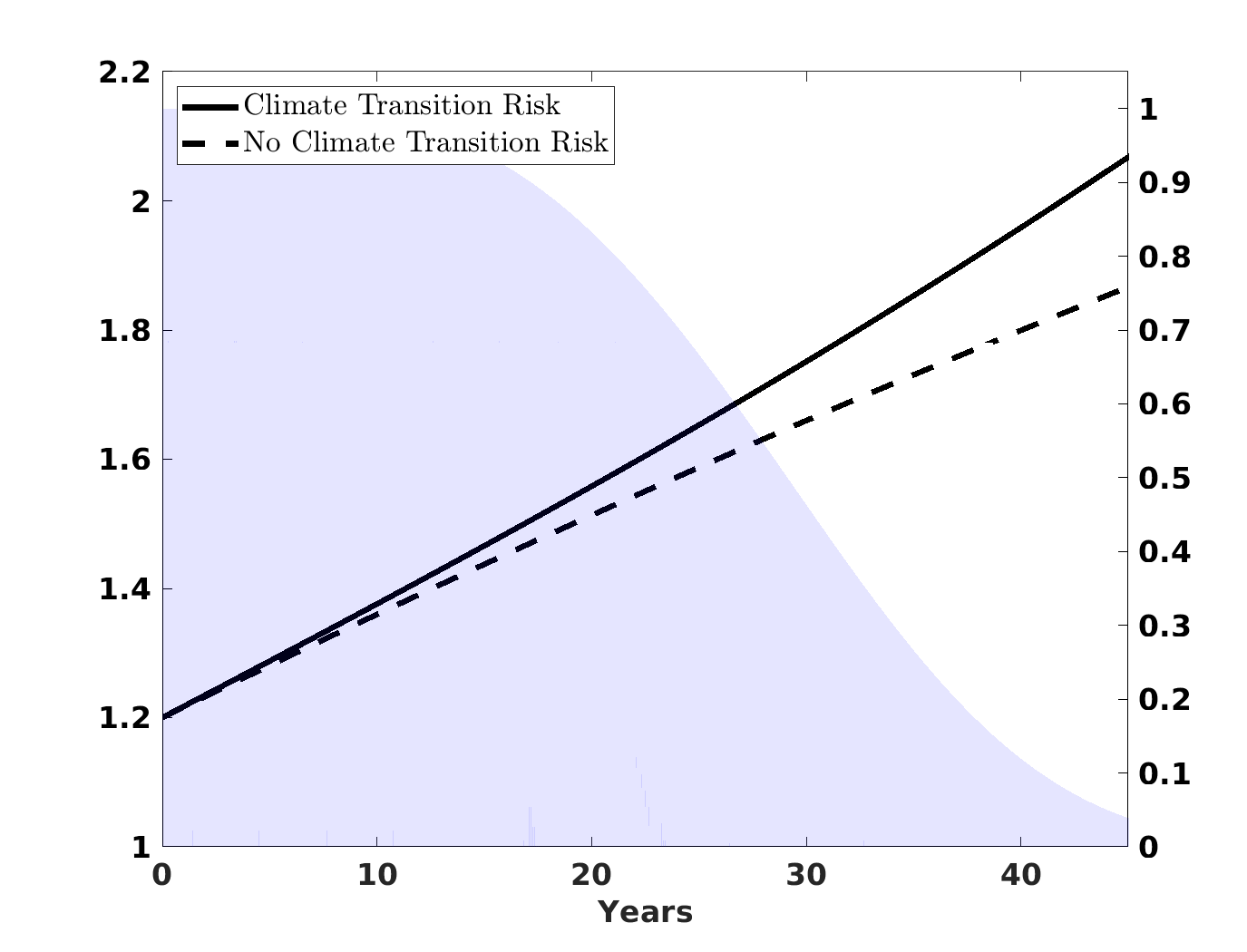
- Anticipation of technology-related transition shocks leads to a run on fossil fuels: accelerated production and lower spot prices despite higher climate damages.
- Anticipation of taxation-related transition shocks leads to a reverse run: production restraint and higher spot prices to postpone the transition.
- Fossil fuel firm prices decline under both run and reverse run scenarios, consistent with the model’s feedback mechanisms.
- Empirical tests show sectors with higher transition risk exposure exhibit larger abnormal returns around transition events, and a climate-transition event index implies higher oil production and lower oil prices when transition likelihood rises (particularly 2009–2019).
- Model extensions and counterfactuals highlight state-dependent effects and robustness to alternative utility specifications and frictions.
Better researchstarts right now
From reading papers to final review, dramatically reduce your research time.
No credit card · Free plan available
This review was created by AI and reviewed by human editors.