
[Paper Review] A simple model for the emergence of relaxation-oscillator convection
This paper demonstrates that relaxation-oscillator (RO) convection—characterized by periodic, intense storms followed by dry spells—emerges in single-column models of radiative-convective equilibrium with parameterized convection, not just in cloud-resolving 3D simulations. The RO state arises when convective available potential energy (CAPE) can no longer sustain deep, entraining plumes, leading to oscillatory behavior due to instability in a steady-state analytical model, a mechanism applicable to any moist planetary atmosphere including Titan’s methane cycle.
Earth's tropics are characterized by quasi-steady precipitation with small oscillations about a mean value, which has led to the hypothesis that moist convection is in a state of quasi-equilibrium (QE). In contrast, very warm simulations of Earth's tropical convection are characterized by relaxation-oscillator-like (RO) precipitation, with short-lived convective storms and torrential rainfall forming and dissipating at regular intervals with little to no precipitation in between. We develop a model of moist convection by combining a zero-buoyancy model of bulk-plume convection with a QE heat engine model, and we use it to show that QE is violated at high surface temperatures. We hypothesize that the RO state emerges when the equilibrium condition of the convective heat engine is violated, i.e., when the heating rate times a thermodynamic efficiency exceeds the rate at which work can be performed. We test our hypothesis against one- and three-dimensional numerical simulations and find that it accurately predicts the onset of RO convection. The proposed mechanism for RO emergence from QE breakdown is agnostic of the condensable, and can be applied to any planetary atmosphere undergoing moist convection. To date, RO states have only been demonstrated in three-dimensional convection-resolving simulations, which has made it seem that the physics of the RO state requires simulations that can explicitly resolve the three-dimensional interaction of cloudy plumes and their environment. We demonstrate that RO states also exist in single-column simulations of radiative-convective equilibrium with parameterized convection, albeit in a different surface temperature range and with much longer storm-free intervals.
Motivation & Objective
- To investigate whether relaxation-oscillator (RO) convection—periodic, intense storms followed by dry spells—can emerge in single-column models with parameterized convection, rather than requiring cloud-resolving 3D simulations.
- To determine the physical mechanism underlying RO state emergence by analyzing the absence of steady-state solutions in a simplified quasi-equilibrium (QE) model of radiative-convective equilibrium.
- To test the generality of the proposed mechanism across different condensing substances, including water on Earth and methane on Titan.
- To establish that RO states are not dependent on explicit convection resolution but instead stem from fundamental instability in the energy budget when CAPE is insufficient to sustain continuous convection.
Proposed method
- Used a modified ECHAM6 general circulation model in single-column mode with parameterized radiation, convection, and cloud processes.
- Applied a bulk-plume convection scheme with entrainment and detrainment, and a large-scale condensation/re-evaporation scheme based on relative humidity.
- Varied sea surface temperature (SST) from 290 K to 370 K in 1–5 K increments to explore transitions in convective regimes.
- Developed an analytical quasi-equilibrium (QE) model of radiative-convective equilibrium assuming constant entrainment rate and fixed tropopause temperature of 200 K.
- Derived the temperature lapse rate and latent heat release for entraining plumes using conservation of moist static energy and the bulk-plume parameterization.
- Evaluated the system’s stability by analyzing the absence of steady-state solutions in the analytical model, linking this to the emergence of oscillatory RO states.
Experimental results
Research questions
- RQ1Can relaxation-oscillator (RO) convection emerge in single-column models with parameterized convection, rather than requiring cloud-resolving 3D simulations?
- RQ2What is the physical mechanism underlying the emergence of RO states in radiative-convective equilibrium?
- RQ3Why do RO states appear at high surface temperatures or high atmospheric moisture, and how does this relate to convective available potential energy (CAPE)?
- RQ4Is the RO mechanism generalizable across different condensing substances, such as water on Earth and methane on Titan?
- RQ5Does the absence of steady-state solutions in a simplified analytical model of RCE explain the emergence of oscillatory behavior?
Key findings
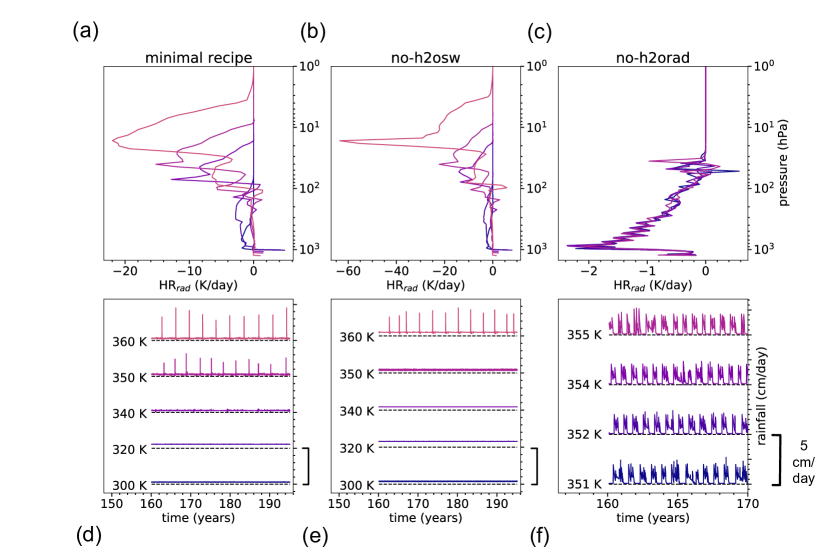
- Relaxation-oscillator (RO) states emerge in single-column models of radiative-convective equilibrium (1D-RCE) with parameterized convection, confirming that explicit cloud resolution is not required for RO behavior.
- RO states appear at surface temperatures around 350 K, where precipitation bursts reach up to 5 cm/day and recur every 100–1000 days, alternating with dry spells.
- The RO state emerges when convective available potential energy (CAPE) can no longer support sustained deep convection, leading to a breakdown of steady-state solutions in the analytical QE model.
- The mechanism is general: it applies to any moist planetary atmosphere regardless of the condensing substance, as demonstrated by successful application to Titan’s methane cycle.
- The analytical model shows that when the ratio of precipitable water to entrainment rate (PE/a) is not constant, steady-state solutions fail, leading to oscillatory behavior consistent with RO states.
- The transition to RO behavior is tied to the collapse of CAPE and the inability of entraining plumes to maintain buoyancy, resulting in periodic storm cycles.
Better researchstarts right now
From reading papers to final review, dramatically reduce your research time.
No credit card · Free plan available
This review was created by AI and reviewed by human editors.