
[Paper Review] Additive Covariance Matrix Models: Modelling Regional Electricity Net-Demand in Great Britain
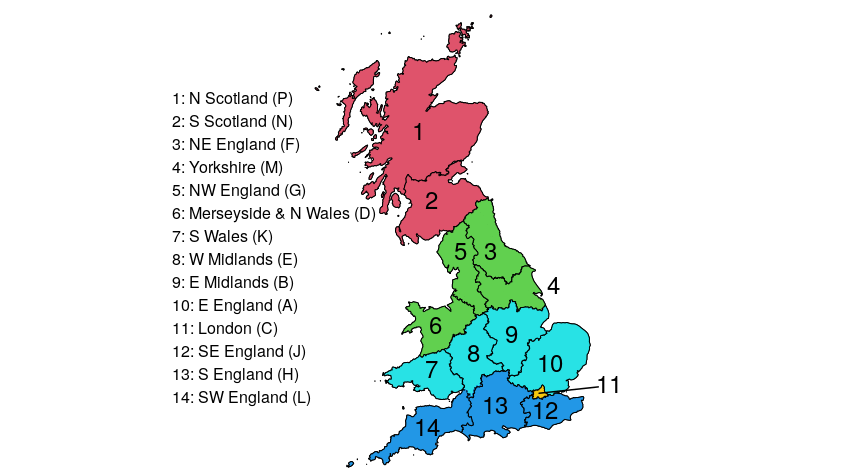
This paper proposes a multivariate Gaussian additive covariance matrix model using a modified Cholesky decomposition to jointly forecast regional net-demand across Great Britain’s 14 transmission regions, enabling spatially coherent, probabilistic forecasts that account for time-varying dependencies and variability. The model outperforms non-Gaussian copula-based alternatives in key metrics after excluding extreme weather events, demonstrating superior predictive accuracy and interpretability for power system operations.
Forecasts of regional electricity net-demand, consumption minus embedded generation, are an essential input for reliable and economic power system operation, and energy trading. While such forecasts are typically performed region by region, operations such as managing power flows require spatially coherent joint forecasts, which account for cross-regional dependencies. Here, we forecast the joint distribution of net-demand across the 14 regions constituting Great Britain's electricity network. Joint modelling is complicated by the fact that the net-demand variability within each region, and the dependencies between regions, vary with temporal, socio-economical and weather-related factors. We accommodate for these characteristics by proposing a multivariate Gaussian model based on a modified Cholesky parametrisation, which allows us to model each unconstrained parameter via an additive model. Given that the number of model parameters and covariates is large, we adopt a semi-automated approach to model selection, based on gradient boosting. In addition to comparing the forecasting performance of several versions of the proposed model with that of two non-Gaussian copula-based models, we visually explore the model output to interpret how the covariates affect net-demand variability and dependencies. The code for reproducing the results in this paper is available at https://doi.org/10.5281/zenodo.7315105, while methods for building and fitting multivariate Gaussian additive models are provided by the SCM R package, available at https://github.com/VinGioia90/SCM.
Motivation & Objective
- To develop a spatially coherent, probabilistic forecasting model for regional electricity net-demand across Great Britain’s 14 transmission regions.
- To model time-varying net-demand variability and cross-regional dependencies driven by temporal, socio-economic, and weather-related factors.
- To ensure interpretability and trust in forecasting for critical power system operations, especially under extreme conditions.
- To enable flexible post-processing of forecasts for power flow analysis across dynamic network boundaries.
- To compare the performance of the proposed Gaussian additive model against non-Gaussian copula-based alternatives.
Proposed method
- A multivariate Gaussian model is constructed using a modified Cholesky parametrization to ensure positive-definite covariance matrices.
- Each unconstrained Cholesky parameter is modeled via additive predictors, allowing flexible, nonparametric modeling of covariance structure.
- Covariates such as calendar effects, temperature, and renewable generation are included in additive models to capture time-varying dependencies.
- A semi-automated model selection approach based on gradient boosting is used to handle the high-dimensional parameter space.
- The model is fitted using the SCM R package, with probabilistic forecasts evaluated via log scores, CRPS, and quantile scores.
- Performance is assessed on both full regional data and aggregated macro-regions, with sensitivity to extreme events like the Beast from the East analyzed.
Experimental results
Research questions
- RQ1Can a multivariate Gaussian model with additive covariance structure effectively capture time-varying net-demand dependencies across Great Britain’s 14 regions?
- RQ2How does the inclusion of calendar, weather, and renewable generation covariates improve forecast accuracy and spatial coherence?
- RQ3Does the proposed additive covariance model outperform non-Gaussian copula-based models in probabilistic forecasting of net-demand?
- RQ4How do extreme weather events like the Beast from the East affect model performance, and can the model remain robust after their exclusion?
- RQ5To what extent is the model interpretable, and can it support post-processing for power flow analysis across dynamic network boundaries?
Key findings
- After excluding the Beast from the East cold wave, the Full and Cal+Ren versions of the proposed Gaussian additive model achieved the best log score performance across all regions and macro-regions.
- The Full model achieved a log score of 2427 on the 14 GSP groups and 2684 on the 5 macro-regions, outperforming all copula-based models in both settings.
- The model's performance was particularly strong in forecasting extreme quantiles, with Pin 001 and Pin 999 scores below 6.00 in the London-Neighbours region, indicating accurate tail forecasts.
- The CRPS values were consistently below 1200 for the 14 GSP groups and below 370 for the 5 macro-regions, showing high marginal forecast accuracy.
- The model demonstrated robustness and interpretability, with clear visualization of how covariates such as temperature and renewable generation affect net-demand variability and dependencies.
- The proposed model outperformed non-Gaussian copula-based models in both marginal and joint forecast evaluation metrics after removing extreme weather data.

Better researchstarts right now
From reading papers to final review, dramatically reduce your research time.
No credit card · Free plan available
This review was created by AI and reviewed by human editors.