
[Paper Review] Advancements in Molecular Property Prediction: A Survey of Single and Multimodal Approaches
This survey provides a comprehensive analysis of single- and multimodal deep learning approaches for molecular property prediction, focusing on representation learning techniques like GNNs, Transformers, and multimodal fusion. It identifies key challenges in molecular data representation, evaluates state-of-the-art methods, and outlines future research directions in interpretability, uncertainty quantification, and efficient learning paradigms.
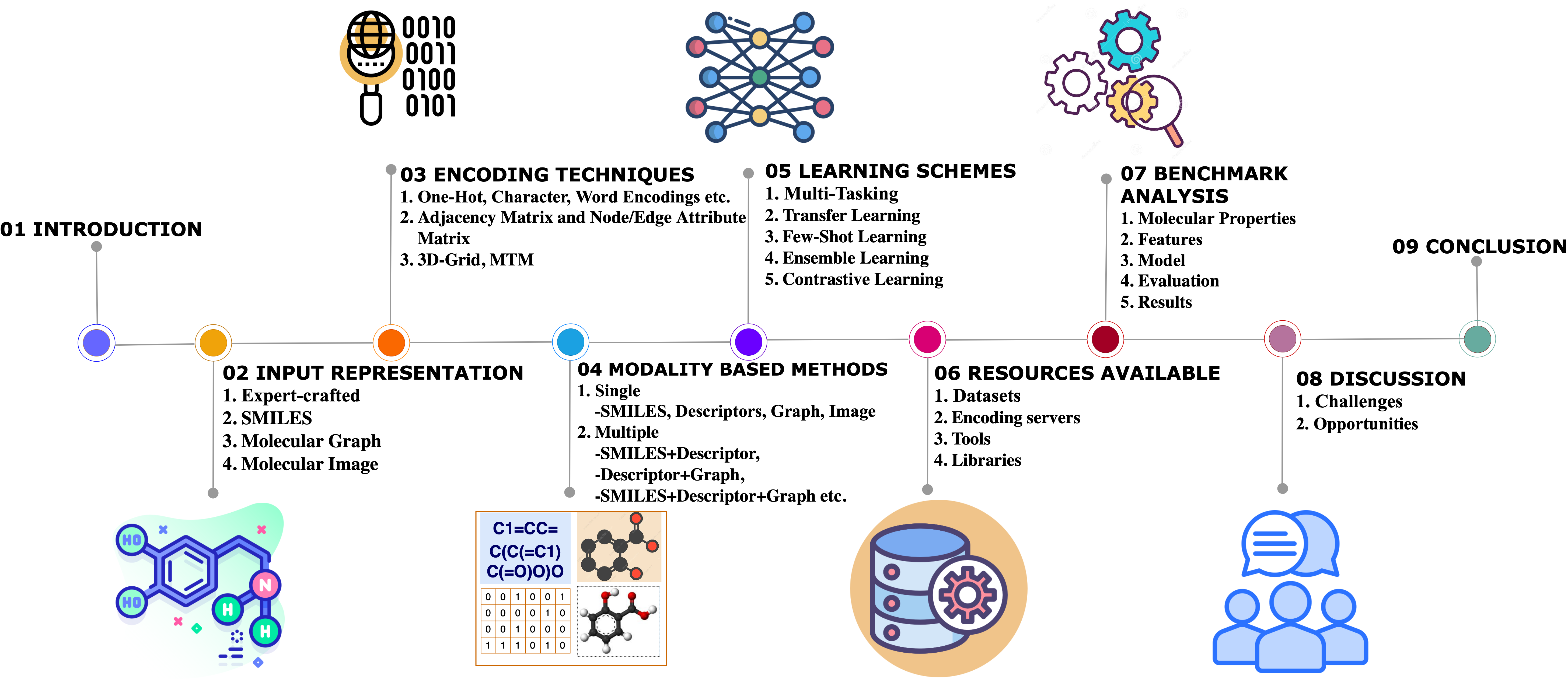
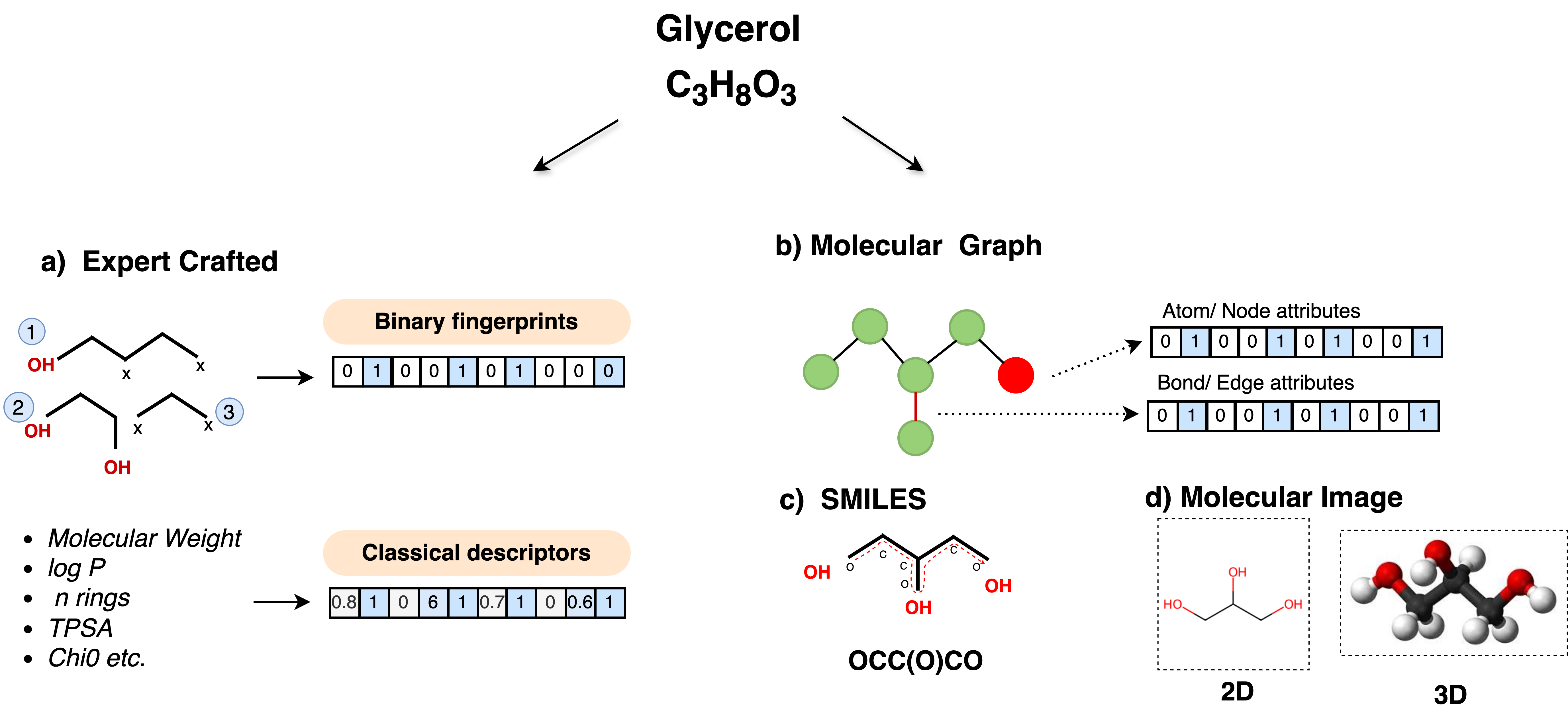
Molecular Property Prediction (MPP) plays a pivotal role across diverse domains, spanning drug discovery, material science, and environmental chemistry. Fueled by the exponential growth of chemical data and the evolution of artificial intelligence, recent years have witnessed remarkable strides in MPP. However, the multifaceted nature of molecular data, such as molecular structures, SMILES notation, and molecular images, continues to pose a fundamental challenge in its effective representation. To address this, representation learning techniques are instrumental as they acquire informative and interpretable representations of molecular data. This article explores recent AI/-based approaches in MPP, focusing on both single and multiple modality representation techniques. It provides an overview of various molecule representations and encoding schemes, categorizes MPP methods by their use of modalities, and outlines datasets and tools available for feature generation. The article also analyzes the performance of recent methods and suggests future research directions to advance the field of MPP.
Motivation & Objective
- To provide a systematic review of recent AI-based methods for molecular property prediction, emphasizing representation learning techniques.
- To categorize and analyze single- and multimodal approaches for molecular data representation, including SMILES, molecular graphs, and images.
- To evaluate the performance of state-of-the-art models across benchmark datasets and identify gaps in current methodologies.
- To highlight emerging challenges such as uncertainty quantification, model interpretability, and data efficiency in molecular property prediction.
- To outline future research directions, including few-shot learning, federated learning, and contrastive learning for improved generalization and robustness.
Proposed method
- The paper employs a taxonomy-based survey methodology, classifying MPP methods by modality—single (e.g., SMILES, graphs) or multimodal (e.g., combining SMILES, images, and 3D structures).
- It reviews key deep learning architectures such as Graph Neural Networks (GNNs), Transformers, Recurrent Neural Networks (RNNs), and Convolutional Neural Networks (CNNs) for molecular representation learning.
- The study evaluates multimodal fusion strategies, including early fusion, late fusion, and attention-based bottlenecks, to integrate information across different data types effectively.
- It analyzes representation learning techniques such as contrastive learning and self-supervised pretraining to improve feature quality and generalization.
- The paper examines explainability techniques like attention maps, saliency maps, and feature importance scores to enhance model interpretability in molecular prediction.
- It discusses advanced learning paradigms such as meta-learning, few-shot learning, and federated learning to address data scarcity and privacy concerns in molecular datasets.
Experimental results
Research questions
- RQ1How do single-modality representation techniques (e.g., GNNs, SMILES-based RNNs) compare in performance and generalization across molecular property prediction tasks?
- RQ2What are the most effective multimodal fusion strategies for combining molecular data types (e.g., SMILES, 2D/3D structures, images) in property prediction?
- RQ3How do recent advances in uncertainty quantification and model interpretability impact the reliability and trustworthiness of molecular property predictions?
- RQ4To what extent can meta-learning and few-shot learning improve model generalization in low-data regimes common in drug discovery?
- RQ5What are the key challenges and opportunities in developing efficient, privacy-preserving, and scalable MPP models using federated and self-supervised learning?
Key findings
- Graph Neural Networks (GNNs) and Transformer-based models have emerged as leading architectures for learning structural representations from molecular graphs and SMILES strings.
- Multimodal integration—especially when combining SMILES, 2D structures, and molecular images—leads to improved prediction performance over unimodal baselines, particularly in complex property prediction tasks.
- Attention mechanisms and fusion bottlenecks enable effective cross-modal information distillation, reducing dimensionality while preserving key predictive signals.
- Contrastive learning enhances representation quality by learning to distinguish between similar and dissimilar molecular patterns, improving downstream prediction accuracy.
- Despite progress, uncertainty quantification remains inconsistent across methods, with no consensus on optimal techniques, highlighting a critical open challenge.
- Explainable AI (XAI) methods such as attention maps and saliency visualization are increasingly used to interpret GNN and transformer predictions, though robust and generalizable explanation frameworks remain underdeveloped.
Better researchstarts right now
From reading papers to final review, dramatically reduce your research time.
No credit card · Free plan available
This review was created by AI and reviewed by human editors.