
[Paper Review] Aerostack2: A Software Framework for Developing Multi-robot Aerial Systems
Aerostack2 is a ROS 2-based, open-source, platform-independent framework that modularly supports multi-robot aerial systems with a logical mission spec, reusable components, and swarming capabilities, validated in simulation and real flights.
The development of autonomous aerial systems, particularly for multi-robot configurations, is a complex challenge requiring multidisciplinary expertise. Unlike ground robotics, aerial robotics has seen limited standardization, leading to fragmented development efforts. To address this gap, we introduce Aerostack2, a comprehensive, open-source ROS 2 based framework designed for creating versatile and robust multi-robot aerial systems. Aerostack2 features platform independence, a modular plugin architecture, and behavior-based mission control, enabling easy customization and integration across various platforms. In this paper, we detail the full architecture of Aerostack2, which has been tested with several platforms in both simulation and real flights. We demonstrate its effectiveness through multiple validation scenarios, highlighting its potential to accelerate innovation and enhance collaboration in the aerial robotics community.
Motivation & Objective
- Address fragmentation in aerial robotics software by offering a standard, collaborative framework.
- Provide a modular, platform-independent environment built on ROS 2 for autonomous aerial operations.
- Enable reusable components and sub-systems to accelerate development of complete control architectures.
- Support multi-robot swarms and heterogenous platforms through a common data channel and interfaces.
- Facilitate simulation-to-real-transfer and community-driven development via open-source tooling.
Proposed method
- Proposes Aerostack2 as an evolution of Aerostack, built on ROS 2 with a modular, multi-robot oriented architecture.
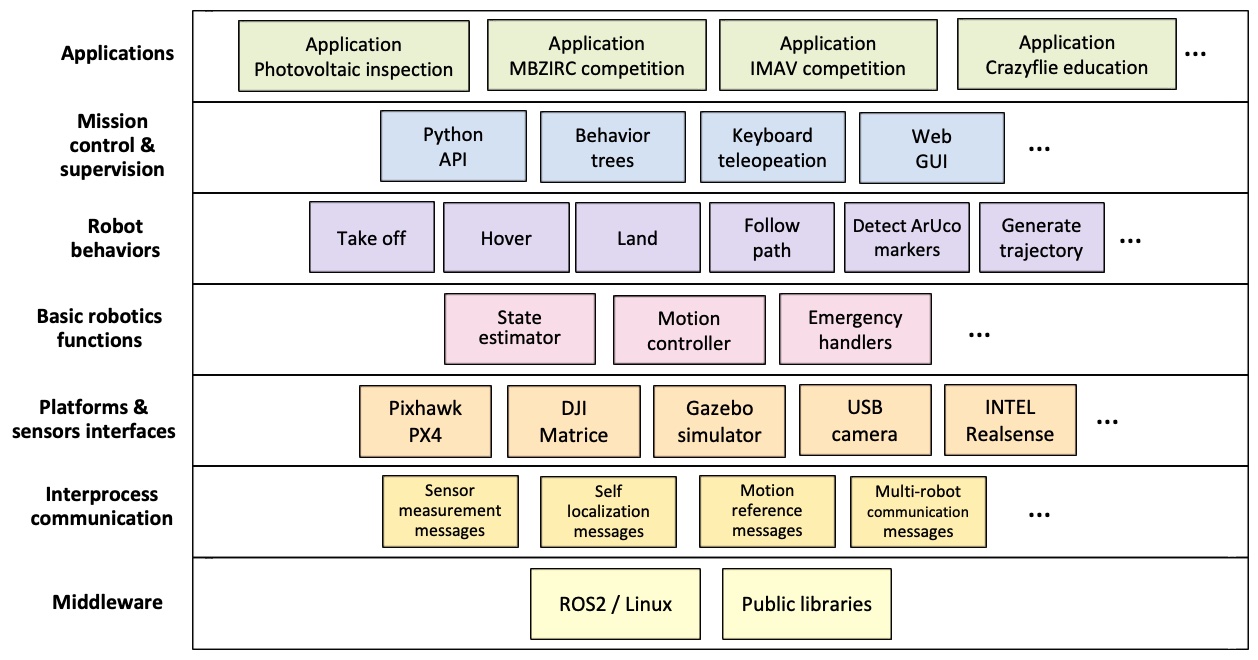
- Defines a hierarchical software stack with layers: Middleware, Inter-process Communication, Platform/Sensor Interfaces, Basic Robotic Functions, Behaviors, Mission Control, and Applications.
- Implements a standard interprocess data channel with ROS 2 topics/services/actions and platform-agnostic data representations.
- Architects basic robotic functions (motion control and state estimation) as pluggable plugins selected by managers and a plugin selector.
- Uses specialized behavior components to encapsulate skills (e.g., takeoff, hover, follow trajectory) with execution monitoring and a ROS 2 action-based interface.
- Offers mission specification tools (Python API and behavior trees) and a web-based GUI for planning, monitoring, and supervising missions.
Experimental results
Research questions
- RQ1How can aerial robotics software be standardized to enable reuse and collaboration across research groups?
- RQ2Can a modular, multi-robot framework built on ROS 2 support heterogeneous drone platforms and simulations while maintaining plug-in extensibility?
- RQ3What mechanisms enable reliable mission specification, execution monitoring, and swarming coordination in aerial systems?
- RQ4How effectively can Aerostack2 bridge simulation and real-world deployments across different platforms and sensors?
Key findings
- Aerostack2 demonstrates platform independence and modularity across multiple drone platforms (e.g., Pixhawk, DJI).
- The framework supports a wide range of capabilities from flight control to localization, planning, and inter-drone communication.
- A logical mission layer (behaviors) simplifies mission specification compared to low-level ROS 2 programming.
- Integration of Python API and behavior trees provides flexible mission planning and monitoring tools.
- Experiments show sim-to-real transfer with minimal changes (platform and state estimation plugins) in gate-crossing tasks.
- Heterogeneous swarms using different platforms (e.g., Pixhawk F450 and DJI M210) were demonstrated, validating multi-platform swarming capabilities.
Better researchstarts right now
From reading papers to final review, dramatically reduce your research time.
No credit card · Free plan available
This review was created by AI and reviewed by human editors.