
[Paper Review] AI-driven materials design: a mini-review
The paper surveys AI-enabled materials design, highlighting the shift from forward screening to inverse design with deep generative models, RL/BO, and autonomous labs, and discusses challenges and future directions.
Materials design is an important component of modern science and technology, yet traditional approaches rely heavily on trial-and-error and can be inefficient. Computational techniques, enhanced by modern artificial intelligence (AI), have greatly accelerated the design of new materials. Among these approaches, inverse design has shown great promise in designing materials that meet specific property requirements. In this mini-review, we summarize key computational advancements for materials design over the past few decades. We follow the evolution of relevant materials design techniques, from high-throughput forward machine learning (ML) methods and evolutionary algorithms, to advanced AI strategies like reinforcement learning (RL) and deep generative models. We highlight the paradigm shift from conventional screening approaches to inverse generation driven by deep generative models. Finally, we discuss current challenges and future perspectives of materials inverse design. This review may serve as a brief guide to the approaches, progress, and outlook of designing future functional materials with technological relevance.
Motivation & Objective
- Motivate the need for faster, more efficient materials discovery beyond trial-and-error methods.
- Summarize the evolution from forward screening to inverse design in materials science.
- Highlight key AI methodologies enabling inverse design (deep generative models, RL, BO, autonomous labs).
- Discuss current challenges and propose a future roadmap for AI-driven materials design.
Proposed method
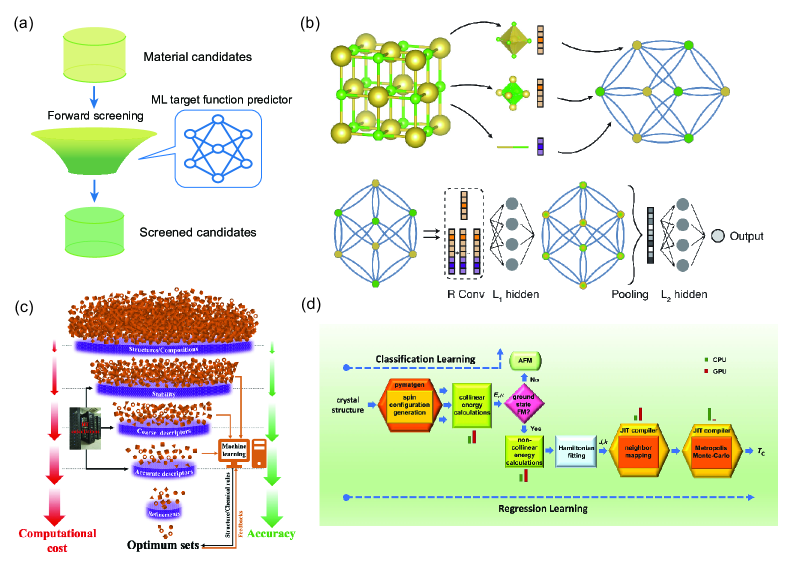
- Describe forward screening workflows and the role of ML surrogates and graph-based representations (e.g., CGCNN) in property prediction.
- Outline evolutionary algorithm families (GA, PSO, MCTS) and their applications to crystal structure prediction, materials optimization, and nanoparticle design.
- Explain adaptive and interactive approaches (Bayesian optimization, reinforcement learning, autonomous laboratories) and their closed-loop design-evaluation cycles.
- Discuss deep generative models for inverse design (VAEs, GANs, diffusion models, LLMs) and conditional generation for target properties.
- Provide a synthesis of current challenges in adaptive design, including data speed, database-centric workflows, and infrastructural needs.
Experimental results
Research questions
- RQ1What AI methodologies have driven the shift from forward screening to inverse design in materials science?
- RQ2How do forward screening and inverse design compare in efficiency and capability to discover materials with target properties?
- RQ3What are the main challenges and future directions for integrating AI-driven inverse design into scientific research and technology development?
Key findings
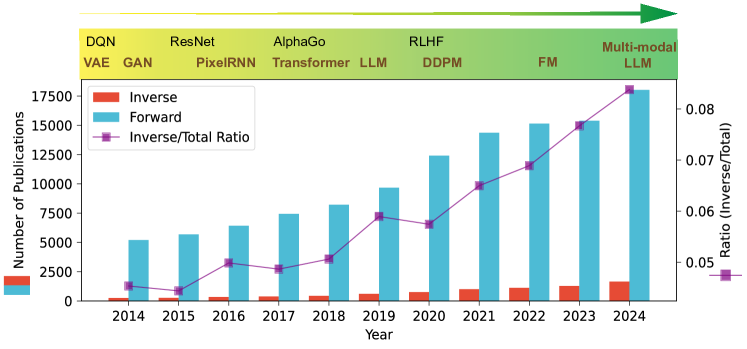
- Inverse design is increasingly prominent, now comprising about 8% of the materials design literature.
- Deep generative models enable direct, property-targeted material generation through latent spaces and conditional sampling.
- Adaptive, interactive approaches (Bayesian optimization, reinforcement learning, autonomous labs) can accelerate design under data and experimental constraints.
- Forward screening accelerates with ML surrogates but struggles with extrapolation and high false-negative rates due to vast design spaces.
- Evolutionary algorithms (GA, PSO, MCTS) laid groundwork for inverse design but face computational cost and hyperparameter sensitivity challenges.
Better researchstarts right now
From reading papers to final review, dramatically reduce your research time.
No credit card · Free plan available
This review was created by AI and reviewed by human editors.