
[Paper Review] AI Ethics: An Empirical Study on the Views of Practitioners and Lawmakers
This empirical study investigates AI ethics principles and challenges through a global survey of 99 practitioners and lawmakers across 20 countries. It identifies transparency, accountability, and privacy as the most critical ethics principles, while highlighting lack of ethical knowledge, absence of legal frameworks, and weak monitoring bodies as top challenges—offering a foundation for ethics-aware AI development and maturity modeling.
Artificial Intelligence (AI) solutions and technologies are being increasingly adopted in smart systems context, however, such technologies are continuously concerned with ethical uncertainties. Various guidelines, principles, and regulatory frameworks are designed to ensure that AI technologies bring ethical well-being. However, the implications of AI ethics principles and guidelines are still being debated. To further explore the significance of AI ethics principles and relevant challenges, we conducted a survey of 99 representative AI practitioners and lawmakers (e.g., AI engineers, lawyers) from twenty countries across five continents. To the best of our knowledge, this is the first empirical study that encapsulates the perceptions of two different types of population (AI practitioners and lawmakers) and the study findings confirm that transparency, accountability, and privacy are the most critical AI ethics principles. On the other hand, lack of ethical knowledge, no legal frameworks, and lacking monitoring bodies are found the most common AI ethics challenges. The impact analysis of the challenges across AI ethics principles reveals that conflict in practice is a highly severe challenge. Moreover, the perceptions of practitioners and lawmakers are statistically correlated with significant differences for particular principles (e.g. fairness, freedom) and challenges (e.g. lacking monitoring bodies, machine distortion). Our findings stimulate further research, especially empowering existing capability maturity models to support the development and quality assessment of ethics-aware AI systems.
Motivation & Objective
- To empirically examine the perceptions of AI practitioners and lawmakers on core AI ethics principles and challenges.
- To assess the severity impacts of identified challenges across different AI ethics principles.
- To compare and contrast the differing perceptions of practitioners and lawmakers regarding ethics principles and challenges.
- To provide actionable insights for developing robust, lawful, and ethically aligned AI systems through evidence-based guidelines.
- To support the creation of AI ethics capability maturity models by identifying key principles and challenges from real-world stakeholder perspectives.
Proposed method
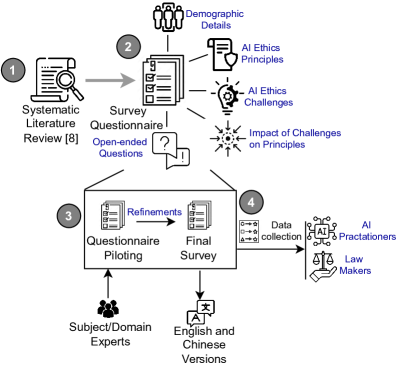
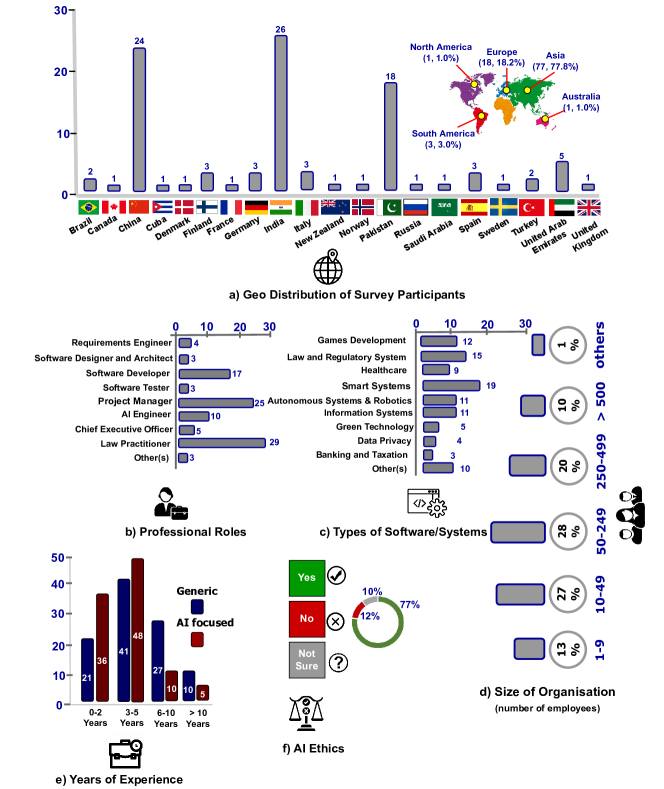
- Conducted a cross-sectional survey with 99 respondents from 20 countries, including AI engineers, lawyers, and policymakers.
- Collected data on perceptions of 15 AI ethics principles and 12 key challenges using a structured questionnaire.
- Applied statistical analysis (e.g., correlation and significance testing) to compare perceptions between practitioners and lawmakers.
- Used severity impact analysis to evaluate the long-term consequences of challenges across different ethics principles.
- Validated findings against a prior systematic literature review (SLR) to ensure alignment with existing theoretical frameworks.
- Developed a final catalogue of principles and challenges for use in future AI ethics maturity modeling and industrial application.
Experimental results
Research questions
- RQ1What are the practitioners’ and lawmakers’ insights on AI ethics principles and challenges?
- RQ2What would be the severity impacts of identified challenges across the AI ethics principles?
- RQ3How are these challenges and principles differently perceived by practitioners and lawmakers?
Key findings
- Transparency, accountability, and privacy were ranked as the most critical AI ethics principles by both practitioners and lawmakers.
- The most severe challenges identified were lack of ethical knowledge, absence of legal frameworks, and lack of monitoring bodies.
- Conflict in practice was identified as a highly severe challenge, particularly impacting fairness and freedom principles.
- Significant statistical correlation was found between practitioners’ and lawmakers’ perceptions, though notable differences emerged for fairness and freedom principles.
- Lack of monitoring bodies and machine distortion were perceived as more severe challenges by lawmakers than by practitioners.
- The study’s final catalogue of principles and challenges provides a validated foundation for future development of AI ethics maturity models.
Better researchstarts right now
From reading papers to final review, dramatically reduce your research time.
No credit card · Free plan available
This review was created by AI and reviewed by human editors.