
[Paper Review] AIFS -- ECMWF's data-driven forecasting system
AIFS is ECMWF’s data-driven weather forecasting system using a graph neural network encoder-decoder and a sliding window transformer processor trained on ERA5 and ECMWF analyses; it runs four times daily alongside the physics-based NWP model and shows competitive forecast skill versus IFS and ERA5 for upper-air, surface, and tropical cyclone forecasts.
Machine learning-based weather forecasting models have quickly emerged as a promising methodology for accurate medium-range global weather forecasting. Here, we introduce the Artificial Intelligence Forecasting System (AIFS), a data driven forecast model developed by the European Centre for Medium-Range Weather Forecasts (ECMWF). AIFS is based on a graph neural network (GNN) encoder and decoder, and a sliding window transformer processor, and is trained on ECMWF's ERA5 re-analysis and ECMWF's operational numerical weather prediction (NWP) analyses. It has a flexible and modular design and supports several levels of parallelism to enable training on high-resolution input data. AIFS forecast skill is assessed by comparing its forecasts to NWP analyses and direct observational data. We show that AIFS produces highly skilled forecasts for upper-air variables, surface weather parameters and tropical cyclone tracks. AIFS is run four times daily alongside ECMWF's physics-based NWP model and forecasts are available to the public under ECMWF's open data policy.
Motivation & Objective
- Motivate the development of data-driven, operational weather forecasting systems as alternatives or complements to physics-based NWP.
- Describe the architecture and training regime of AIFS, including data sources, graph neural networks, and transformer-based processing.
- Assess forecast skill of AIFS relative to ECMWF IFS analyses and ERA5 observations across upper-air and surface variables and tropical cyclones.
- Demonstrate scalability and parallelism enabling high-resolution data handling and potential probabilistic ensemble capabilities.
Proposed method
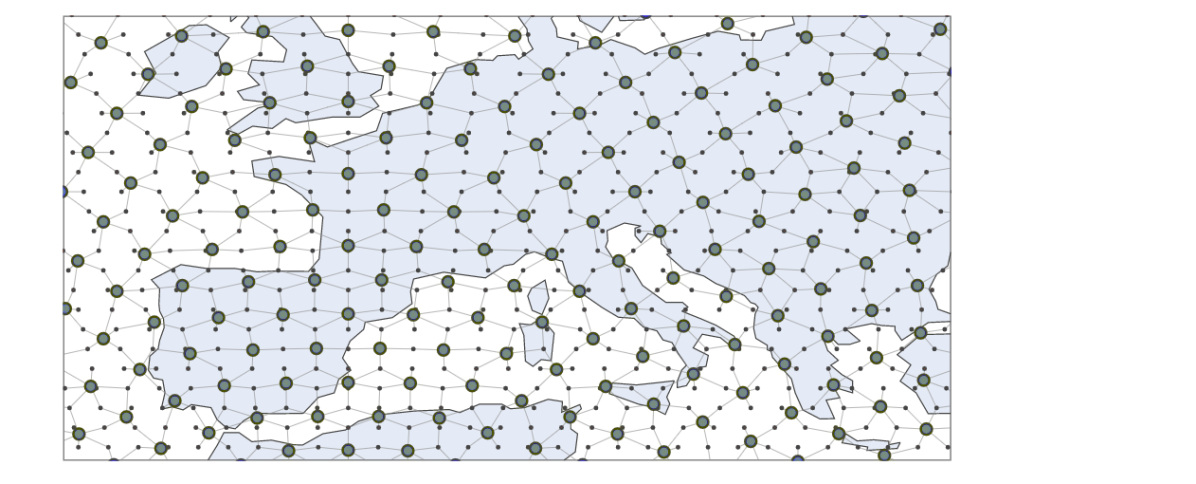
- Encoder-processor-decoder design that maps ERA5 input onto a processor grid via a cut-off radius, then projects latent states back to the ERA5 grid.
- GNN blocks with multi-head graph transformer convolution for encoder/decoder and a pre-norm transformer with shifted window attention for the processor.
- Processor grid based on an octahedral reduced Gaussian grid (N320) with around 1° resolution; eight learnable features added to each node and edges.
- Activation checkpointing and sequence/tensor parallelism to enable training on high-resolution data and mixed-precision training.
- End-to-end training with auto-regressive rollout, pre-training on ERA5, rollout training, and fine-tuning on operational IFS analyses; loss is area-weighted MSE with per-variable scaling.
Experimental results
Research questions
- RQ1How does AIFS's data-driven forecast quality compare to ECMWF’s IFS analyses and ERA5 observations across lead times up to 10 days?
- RQ2What architectural choices (GNN encoder/decoder, transformer processor, reduced Gaussian grids) enable scalable, high-resolution data-driven forecasting?
- RQ3Can data-parallel and tensor-parallel training regimes support large ensembles and probabilistic forecasting within operational-like workflows?
- RQ4What are the strengths and limitations of AIFS in upper-air versus surface fields and tropical cyclone tracking?
- RQ5What refinements (loss scaling, fine-tuning strategy, probabilistic objectives) could further improve forecast skill?
Key findings
- AIFS delivers highly skilled forecasts for upper-air and surface variables and tropical cyclone tracks, with competitive ACC improvements over IFS in several metrics.
- Forecast skill advantage over IFS is observed for longer lead-times, with substantial improvements in tropospheric forecasts up to about 100 hPa when verified against analyses and radiosondes.
- Surface forecasts (e.g., 2 m temperature, 10 m wind) show consistent improvements over IFS when verified against analyses and observations.
- AIFS tends to smooth forecast fields with lead time, a behavior linked to the area-weighted MSE loss used during training; probabilistic objectives are being explored to mitigate this.
- Compared to GraphCast, AIFS performs similarly, with differences varying over time and depending on training/fine-tuning approaches.
- Tropical cyclone track forecasts are notably better with AIFS than IFS, primarily due to reduced slow bias in TC propagation speed, though TC intensity can be underestimated relative to IFS.
Better researchstarts right now
From reading papers to final review, dramatically reduce your research time.
No credit card · Free plan available
This review was created by AI and reviewed by human editors.