
[Paper Review] Aligning sequence reads, clone sequences and assembly contigs with BWA-MEM
BWA-MEM is a new alignment algorithm that handles reads and contigs from 70 bp up to a few megabases, automatically choosing between local and end-to-end alignments and supporting chimeric and paired-end mappings with good speed and accuracy.
Summary: BWA-MEM is a new alignment algorithm for aligning sequence reads or long query sequences against a large reference genome such as human. It automatically chooses between local and end-to-end alignments, supports paired-end reads and performs chimeric alignment. The algorithm is robust to sequencing errors and applicable to a wide range of sequence lengths from 70bp to a few megabases. For mapping 100bp sequences, BWA-MEM shows better performance than several state-of-art read aligners to date. Availability and implementation: BWA-MEM is implemented as a component of BWA, which is available at http://github.com/lh3/bwa. Contact: hengli@broadinstitute.org
Motivation & Objective
- Motivate the need for a versatile aligner that handles both short and long reads, contigs, and assembly improvements.
- Develop an alignment algorithm that uses seed-and-extend with long exact matches and re-seeding to robustly map diverse read lengths.
- Enable automatic selection between local and end-to-end alignments to reduce reference bias and handle structural variations.
- Support paired-end mapping with rescue of missing hits and informed pairing to account for insert sizes and chimeric reads.
Proposed method
- Use seed-and-extend with supermaximal exact matches (SMEMs) to seed alignments.
- Introduce re-seeding: when an SMEM is too long, seed with longest exact matches covering the middle base that occur at least k+1 times.
- Greedily chain seeds into chains and filter short, contained chains to reduce wasted extension.
- Extend seeds with a banded affine-gap-penalty DP and apply an X-drop-like stopping rule to avoid poor extensions.
- Track the best extension ending at the query end to automatically decide local vs end-to-end alignment.
- For paired-end mapping, rescue missing hits with SW alignment in insert-size windows and pair ends by maximizing a combined score S_ij.
- Compute S_ij using S_i, S_j, and a probabilistic insert-size term with a log4 transformation and a cap U.
Experimental results
Research questions
- RQ1Can BWA-MEM accurately map sequencing reads across a wide length spectrum (70 bp to several Mb) and align contigs?
- RQ2Does the algorithm automatically select between local and end-to-end alignments to minimize reference bias while preserving alignment quality?
- RQ3How does BWA-MEM perform relative to state-of-the-art mappers in accuracy and speed for both single-end and paired-end reads?
- RQ4Is there an effective strategy to rescue missing hits and correctly pair reads in the presence of structural variations or misassemblies?
- RQ5Can BWA-MEM identify chimeric reads and scale to long sequences better than existing tools?
Key findings
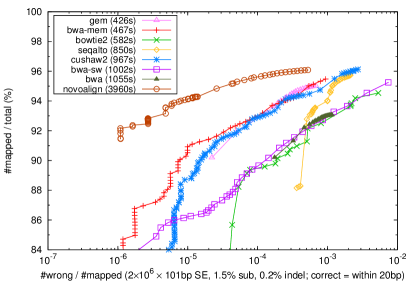
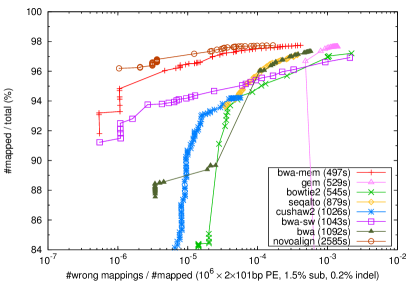
- BWA-MEM demonstrates good accuracy for both single-end and paired-end reads, approaching NovoAlign and comparable to GEM/Cushaw2 in SE and PE respectively.
- BWA-MEM runs at speeds similar to GEM and Bowtie2 on typical data and about six times faster than Bowtie2 and Cushaw2 on a 650 bp long-read dataset.
- The algorithm handles long reads and contigs, identifying chimeric reads, which is crucial for contig alignment.
- Seeding with SMEMs plus re-seeding and chain filtering improves seed extension efficiency and accuracy.
- The end-to-end vs local alignment decision is automated by tracking end-of-query extension quality, reducing reference bias while avoiding excessive gaps.
- In long-genome tests, BWA-MEM produced results comparable to nucmer but scales better to large genomes, despite nucmer being faster on a per-alignment basis.
Better researchstarts right now
From reading papers to final review, dramatically reduce your research time.
No credit card · Free plan available
This review was created by AI and reviewed by human editors.