
[Paper Review] Altermagnetic Ground State in Distorted Kagome Metal CsCr$_3$Sb$_5$
This study reveals that CsCr₃Sb₅ exhibits a $4\times2$ altermagnetic spin-density wave (SDW) ground state at ambient pressure, driven by strong magnetic frustration and electron correlation. Under pressure, magnetic order is suppressed, a Lifshitz transition occurs at ~5 GPa due to metallization of a bonding state, and the persistence of magnetic fluctuations supports unconventional, possibly spin-triplet, superconductivity above 5 GPa.
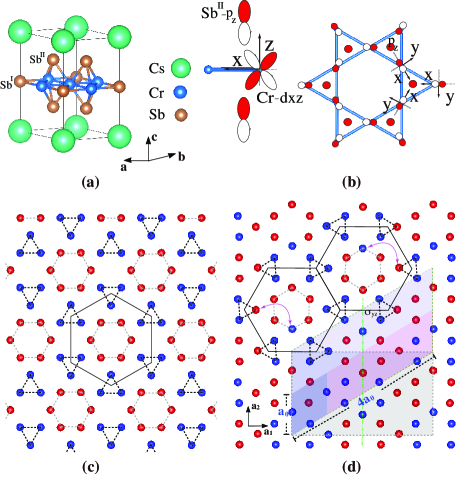
The CsCr$_3$Sb$_5$ exhibits superconductivity in close proximity to a density-wave (DW) like ground state at ambient pressure\cite{Liu:2024aa}, however details of the DW is still elusive. Using first-principles density-functional calculations, we found its ground state to be a $4 imes2$ altermagnetic spin-density-wave (SDW) at ambient pressure, with an averaged effective moment of $\sim$1.7$μ_B$/Cr. The magnetic long range order is coupled to the lattice, generating 4$a_0$ structural modulation. Multiple competing SDW phases are present and energetically close, suggesting strong magnetic fluctuation at finite temperature. The electronic states near Fermi level are dominated by Cr-3$d$ orbitals, and the kagome flat bands are closer to the Fermi level than those in the $A$V$_3$Sb$_5$ family in paramagnetic state. When external pressure is applied, the energy differences between competing orders and structural modulations are suppressed. Yet, the magnetic fluctuation remains present and important even at high pressure because the high-symmetry kagome lattice is unstable in nonmagnetic phase up to 30 GPa. Our results suggest the crucial role of magnetism to stabilize the crystal structure, under both ambient and high pressure.
Motivation & Objective
- To determine the electronic and magnetic ground state of the kagome superconductor CsCr₃Sb₅ using first-principles calculations.
- To investigate the role of electron correlation and magnetic frustration in stabilizing unconventional magnetism.
- To examine the pressure dependence of magnetic order, structural modulation, and electronic structure.
- To assess the implications of magnetic fluctuations and electronic topology for superconductivity in CsCr₃Sb₅.
- To clarify the nature of the superconducting pairing mechanism, particularly the potential for spin-triplet pairing.
Proposed method
- Employed spin-polarized density-functional theory (DFT) with the generalized gradient approximation (GGA) to compute electronic structure and magnetic ground states.
- Performed total energy calculations across multiple collinear magnetic configurations to identify the lowest-energy spin-density wave (SDW) order.
- Analyzed phonon spectra under non-magnetic (NM) and inverse antiferromagnetic (IAFM) states to assess structural stability and soft modes under pressure.
- Tracked the evolution of the Fermi surface and electronic bands under hydrostatic pressure up to 30 GPa to detect Lifshitz transitions.
- Used the Heisenberg spin model with $J_1$, $J_2$, $J_3$, and $J_3^h$ terms to analyze magnetic interactions, though found it insufficient to explain the data.
- Identified the emergence of a dispersive bonding state between Cr-3d and Sb-4p orbitals near the Fermi level at ~5 GPa, signaling a Lifshitz transition.
Experimental results
Research questions
- RQ1What is the nature of the magnetic ground state in CsCr₃Sb₅ at ambient pressure?
- RQ2How do competing spin-density wave (SDW) phases and magnetic frustration evolve under hydrostatic pressure?
- RQ3At what pressure does a Lifshitz transition occur, and what is its electronic origin?
- RQ4How does the suppression of long-range magnetic order correlate with the emergence of superconductivity?
- RQ5What is the role of magnetic fluctuations and electron correlation in enabling unconventional superconductivity?
Key findings
- The ground state of CsCr₃Sb₅ at ambient pressure is a $4\times2$ collinear altermagnetic spin-density wave (SDW) order with an effective moment of ~1.7 $\mu_B$ per Cr atom.
- Multiple competing SDW phases are energetically nearly degenerate, indicating strong magnetic frustration and fluctuation at ambient pressure.
- The energy difference between competing magnetic orders is significantly reduced under pressure, with $\Delta E$ between phases falling to within a few meV at 30 GPa.
- A Lifshitz transition occurs at ~5 GPa, where a bonding state between Cr-3d and Sb-4p orbitals acquires dispersion and crosses the Fermi level, leading to metallization.
- The non-magnetic state remains unstable up to 30 GPa, indicating persistent magnetic fluctuations even in the absence of long-range order.
- The coexistence of strong magnetic fluctuations, topological band features, and a pressure-induced Lifshitz transition supports an unconventional, possibly spin-triplet, superconducting pairing mechanism above 5 GPa.

Better researchstarts right now
From reading papers to final review, dramatically reduce your research time.
No credit card · Free plan available
This review was created by AI and reviewed by human editors.