
[Paper Review] Amalgame: Cosmological Constraints from the First Combined Photometric Supernova Sample
This paper presents Amalgame, the first cosmological analysis combining two photometric supernova samples (SDSS and Pan-STARRS) without a low-redshift spectroscopic anchor. It demonstrates consistency between the samples at under 1σ and derives ΩM = 0.328 ± 0.024 in flat ΛCDM, showing photometric samples can yield robust cosmological constraints comparable to spectroscopic ones.
Future constraints of cosmological parameters from Type Ia supernovae (SNe Ia) will depend on the use of photometric samples, those samples without spectroscopic measurements of the SNe Ia. There is a growing number of analyses that show that photometric samples can be utilised for precision cosmological studies with minimal systematic uncertainties. To investigate this claim, we perform the first analysis that combines two separate photometric samples, SDSS and Pan-STARRS, without including a low-redshift anchor. We evaluate the consistency of the cosmological parameters from these two samples and find they are consistent with each other to under $1σ$. From the combined sample, named Amalgame, we measure $Ω_M = 0.328 \pm 0.024$ with SN alone in a flat $Λ$CDM model, and $Ω_M = 0.330 \pm 0.018$ and $w = -1.016^{+0.055}_{-0.058}$ when combining with a Planck data prior and a flat $w$CDM model. These results are consistent with constraints from the Pantheon+ analysis of only spectroscopically confirmed SNe Ia, and show that there are no significant impediments to analyses of purely photometric samples of SNe Ia.
Motivation & Objective
- To evaluate the cosmological consistency between two major photometric supernova samples, SDSS and Pan-STARRS, without relying on low-redshift spectroscopic anchors.
- To test whether photometric samples alone can produce cosmological constraints with minimal systematic uncertainties.
- To establish a foundation for future large-scale photometric SN Ia samples by validating the combination of multiple photometric datasets.
- To demonstrate the effectiveness of BEAMS and photometric classifiers in mitigating non-Ia contamination in cosmological analyses.
Proposed method
- Combines the SDSS and Pan-STARRS photometric supernova samples into a single dataset named Amalgame, excluding low-redshift spectroscopic anchors.
- Applies photometric classifiers (e.g., SNN) to assign Ia likelihoods (PIa > 0.5) and reduce contamination from non-Ia supernovae.
- Uses the BEAMS method to weight distance measurements by Ia probability, enabling robust cosmological inference despite contamination.
- Employs the SALT2mu light-curve fitter with consistent β values in data and simulations to avoid bias in Hubble residual metrics.
- Applies Dust2Dust and bounded simulations to assess systematics, including color vs. Hubble residual scatter and intrinsic scatter σ_int.
- Performs χ² goodness-of-fit tests across multiple metrics (e.g., μ_res, σ_r, β_int) to validate model consistency with data.
Experimental results
Research questions
- RQ1Can two independent photometric supernova samples (SDSS and Pan-STARRS) produce consistent cosmological constraints without a low-redshift spectroscopic anchor?
- RQ2To what extent do photometric samples with non-Ia contamination affect cosmological parameter estimation when using BEAMS and photometric classifiers?
- RQ3How do the cosmological constraints from a combined photometric sample compare to those from spectroscopically confirmed samples like Pantheon+?
- RQ4What systematic effects arise from inconsistent β values in data and simulations, and how can they be corrected?
- RQ5Can bounded simulations that exclude core-collapse SNe still accurately represent the observed data when combined with BEAMS?
Key findings
- The cosmological constraints from the SDSS and Pan-STARRS photometric samples are consistent with each other at less than 1σ significance.
- The Amalgame sample yields ΩM = 0.328 ± 0.024 in a flat ΛCDM model using only Type Ia supernovae.
- When combined with Planck priors in a flat wCDM model, the Amalgame sample yields ΩM = 0.330 ± 0.018 and w = -1.016⁺⁰.⁰⁵⁵₋₀.⁰⁵⁸.
- The results are consistent with those from the Pantheon+ analysis of spectroscopically confirmed SNe Ia, indicating no significant degradation from photometric-only samples.
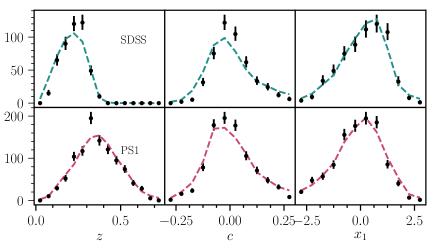
- The χ² goodness-of-fit metrics (e.g., μ_res, σ_r) show good agreement between data and simulations, with χ² values of 27.3 (high mass) and 13.1 (low mass) for Hubble residual scatter.
- A correction was applied to σ_int calculations to ensure consistent β values in μ and μ_ERR, resolving an overestimation in intrinsic scatter.
Better researchstarts right now
From reading papers to final review, dramatically reduce your research time.
No credit card · Free plan available
This review was created by AI and reviewed by human editors.