
[Paper Review] An Atlas of Color-selected Quiescent Galaxies at $z>3$ in Public $JWST$ Fields
This study presents a systematic search for quiescent galaxies at $z>3$ using public JWST and Hubble Space Telescope data across 11 fields, identifying ~80 candidate quiescent and quenching galaxies via UVJ colors and a novel Gaussian Mixture Modeling approach in rest-frame color space. It reveals significant field-to-field variations in number densities (up to a factor of 2–3), indicating cosmic variance and potential overdensities, while demonstrating JWST's enhanced sensitivity to low-mass, high-redshift quiescent systems.
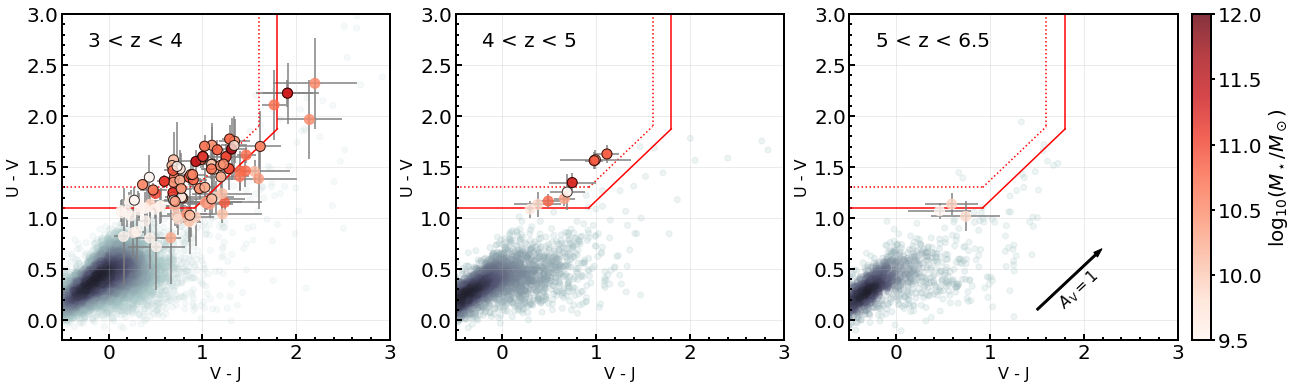
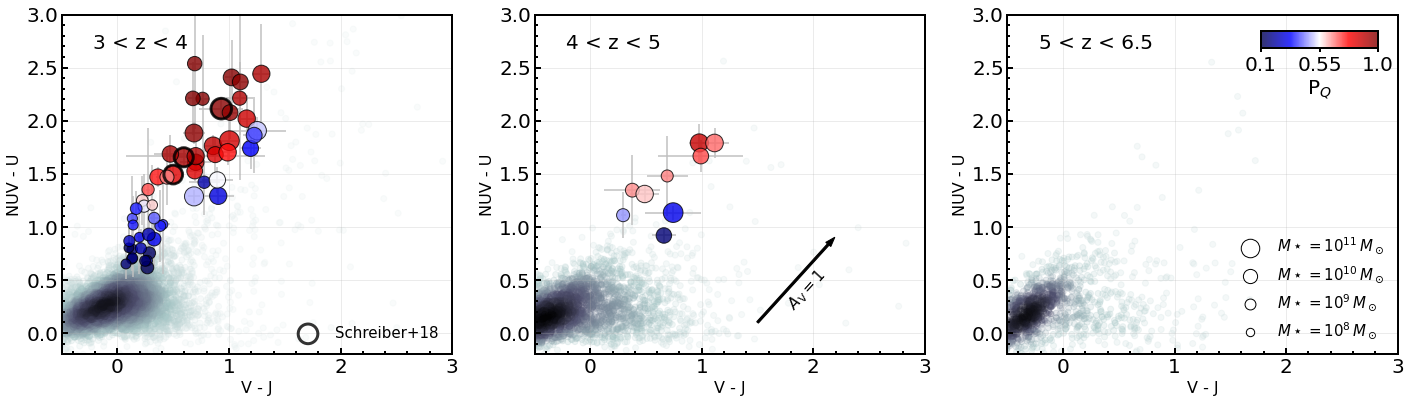
We present the results of a systematic search for candidate quiescent galaxies in the distant Universe in eleven $JWST$ fields with publicly available observations collected during the first three months of operations and covering an effective sky area of $\sim145$ arcmin$^2$. We homogeneously reduce the new $JWST$ data and combine them with existing observations from the $Hubble\,Space\,Telescope$. We select a robust sample of $\sim80$ candidate quiescent and quenching galaxies at $3 < z < 5$ using two methods: (1) based on their rest-frame $UVJ$ colors, and (2) a novel quantitative approach based on Gaussian Mixture Modeling of the $NUV-U$, $U-V$, and $V-J$ rest-frame color space, which is more sensitive to recently quenched objects. We measure comoving number densities of massive ($M_\star\geq 10^{10.6} M_\odot$) quiescent galaxies consistent with previous estimates relying on ground-based observations, after homogenizing the results in the literature with our mass and redshift intervals. However, we find significant field-to-field variations of the number densities up to a factor of $2-3$, highlighting the effect of cosmic variance and suggesting the presence of overdensities of red quiescent galaxies at $z>3$, as it could be expected for highly clustered massive systems. Importantly, $JWST$ enables the robust identification of quenching/quiescent galaxy candidates at lower masses and higher redshifts than before, challenging standard formation scenarios. All data products, including the literature compilation, are made publicly available.
Motivation & Objective
- To identify and characterize quiescent and quenching galaxies at $z>3$ using deep, publicly available JWST and HST data.
- To assess the comoving number density of massive quiescent galaxies ($M_* \geq 10^{10.6} M_\odot$) at $3<z<5$ and compare with prior ground-based estimates.
- To investigate field-to-field variations in quiescent galaxy number densities to quantify cosmic variance and probe large-scale structure.
- To demonstrate the sensitivity of JWST to low-mass, high-redshift quiescent galaxies, challenging current galaxy formation models.
- To provide a publicly available atlas of color-selected quiescent galaxy candidates and associated data products for the community.
Proposed method
- Homogeneous reduction of JWST and HST data across 11 public fields, covering ~145 arcmin² of sky.
- Selection of quiescent galaxy candidates using two methods: (1) rest-frame UVJ color criteria, and (2) Gaussian Mixture Modeling (GMM) in the $NUV-U$, $U-V$, $V-J$ color space for improved sensitivity to recently quenched systems.
- Stellar mass function (SMF) derivation via SED fitting and integration of best-fit parameters, with mass corrections applied using the Chabrier IMF.
- Computation of comoving number densities in $3<z<4$ with Poissonian uncertainties and cosmic variance quantified via $\sigma_{\rm CV}$.
- Use of $P_{\rm Q,50\%} \geq 0.1$ as a threshold in the GMM-based selection to define quiescent probability.
- Cross-comparison with literature and simulations (e.g., Illustris, TNG, EAGLE) to contextualize results within theoretical frameworks.
Experimental results
Research questions
- RQ1What is the comoving number density of massive quiescent galaxies ($M_* \geq 10^{10.6} M_\odot$) at $3<z<5$ as measured by JWST?
- RQ2How do field-to-field variations in quiescent galaxy number densities at $z>3$ reflect cosmic variance and potential overdensities?
- RQ3To what extent does JWST improve the detection of low-mass, high-redshift quiescent galaxies compared to ground-based surveys?
- RQ4How effective is the novel Gaussian Mixture Modeling (GMM) approach in identifying recently quenched galaxies compared to traditional UVJ selection?
- RQ5How do the observed number densities compare with predictions from cosmological simulations (e.g., Illustris, TNG, EAGLE) at $z \sim 3$–$4$?
Key findings
- The study identifies a robust sample of ~80 candidate quiescent and quenching galaxies at $3<z<5$ using UVJ and GMM-based color selection.
- Comoving number densities of massive quiescent galaxies ($M_* \geq 10^{10.6} M_\odot$) are consistent with previous ground-based estimates after homogenization of mass and redshift intervals.
- Significant field-to-field variations in number densities are observed, with fluctuations up to a factor of 2–3, indicating strong cosmic variance and potential overdensities of massive quiescent systems.
- The GMM-based method detects quiescent galaxies with higher sensitivity to recently quenched systems, particularly at lower masses and higher redshifts than previously possible.
- JWST enables the detection of quiescent galaxy candidates at $z>3$ with stellar masses below $10^{10.6} M_\odot$, challenging standard galaxy quenching scenarios.
- The combined number density across all fields is $2.8 \times 10^{-5}$ Mpc⁻³ (GMM) and $2.3 \times 10^{-5}$ Mpc⁻³ (UVJ), with uncertainties of $\sim 10\%$ and $\sim 18\%$ respectively, and cosmic variance $\sigma_{\rm CV} \approx 0.1$–$0.67$.
Better researchstarts right now
From reading papers to final review, dramatically reduce your research time.
No credit card · Free plan available
This review was created by AI and reviewed by human editors.