
[Paper Review] Analysis of full disc Ca II K spectroheliograms III. Plage area composite series covering 1892-2019
This study presents the most comprehensive composite time series of solar plage areas from 1892 to 2019, derived from over 290,000 full-disk Ca II K spectroheliograms across 43 datasets. Using consistent photometric calibration, limb-darkening correction, and artifact mitigation—including site-specific issues like bright arcs—the authors produce a calibrated, cross-validated composite with 88% daily coverage since 1892 and 98% since 1907, enabling robust long-term analysis of solar chromospheric magnetic activity.
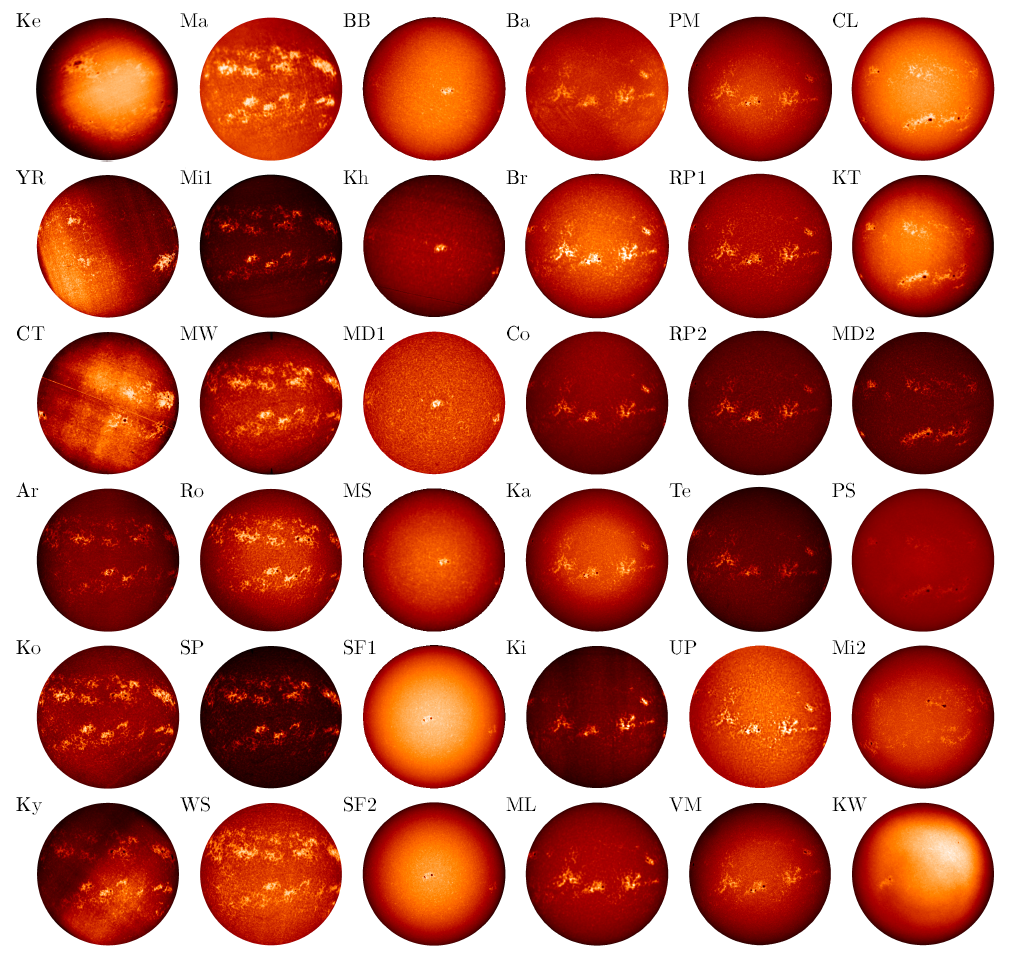
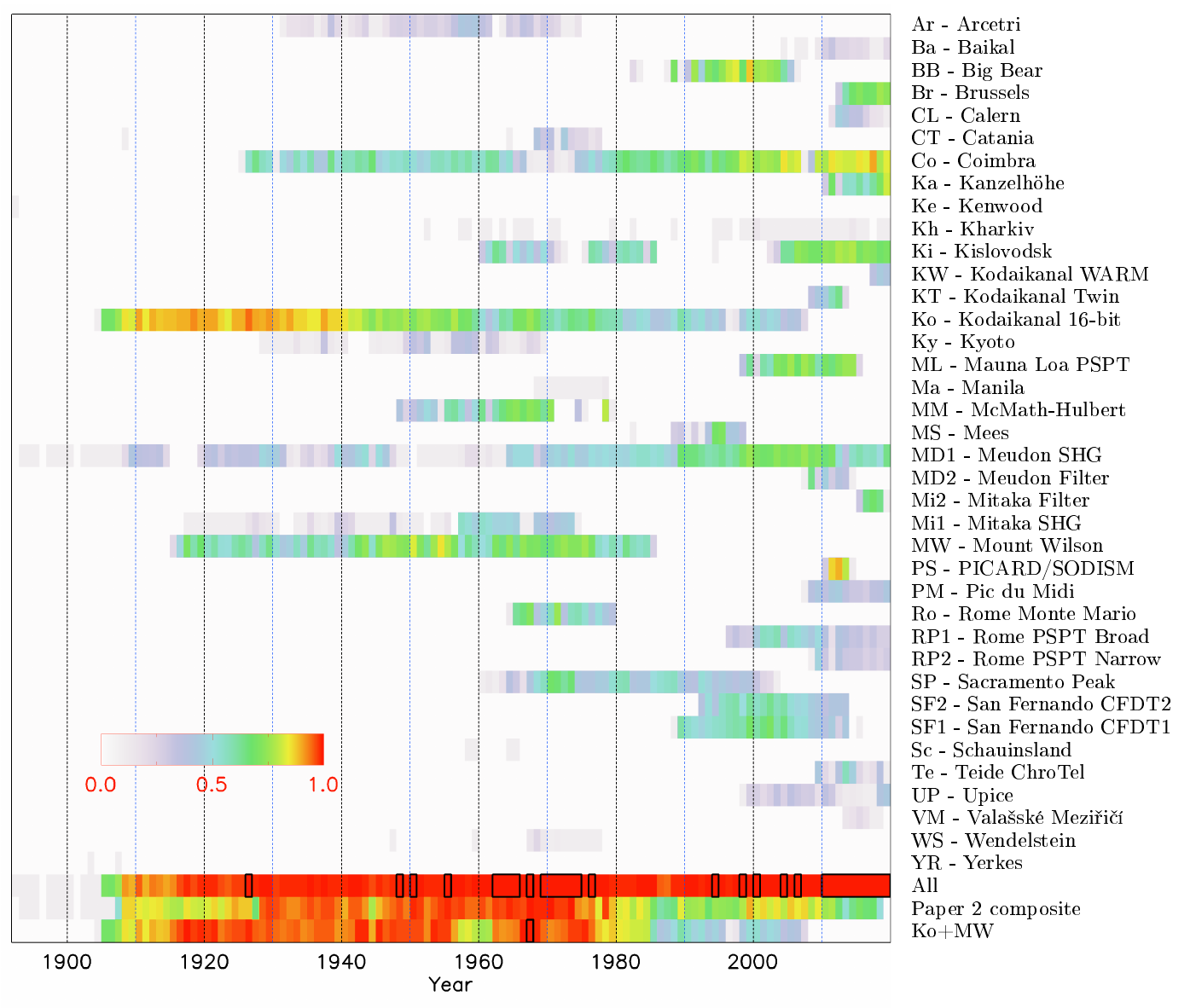
We derive the plage area evolution over the last 12 solar cycles employing data from all Ca II K archives available publicly in digital form known to us, including several as yet unexplored Ca II K archives. We analyse more than 290,000 full-disc Ca II K observations from 43 datasets spanning the period 1892-2019. All images were consistently processed with an automatic procedure that performs the photometric calibration (if needed) and the limb-darkening compensation. The processing also accounts for artefacts plaguing many of the images, including some very specific artefacts such as bright arcs found in Kyoto and Yerkes data. We have produced a plage area time-series from each analysed dataset. We found that the differences between the plage areas derived from individual archives are mainly due to the differences in the central wavelength and the bandpass used to acquire the data at the various sites. We have empirically cross-calibrated and combined the results obtained from each dataset to produce a composite series of plage areas. "Backbone" series are used to bridge all the series together. We have also shown that the selection of the backbone series has little effect on the final plage area composite. We have quantified the uncertainty of determining the plage areas with our processing due to shifts in the central wavelength and found it to be less than 0.01 in fraction of the solar disc for the average conditions found on historical data. We also found the variable seeing conditions during the observations to slightly increase the plage areas during activity maxima. We provide the so far most complete time series of plage areas based on corrected and calibrated historical and modern Ca II K images. Consistent plage areas are now available on 88% of all days from 1892 onwards and on 98% from 1907 onwards.
Motivation & Objective
- To reconstruct a long-term, consistent time series of plage areas using historical and modern full-disk Ca II K spectroheliograms.
- To address inconsistencies in plage area measurements arising from differences in central wavelength, bandpass, and instrumental artifacts across observatories.
- To produce a unified, calibrated composite dataset with high temporal coverage for studying solar chromospheric magnetic activity over 12 solar cycles.
- To quantify uncertainties in plage area measurements due to wavelength shifts and variable seeing conditions.
- To enable future updates and integration of newly digitized historical archives into the composite series.
Proposed method
- Processing over 290,000 full-disk Ca II K images from 43 datasets using a consistent automated pipeline for photometric calibration and limb-darkening compensation.
- Applying artifact correction techniques tailored to specific issues, such as bright arcs in Kyoto and Yerkes data, based on known instrumental characteristics.
- Using 'backbone' series to cross-calibrate and merge data from different observatories, ensuring consistency across the composite.
- Empirically assessing uncertainty from central wavelength shifts, finding it to be less than 0.01 in fractional disc area under average historical conditions.
- Accounting for variable seeing conditions, which slightly inflate plage areas during solar activity maxima.
- Employing a modular approach to handle discontinuities and site-specific variations by segmenting and recalibrating data series independently.
Experimental results
Research questions
- RQ1How can disparate Ca II K spectroheliogram archives be consistently calibrated and combined into a single, coherent composite plage area time series?
- RQ2What are the dominant sources of systematic error in historical plage area measurements, and how can they be quantified and minimized?
- RQ3To what extent do differences in central wavelength and bandpass across observatories affect the derived plage areas?
- RQ4How does variable atmospheric seeing during observations influence the measured plage area, particularly during solar maximum?
- RQ5What is the achievable temporal coverage and reliability of a composite plage area series spanning over 125 years?
Key findings
- The authors produced a composite plage area time series with 88% daily coverage from 1892 and 98% from 1907 onward, significantly improving upon previous efforts.
- The selection of backbone series for cross-calibration has minimal impact on the final composite, indicating robustness of the method.
- Uncertainty in plage area determination due to central wavelength shifts is less than 0.01 in fractional disc area under typical historical conditions.
- Variable seeing conditions during observations lead to a slight overestimation of plage areas, especially during solar activity maxima.
- The method successfully mitigates site-specific artifacts such as bright arcs in Kyoto and Yerkes data, improving data consistency.
- The composite dataset is designed for future updates and integration of newly digitized archives, ensuring long-term utility for solar variability research.
Better researchstarts right now
From reading papers to final review, dramatically reduce your research time.
No credit card · Free plan available
This review was created by AI and reviewed by human editors.