
[Paper Review] AntiFold: Improved antibody structure-based design using inverse folding
AntiFold is an antibody-specific inverse folding model, fine-tuned from ESM-IF1, that improves CDR sequence recovery and zero-shot antibody-antigen affinity prediction while preserving backbone structure.
The design and optimization of antibodies requires an intricate balance across multiple properties. Protein inverse folding models, capable of generating diverse sequences folding into the same structure, are promising tools for maintaining structural integrity during antibody design. Here, we present AntiFold, an antibody-specific inverse folding model, fine-tuned from ESM-IF1 on solved and predicted antibody structures. AntiFold outperforms existing inverse folding tools on sequence recovery across complementarity-determining regions, with designed sequences showing high structural similarity to their solved counterpart. It additionally achieves stronger correlations when predicting antibody-antigen binding affinity in a zero-shot manner, while performance is augmented further when including antigen information. AntiFold assigns low probabilities to mutations that disrupt antigen binding, synergizing with protein language model residue probabilities, and demonstrates promise for guiding antibody optimization while retaining structure-related properties. AntiFold is freely available under the BSD 3-Clause as a web server at https://opig.stats.ox.ac.uk/webapps/antifold/ and and pip installable package at https://github.com/oxpig/AntiFold
Motivation & Objective
- Motivate improved design of antibodies by preserving backbone structure during sequence design.
- Develop an antibody-specific inverse folding model fine-tuned from a large pre-trained structure-based model.
- Evaluate performance on CDR regions for sequence recovery and backbone preservation.
- Assess zero-shot and antigen-informed binding affinity predictions.
- Provide accessible implementation for researchers to guide antibody optimization.
Proposed method
- Fine-tune ESM-IF1 on solved and predicted antibody structures to create AntiFold.
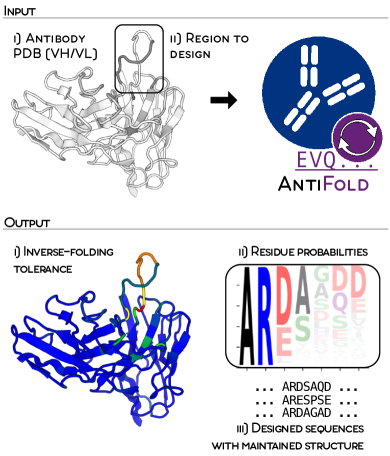
- Use structure-conditioned inverse folding to output per-position mutation tolerance and amino-acid probabilities.
- Sample designed sequences for specified regions with a controllable temperature parameter for diversity.
- Evaluate amino acid recovery (AAR) and backbone RMSD of designed CDRs after refolding with ABodyBuilder2.
- Assess antibody-antigen binding affinity prediction via inverse folding log-likelihoods, with and without antigen context.
- Provide web server and pip-installable package for broad accessibility.
Experimental results
Research questions
- RQ1Can antibody-specific inverse folding improve CDR sequence recovery while maintaining backbone structure?
- RQ2Do AntiFold-designed sequences fold similarly to the original structures when re-folded?
- RQ3Do inverse folding scores correlate with antibody-antigen binding affinity, and does including antigen information improve this correlation?
- RQ4How does AntiFold perform relative to existing inverse folding tools on antibody design tasks?
- RQ5Can AntiFold assist affinity maturation strategies by prioritizing high-fitness, structurally-constrained variants?
Key findings
- AntiFold improves CDRH3 amino acid recovery and overall AAR compared with AbMPNN and baseline models.
- Designed sequences retain backbone structure with mean CDR RMSD around 0.95 Å, indicating preserved geometry.
- Inverse folding scores correlate with binding affinity, with AntiFold achieving higher Spearman correlations than competitors in zero-shot tests (0.418 vs 0.334–0.322).
- Including antigen information improves performance for CDRs near the binding site, particularly CDR2 and CDR3.
- AntiFold better separates improved versus non-improved variants in affinity maturation experiments (median rank 80% vs 57–73% for others).
- AntiFold scores are robust to input structure type (solved, predicted, AlphaFold) and show strong performance even when applied to predicted structures.
![Figure S1: Overview of the AntiFold training strategy. (A) AntiFold was trained and evaluated on solved antibody structures from SAbDab [Dunbar et al., 2014 , Schneider et al., 2021 ] and structures of antibody sequences from OAS [Kovaltsuk et al., 2018 , Olsen et al., 2022b ] modeled with ABodyBuil](https://ar5iv.labs.arxiv.org/html/2405.03370/assets/x2.png)
Better researchstarts right now
From reading papers to final review, dramatically reduce your research time.
No credit card · Free plan available
This review was created by AI and reviewed by human editors.