
[Paper Review] Approximating Nash Social Welfare by Matching and Local Search
This paper presents a deterministic, polynomial-time algorithm that achieves a $(4 + \varepsilon)$-approximation for the symmetric Nash social welfare (NSW) problem under submodular valuations, significantly improving upon the prior best randomized $380$-approximation. It also provides an $(\omega + 2 + \varepsilon)e$-approximation for the asymmetric NSW problem when the maximum weight ratio $\omega$ is bounded, and demonstrates that a $\nicefrac{1}{2}$-EFX allocation can be computed simultaneously with an $8 + \varepsilon$-approximation to NSW, resolving a key open problem in fair division.
For any $\eps>0$, we give a simple, deterministic $(4+\eps)$-approximation algorithm for the Nash social welfare (NSW) problem under submodular valuations. We also consider the asymmetric variant of the problem, where the objective is to maximize the weighted geometric mean of agents' valuations, and give an $\ee (ω+ 2 + \eps)$-approximation if the ratio between the largest weight and the average weight is at most $ω$. We also show that the $ frac12$-EFX envy-freeness property can be attained simultaneously with a constant-factor approximation. More precisely, we can find an allocation in polynomial time that is both $ frac12$-EFX and a $(8+\eps)$-approximation to the symmetric NSW problem under submodular valuations.
Motivation & Objective
- To design a deterministic polynomial-time algorithm that achieves a constant-factor approximation for the symmetric Nash social welfare (NSW) problem under submodular valuations, improving upon the prior randomized $380$-approximation.
- To extend the approximation guarantee to the asymmetric NSW problem, where agents have unequal weights, and provide a bound dependent on the ratio $\omega$ between the largest and average weight.
- To simultaneously achieve fairness in the form of $\nicefrac{1}{2}$-EFX (envy-freeness up to half an item) and a constant-factor approximation to NSW, overcoming the prior linear-in-$n$ efficiency loss under such fairness constraints.
- To develop a novel algorithmic framework combining matching and local search techniques that enables tight approximation guarantees under submodular valuations.
Proposed method
- The algorithm uses a local search procedure that iteratively improves allocations by swapping or reassigning items between agents based on marginal gains in NSW, guided by a carefully designed potential function.
- It incorporates a matching-based initialization step to construct a high-quality starting solution, leveraging the structure of submodular functions to ensure bounded approximation ratios.
- A key component is the use of a price vector $p_j$ for items and a perturbation parameter $\bar{\varepsilon}$ to control the trade-off between fairness and efficiency in the local search process.
- The analysis relies on bounding the ratio of valuations between current and optimal allocations using inequalities derived from submodularity and the exponential utility function of NSW.
- The algorithm ensures $\nicefrac{1}{2}$-EFX fairness by enforcing that no agent envies another’s bundle after removing any single item, using a modified local search that respects this constraint.
- The final approximation factor is derived via a product bound over agents, using the AM-GM inequality and maximizing over a parameter $\omega$ to control the worst-case loss.
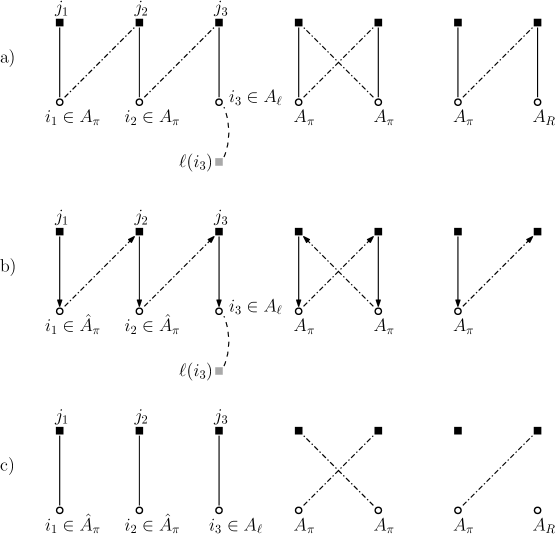
Experimental results
Research questions
- RQ1Can a deterministic constant-factor approximation be achieved for the symmetric NSW problem under submodular valuations, improving upon the prior randomized $380$-approximation?
- RQ2What is the best approximation ratio achievable for the asymmetric NSW problem when the weights of agents differ, and how does it depend on the maximum weight ratio $\omega$?
- RQ3Is it possible to simultaneously achieve a constant-factor approximation to NSW and a non-trivial fairness guarantee such as $\nicefrac{1}{2}$-EFX?
- RQ4Can the approximation factor be improved when combining fairness and efficiency constraints in submodular valuation settings?
Key findings
- The paper presents a deterministic $(4 + \varepsilon)$-approximation algorithm for the symmetric NSW problem under submodular valuations, a significant improvement over the prior best randomized $380$-approximation.
- For the asymmetric NSW problem, the algorithm achieves an $(\omega + 2 + \varepsilon)e$-approximation when the ratio between the largest and average weight is at most $\omega$, where $\omega$ is a known parameter.
- The algorithm computes an allocation that is both $\nicefrac{1}{2}$-EFX and a $(8 + \varepsilon)$-approximation to the symmetric NSW problem, resolving a key open problem in fair division.
- The approximation factor is achieved via a novel combination of matching for initialization and local search with price-based potential functions, ensuring polynomial-time convergence.
- The analysis establishes tight bounds on valuation ratios using submodularity and exponential utility properties, with the final approximation factor derived via optimization over a parameter $\omega$.
- The results demonstrate that fairness and efficiency can be simultaneously achieved with constant-factor guarantees, even under submodular valuations, which are more general than additive or XOS.
Better researchstarts right now
From reading papers to final review, dramatically reduce your research time.
No credit card · Free plan available
This review was created by AI and reviewed by human editors.