
[Paper Review] Article: AI-MAPE Versus SA-SGM - Complete Data Bank
This study compares AI-MAPE, a deep-learning-based simulation-based inference (SBI) method using sequential neural posterior estimation (SNPE), with SA-SGM, a classical simulated annealing approach, for parameter inference in spatial-stochastic models of developmental biology. At equivalent computational cost, AI-MAPE produces significantly richer, more regular posterior distributions, revealing greater detail on parameter interactions and synergies, while both methods show strong agreement on key parameter predictions for the inner cell mass lineage differentiation model.
Mechanistic models provide an in-depth understanding of important biophysical systems. In fields such as developmental biology, these models are inherently complex, as they require genuinely spatial-stochastic descriptions of the underlying systems. This complexity poses significant challenges for inferring model parameters. Recently, modern deep-learning techniques have been integrated with simulation-based inference, creating an exciting new approach for estimating parameters of such models. Their overall goal is to computationally replicate target empirical observations and to develop powerful prediction tools for uncovering hidden system dynamics. However, these modern approaches remain broadly general and are often difficult to implement for specific spatial-stochastic problems, particularly within developmental biology. This difficulty raises the question of how much more valuable these modern approaches are compared to classical techniques. In this study, we compare one modern approach, AI-MAPE, inspired by the sequential neural posterior estimation (SNPE) algorithm, against one classical approach, SA-SGM, inspired by the simulated annealing (SA) algorithm. Our findings show that, while the inferred parameter sets generally agree between the two approaches, the AI-powered method, at comparable computational effort, provides significantly richer and more regular inferred distributions. This results in more detailed information about parameter interactions and synergies than the SA-inspired method.
Motivation & Objective
- To evaluate and compare modern deep-learning-based simulation-based inference (SBI) workflows with classical optimization techniques in spatial-stochastic developmental biology models.
- To assess the computational efficiency and inferential richness of AI-MAPE (SNPE-based) versus SA-SGM (simulated annealing-based) workflows in parameter inference for complex biophysical systems.
- To investigate whether modern SBI methods provide substantial advantages over classical approaches in terms of posterior distribution quality and parameter interaction insights.
- To identify computational scenarios where AI-MAPE outperforms SA-SGM and propose a synergistic integration framework.
- To demonstrate the applicability of advanced SBI methods in systems with limited quantitative data, such as morphogenesis and blastocyst development.
Proposed method
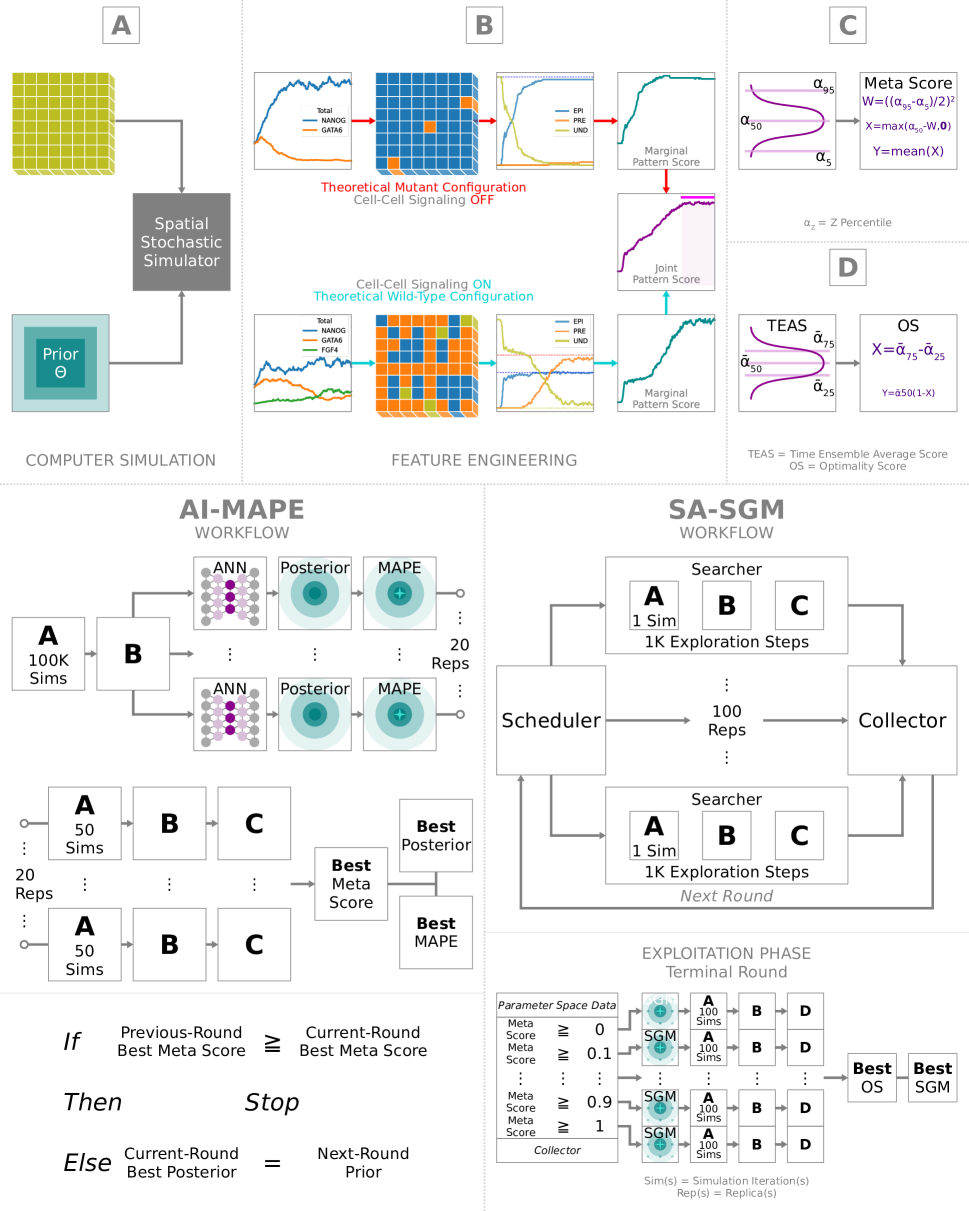
- AI-MAPE employs sequential neural posterior estimation (SNPE), a deep-learning SBI technique that learns a posterior distribution over model parameters through iterative simulation and neural network training.
- SA-SGM uses simulated annealing, a classical optimization method, to search for parameter sets that minimize the discrepancy between simulated and target empirical observations.
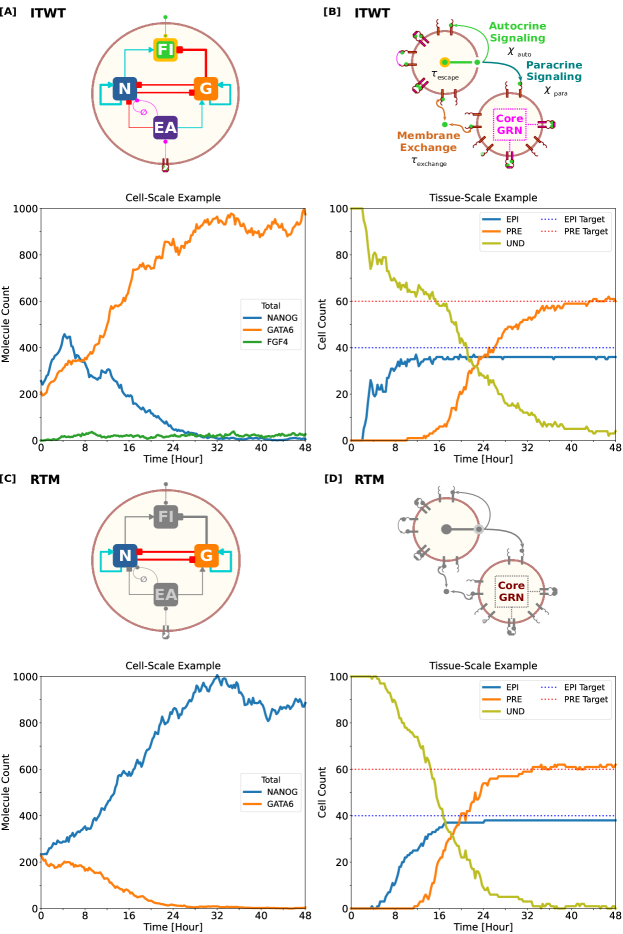
- Both workflows are applied to two spatial-stochastic models of inner cell mass (ICM) lineage differentiation in the mouse blastocyst, incorporating cell-scale dynamics and tissue-scale spatial coupling.
- Parameter inference is evaluated using normalized prior ranges and posterior marginals, with distances between distributions quantified via the Jensen-Shannon divergence (base 2).
- Sensitivity analysis is performed by conditioning the AI_L2 posterior on its own MAPE to assess parameter robustness and tolerance to fluctuations.
- Visualization of marginalized posterior distributions includes one- and two-dimensional marginals, with convex hull approximations and Gaussian kernel density estimates for coarse and smooth projections, respectively.
Experimental results
Research questions
- RQ1Does the modern AI-MAPE SBI workflow produce significantly richer and more informative posterior distributions than the classical SA-SGM optimization method at equivalent computational cost?
- RQ2How do the inferred parameter sets from AI-MAPE and SA-SGM compare in terms of agreement on key regulatory interactions in the core GRN motif of the ICM lineage model?
- RQ3What are the sensitivity profiles of model parameters to value fluctuations, and which parameters exhibit strong, moderate, or weak sensitivity to perturbations?
- RQ4In what computational scenarios does AI-MAPE outperform SA-SGM in terms of posterior regularity and information content?
- RQ5Can the complementary strengths of AI-MAPE and SA-SGM be synergistically integrated to enhance overall parameter space exploration?
Key findings
- At an equivalent number of simulation-inference rounds (R8), AI-MAPE produces significantly richer and more regular posterior distributions than SA-SGM, with greater detail on parameter interactions and synergies.
- The AI-MAPE and SA-SGM workflows show strong agreement on primary core GRN interaction parameters (e.g., Gata6_A-ERK, Nanog_A-ERK), but only moderate agreement on secondary interactions, suggesting potential compensation mechanisms.
- Sensitivity analysis reveals strong sensitivities (50–100%) for key regulatory parameters such as Gata6_GATA6, Gata6_NANOG, and Fgf4_GATA6, indicating low tolerance to value fluctuations when others are fixed.
- Weak sensitivities (0–25%) are observed for parameters like τ_phо_ERK, τ_doh_NANOG, and χ_auto, indicating high robustness to perturbations.
- The Jensen-Shannon divergence metric shows that two-dimensional posterior marginals derived from AI-MAPE exhibit lower divergence from one-dimensional marginals compared to SA-SGM, indicating more consistent and reliable inference.
- The study identifies specific computational regimes where AI-MAPE’s non-amortized, iterative learning approach yields superior posterior characterization, especially in high-dimensional, likelihood-free inference settings.
Better researchstarts right now
From reading papers to final review, dramatically reduce your research time.
No credit card · Free plan available
This review was created by AI and reviewed by human editors.