
[Paper Review] Autoencoder-based Anomaly Detection System for Online Data Quality Monitoring of the CMS Electromagnetic Calorimeter
This paper presents a semi-supervised autoencoder-based anomaly detection system for real-time online data quality monitoring in the CMS electromagnetic calorimeter (ECAL), leveraging 2D detector response images with spatial and time-dependent corrections to improve anomaly detection performance. The system achieves a 10× improvement in detection accuracy and successfully identifies degrading channels missed by conventional DQM, reducing false alarms in LHC Run 3 operations.
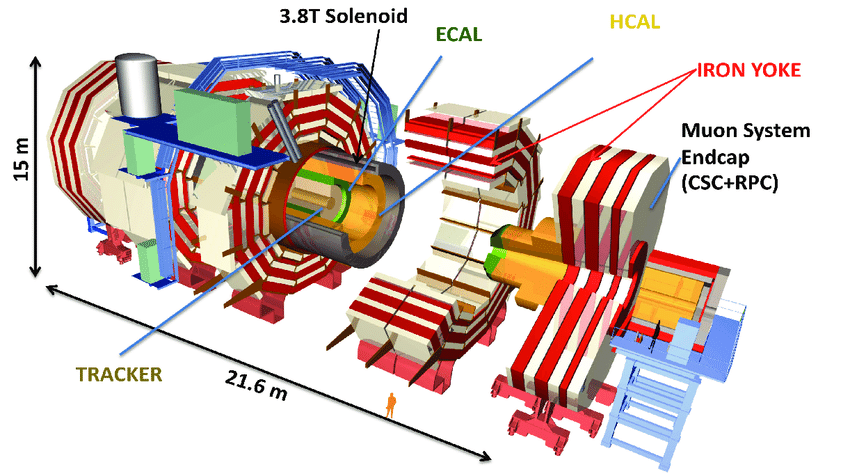
The CMS detector is a general-purpose apparatus that detects high-energy collisions produced at the LHC. Online Data Quality Monitoring of the CMS electromagnetic calorimeter is a vital operational tool that allows detector experts to quickly identify, localize, and diagnose a broad range of detector issues that could affect the quality of physics data. A real-time autoencoder-based anomaly detection system using semi-supervised machine learning is presented enabling the detection of anomalies in the CMS electromagnetic calorimeter data. A novel method is introduced which maximizes the anomaly detection performance by exploiting the time-dependent evolution of anomalies as well as spatial variations in the detector response. The autoencoder-based system is able to efficiently detect anomalies, while maintaining a very low false discovery rate. The performance of the system is validated with anomalies found in 2018 and 2022 LHC collision data. Additionally, the first results from deploying the autoencoder-based system in the CMS online Data Quality Monitoring workflow during the beginning of Run 3 of the LHC are presented, showing its ability to detect issues missed by the existing system.
Motivation & Objective
- To develop an automated, real-time anomaly detection system for the CMS ECAL to enhance data quality monitoring during high-energy proton-proton collisions.
- To address limitations of traditional cut-based DQM systems in detecting subtle, evolving, or transient anomalies due to aging electronics and increasing collision rates.
- To improve anomaly detection performance by modeling spatial variations in detector response and time-dependent anomaly evolution.
- To deploy the system operationally in the CMS online DQM workflow during LHC Run 3 for real-time diagnostics.
- To reduce false discovery rates while maintaining high sensitivity to anomalies across diverse detector conditions.
Proposed method
- The system processes ECAL occupancy histograms as 2D images and feeds them into a deep autoencoder trained in a semi-supervised manner on normal data.
- Spatial response corrections are applied to account for intrinsic non-uniformities in detector response across the ECAL geometry.
- Time-dependent corrections are introduced to model the evolution of anomalies over time, such as degrading or transient channels.
- Anomaly scores are computed as the reconstruction error of the autoencoder, with thresholds set using validation data with injected fake anomalies.
- The system uses a single threshold per ECAL region (barrel/endcap) to flag anomalies at the tower level, enabling localization.
- Post-processing includes frequency-based masking of persistently flagged towers to proactively identify degrading channels.
Experimental results
Research questions
- RQ1Can a semi-supervised autoencoder effectively detect anomalies in real-time ECAL data with low false positive rates?
- RQ2How does incorporating spatial and temporal corrections improve anomaly detection performance compared to baseline methods?
- RQ3Can the system detect anomalies that are missed by existing cut-based DQM systems, particularly transient or slowly degrading channels?
- RQ4To what extent does the system maintain robustness across varying pile-up conditions and detector aging effects?
- RQ5How effective is the system in localizing anomalies at the individual tower level during real LHC operations?
Key findings
- The autoencoder-based system achieved a 10× improvement in anomaly detection performance over baseline methods by integrating spatial and time corrections.
- The system successfully detected degrading ECAL towers with persistent zero occupancy, including cases missed by the existing DQM system during Run 3.
- In validation with real anomalies from 2018 and 2022, the system detected anomalies of various shapes, sizes, and locations with high sensitivity at the tower level.
- The anomaly tagging threshold was set at a 99% estimated tagging rate, ensuring high recall while minimizing false positives.
- The deployment in Run 3 demonstrated the system's ability to identify transient anomalies, such as Tower 2’s intermittent failure, which were not consistently flagged by conventional DQM.
- The system complements existing DQM workflows, enabling faster and more accurate diagnosis of detector issues by ECAL experts.
Better researchstarts right now
From reading papers to final review, dramatically reduce your research time.
No credit card · Free plan available
This review was created by AI and reviewed by human editors.