
[Paper Review] Bayesian Optimal Experimental Design for Constitutive Model Calibration
This paper proposes an Interlaced Characterization and Calibration (ICC) framework that uses Bayesian Optimal Experimental Design (BOED) to dynamically select the most informative load paths for calibrating constitutive material models. By adaptively choosing strain increments based on expected information gain (EIG), the method reduces parameter uncertainty more effectively than static, human-intuition-based load paths, demonstrating a 100% reduction in posterior uncertainty in one exemplar problem and improved reliability in capturing true parameter values.
Computational simulation is increasingly relied upon for high-consequence engineering decisions, and a foundational element to solid mechanics simulations, such as finite element analysis (FEA), is a credible constitutive or material model. Calibration of these complex models is an essential step; however, the selection, calibration and validation of material models is often a discrete, multi-stage process that is decoupled from material characterization activities, which means the data collected does not always align with the data that is needed. To address this issue, an integrated workflow for delivering an enhanced characterization and calibration procedure (Interlaced Characterization and Calibration (ICC)) is introduced. This framework leverages Bayesian optimal experimental design (BOED) to select the optimal load path for a cruciform specimen in order to collect the most informative data for model calibration. The critical first piece of algorithm development is to demonstrate the active experimental design for a fast model with simulated data. For this demonstration, a material point simulator that models a plane stress elastoplastic material subject to bi-axial loading was chosen. The ICC framework is demonstrated on two exemplar problems in which BOED is used to determine which load step to take, e.g., in which direction to increment the strain, at each iteration of the characterization and calibration cycle. Calibration results from data obtained by adaptively selecting the load path within the ICC algorithm are compared to results from data generated under two naive static load paths that were chosen a priori based on human intuition. In these exemplar problems, data generated in an adaptive setting resulted in calibrated model parameters with reduced measures of uncertainty compared to the static settings.
Motivation & Objective
- To address the decoupling of material characterization and model calibration, which often leads to suboptimal data collection for complex constitutive models.
- To integrate Bayesian inference with optimal experimental design to enhance data informativeness and reduce uncertainty in material model parameters.
- To develop a framework—Interlaced Characterization and Calibration (ICC)—that enables real-time, adaptive experimental design for quasi real-time FEA model calibration.
- To evaluate the performance of adaptive load path selection via expected information gain (EIG) against static, intuition-based load paths in terms of posterior uncertainty and reliability.
- To demonstrate feasibility for future real-time, actively controlled experiments using full-field DIC data and fast model evaluations.
Proposed method
- The ICC framework uses Bayesian inference to update posterior distributions over constitutive model parameters after each experimental step.
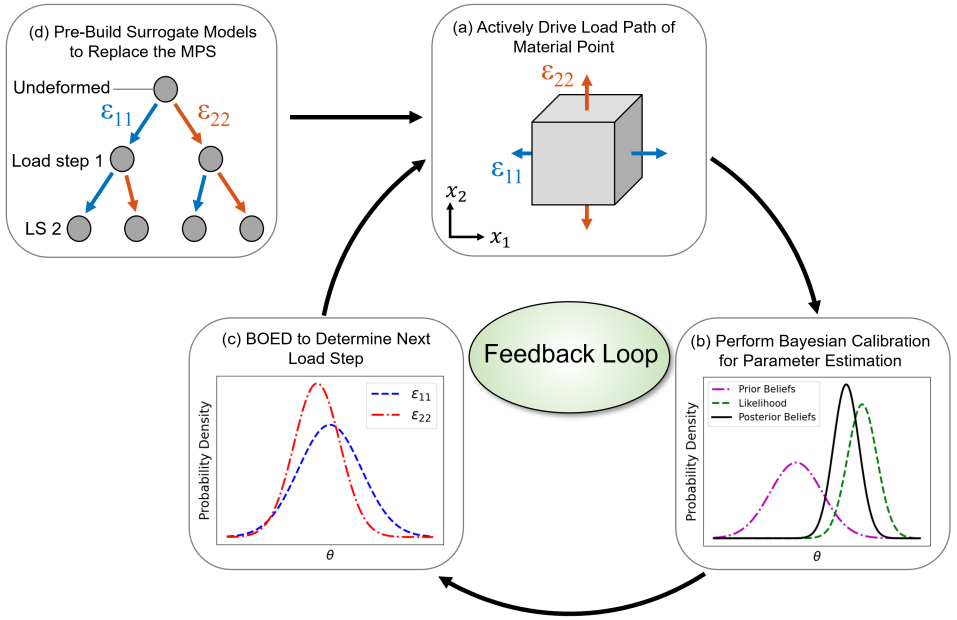
- At each iteration, the algorithm computes the Expected Information Gain (EIG) for all candidate load steps (e.g., strain increments along ε₁₁ or ε₂₂) to identify the most informative next step.
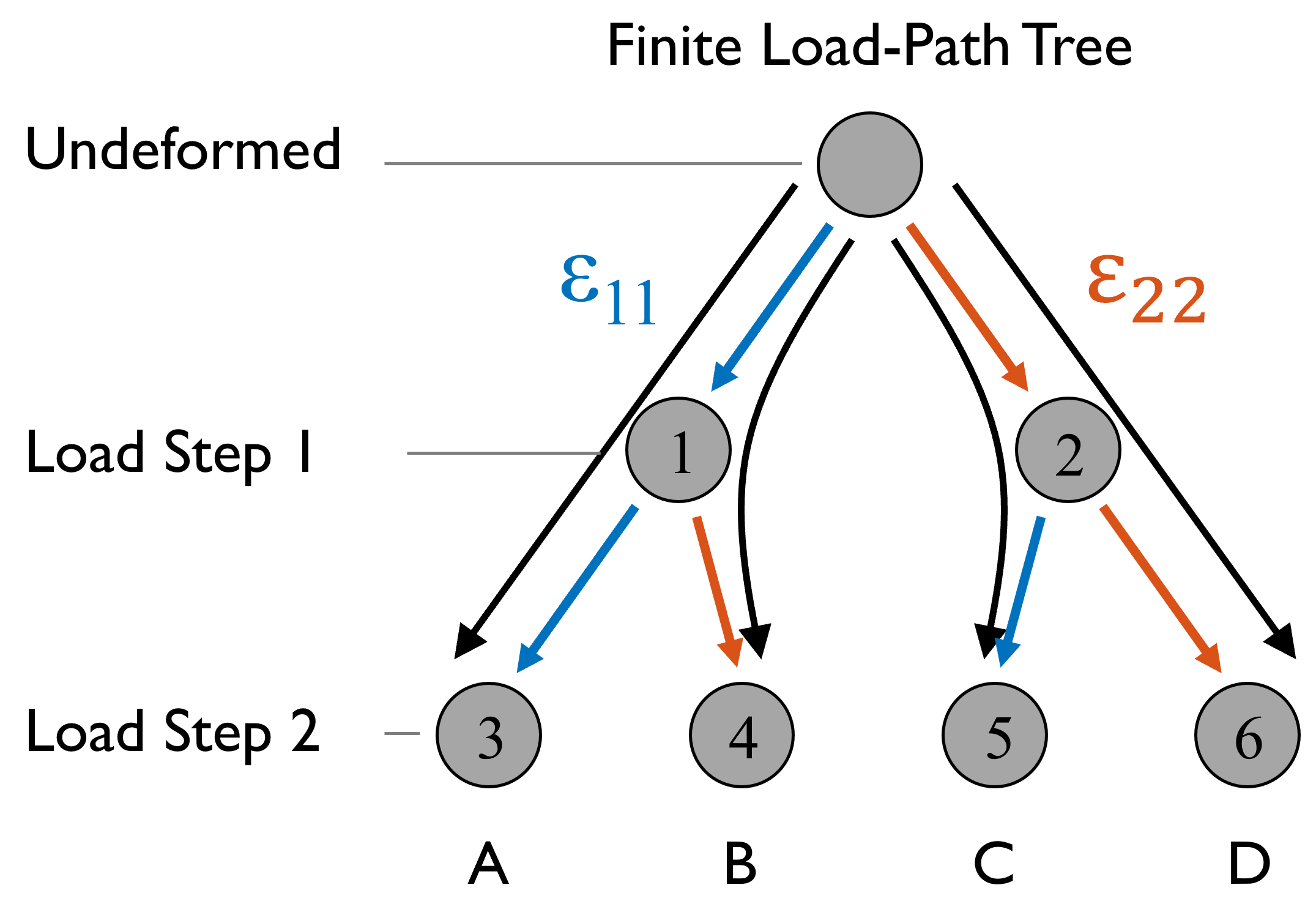
- A binary tree structure models the load path decision space, where each node represents a strain increment choice, and EIG is calculated for each child node.
- The EIG is computed using a fast material point simulator that models plane stress elastoplastic behavior under bi-axial loading.
- The framework compares adaptive designs (selected via EIG maximization) against two static, pre-defined load paths based on human intuition.
- The algorithm runs in under 3 minutes per step in the more complex exemplar, making it suitable for quasi real-time implementation.
Experimental results
Research questions
- RQ1Can adaptive load path selection via Bayesian Optimal Experimental Design (BOED) reduce parameter uncertainty in constitutive model calibration more effectively than static, intuition-based load paths?
- RQ2How does the expected information gain (EIG) criterion guide the selection of optimal strain increment directions in a bi-axial loading scenario?
- RQ3What is the impact of alternating load paths on parameter estimation accuracy and uncertainty reduction in anisotropic plasticity models?
- RQ4How does the reliability of posterior distributions—measured by the distance to the true parameter values—compare between adaptive and static experimental designs?
- RQ5Can the ICC framework be efficiently executed in real-time to support actively controlled experiments with full-field data?
Key findings
- Adaptive load path selection via BOED reduced posterior parameter uncertainty by up to 100% compared to static, intuition-based load paths in one exemplar problem.
- The adaptive designs yielded posterior distributions with lower total and generalized variances, indicating a more precise estimation of model parameters.
- The adaptive designs were more reliable in capturing the true parameter values, as evidenced by a lower mean distance (MD) to the true parameters on average.
- An alternating load path (e.g., switching between ε₁₁ and ε₂₂) was consistently preferred by the algorithm, likely due to the need to probe anisotropic yield behavior.
- The algorithm achieved a runtime of less than 3 minutes per step in the more complex exemplar, including EIG computation and inference, demonstrating feasibility for quasi real-time applications.
- The ICC framework is extensible to non-binary tree structures, such as those including compression or simultaneous strain increments, without altering the core algorithmic logic.
Better researchstarts right now
From reading papers to final review, dramatically reduce your research time.
No credit card · Free plan available
This review was created by AI and reviewed by human editors.