
[Paper Review] Bayesian quantification of strongly-interacting matter with color glass condensate initial conditions
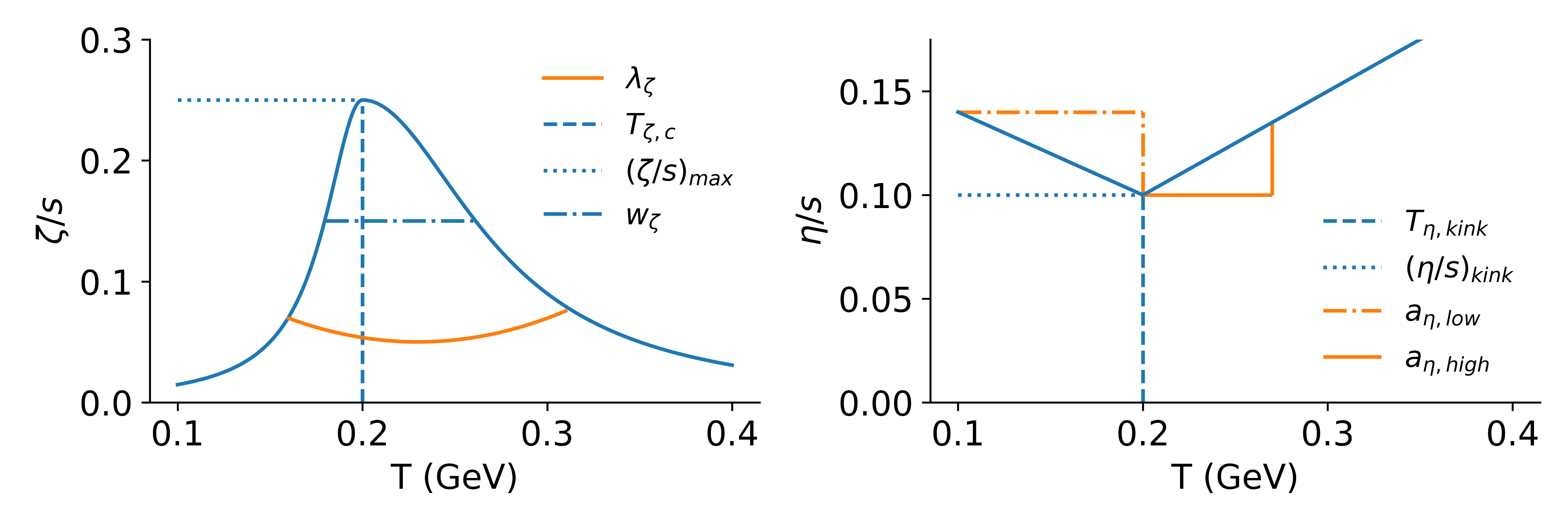
This study performs a global Bayesian inference on Pb+Pb collisions at √sNN = 2.76 TeV using a multistage model with IP-Glasma initial conditions, viscous hydrodynamics, and hadronic transport. It reports the first statistically significant evidence that bulk viscosity over entropy density (ζ/s) is non-zero and peaked during the hydrodynamic phase, while shear viscosity over entropy (η/s) remains consistent with a flat temperature dependence.
A global Bayesian analysis of relativistic Pb + Pb collisions at $\sqrt{s}_{ m NN}$ = 2.76 TeV is performed, using a multistage model consisting of an IP-Glasma initial state, a viscous fluid dynamical evolution, and a hadronic transport final state. The observables considered are from the soft sector hadronic final state. Posterior and Maximum a Posteriori parameter distributions that pertain to the IP-Glasma and hydrodynamic phases are obtained, including the shear and bulk specific viscosity of strong interacting matter. The first use of inference with transfer learning in heavy-ion analyses is presented, together with Bayes Model Averaging.
Motivation & Objective
- To quantify transport coefficients—specifically shear and bulk viscosity over entropy density—in strongly interacting matter produced in ultra-relativistic heavy-ion collisions.
- To assess the influence of early-time color glass condensate (IP-Glasma) initial conditions on final-state hadronic observables through a full Bayesian inference framework.
- To apply advanced statistical techniques—transfer learning and Bayesian Model Averaging (BMA)—to improve uncertainty quantification and model robustness in heavy-ion physics.
- To validate the self-consistency of the multistage model by recovering input parameters in closure tests, ensuring sensitivity to initial state physics.
- To establish a new benchmark for theoretical predictions by combining surrogate modeling with efficient sampling for large-scale inference in high-dimensional parameter spaces.
Proposed method
- Employs a multistage model: IP-Glasma for initial state, viscous relativistic fluid dynamics for the QGP phase, and hadronic transport (e.g., UrQMD) for the final freeze-out stage.
- Uses a global Bayesian analysis to infer posterior distributions of model parameters, including shear and bulk viscosity coefficients, particlization temperature, and IP-Glasma parameters.
- Applies an ordered Maximum Projection Latin Hypercube sampling strategy to improve sampling efficiency and surrogate model fidelity in high-dimensional parameter space.
- Utilizes surrogate modeling with principal component analysis (PCA) to reduce dimensionality and accelerate computation across correlated hadronic observables.
- Integrates transfer learning to enhance inference performance in the early-stage IP-Glasma component, enabling faster convergence and improved generalization.
- Employs Bayesian Model Averaging (BMA) to combine information across models, reducing overfitting and improving uncertainty quantification in the presence of model and interface uncertainties.
![Figure 1: Longitudinal and transverse pressure, scaled by the energy density, as a function of proper time in (2+1)D IP-Glasma. Adapted from [ 84 ] .](https://ar5iv.labs.arxiv.org/html/2302.09478/assets/figures/2d-ipg-pressures.png)
Experimental results
Research questions
- RQ1To what extent do final-state hadronic observables constrain the initial state physics described by the IP-Glasma model?
- RQ2What is the temperature dependence of the specific shear viscosity (η/s) in the quark-gluon plasma, and is it consistent with a constant or non-trivial behavior?
- RQ3Is the specific bulk viscosity (ζ/s) non-zero in the hydrodynamic phase, and does it exhibit a peak structure during the evolution?
- RQ4How do advanced statistical techniques like transfer learning and Bayesian Model Averaging improve the reliability and robustness of transport coefficient inference?
- RQ5Can closure tests with known input parameters confirm the self-consistency and sensitivity of the full multistage model to early-time physics?
Key findings
- The posterior distribution for the specific shear viscosity (η/s) is statistically consistent with a flat temperature dependence, with no significant evidence for a non-trivial temperature evolution.
- The specific bulk viscosity (ζ/s) is found to be non-zero and exhibits a pronounced peak during the hydrodynamic evolution, indicating significant deviation from ideal fluid behavior.
- The study provides the first statistically robust evidence that bulk viscosity is inconsistent with zero, challenging previous assumptions of negligible bulk viscosity in the QGP.
- Closure tests successfully recover input parameters in the IP-Glasma stage, confirming that the final-state observables are sensitive enough to constrain early-time physics.
- The use of transfer learning and Bayesian Model Averaging significantly improves uncertainty quantification and model robustness, setting a new standard for statistical inference in heavy-ion physics.
- The posterior distributions of transport coefficients represent the current best-estimate constraints on the properties of strongly-interacting matter in ultra-relativistic heavy-ion collisions.
Better researchstarts right now
From reading papers to final review, dramatically reduce your research time.
No credit card · Free plan available
This review was created by AI and reviewed by human editors.