
[Paper Review] Benchmarking Generated Poses: How Rational is Structure-based Drug Design with Generative Models?
The paper introduces PoseCheck, a biophysical benchmark suite for evaluating generated binding poses in structure-based drug design, showing that generated poses often have physical violations and that redocking can mask these issues.
Deep generative models for structure-based drug design (SBDD), where molecule generation is conditioned on a 3D protein pocket, have received considerable interest in recent years. These methods offer the promise of higher-quality molecule generation by explicitly modelling the 3D interaction between a potential drug and a protein receptor. However, previous work has primarily focused on the quality of the generated molecules themselves, with limited evaluation of the 3D molecule \emph{poses} that these methods produce, with most work simply discarding the generated pose and only reporting a "corrected" pose after redocking with traditional methods. Little is known about whether generated molecules satisfy known physical constraints for binding and the extent to which redocking alters the generated interactions. We introduce PoseCheck, an extensive analysis of multiple state-of-the-art methods and find that generated molecules have significantly more physical violations and fewer key interactions compared to baselines, calling into question the implicit assumption that providing rich 3D structure information improves molecule complementarity. We make recommendations for future research tackling identified failure modes and hope our benchmark can serve as a springboard for future SBDD generative modelling work to have a real-world impact.
Motivation & Objective
- Assess the quality of generated binding poses beyond 2D molecule metrics in SBDD.
- Evaluate whether 3D generative models meet known biophysical constraints during binding.
- Characterize the impact of redocking on pose quality and interaction accuracy.
- Identify failure modes and provide recommendations to improve SBDD generative methods.
Proposed method
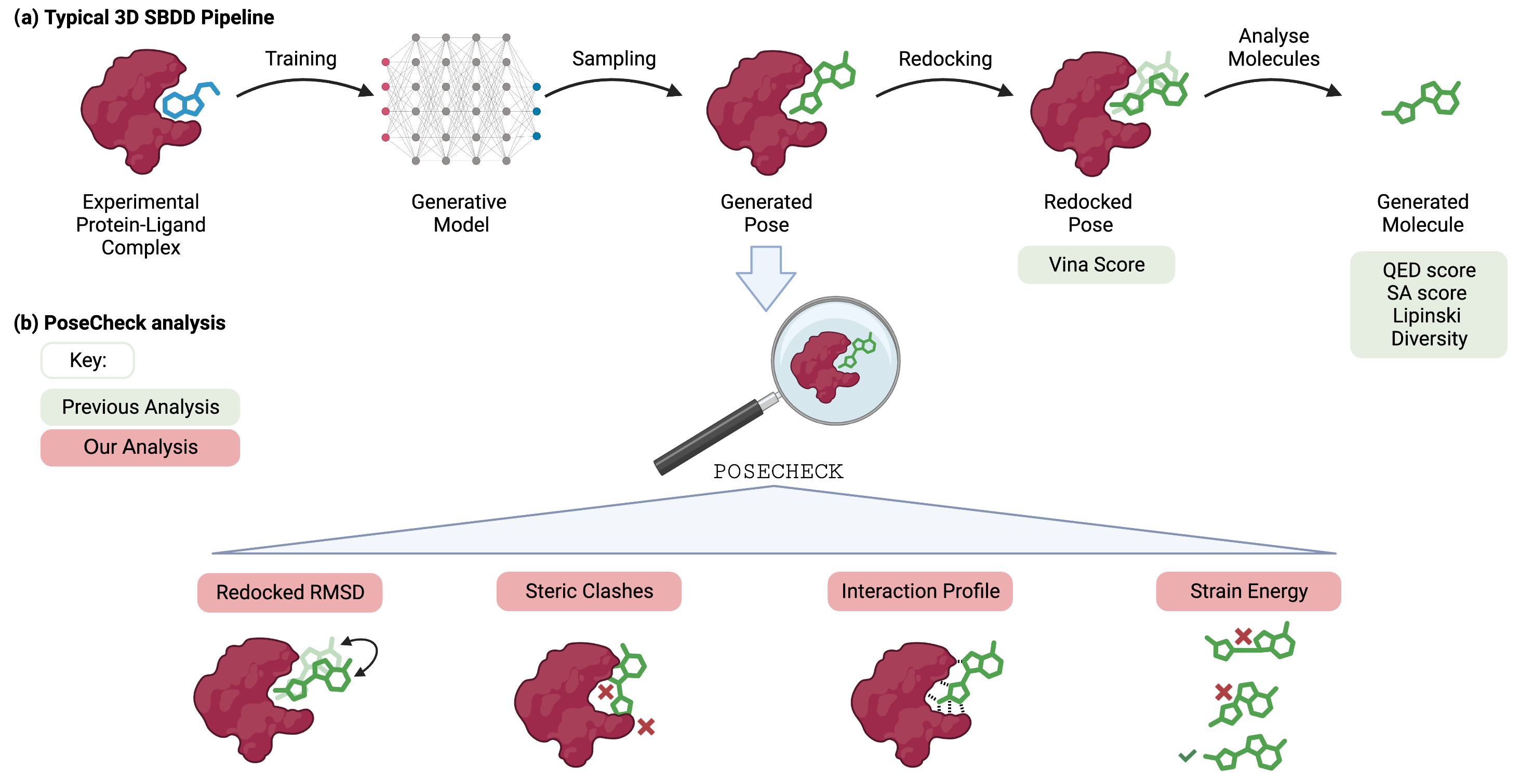
- Introduce PoseCheck comprising pipeline-wide and component-wise metrics for generated and redocked poses.
- Use interaction fingerprinting (ProLIF) to compare hydrogen bonds, vdW contacts, and hydrophobic interactions.
- Quantify steric clashes using a 0.5 Å tolerance based on van der Waals radii.
- Compute strain energy via the difference between relaxed and generated poses using UFF in RDKit.
- Evaluate RMSD between generated and redocked poses with QuickVina2 across five methods on CrossDocked2020 test set.
- Analyze hydrogen bonding and other interactions to compare generated poses to CrossDocked references.
Experimental results
Research questions
- RQ1Do generated poses satisfy biophysical constraints (hydrogen bonding, steric compatibility) as often as the CrossDocked references?
- RQ2How does redocking affect the observed pose quality and interaction patterns of generated molecules?
- RQ3Which SBDD generative methods produce physically plausible poses with fewer clashes and lower strain energy?
- RQ4What are the primary failure modes in current 3D generative SBDD models?
Key findings
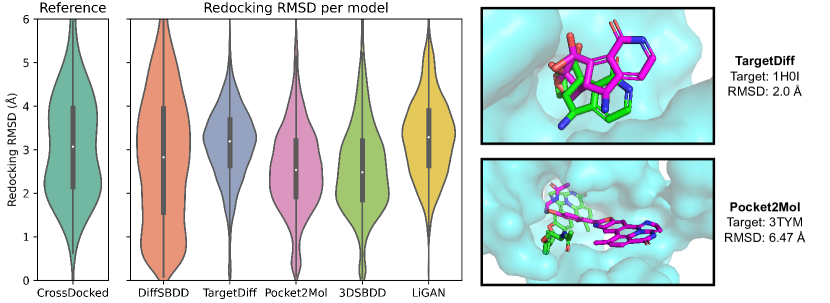
- All methods show high RMSD between generated and redocked poses (median not below 2 Å).
- Generated poses exhibit significantly fewer hydrogen bond donors/acceptors than the baseline, indicating weaker hydrogen bonding networks.
- Steric clashes are more prevalent in diffusion-based methods, with redocking reducing but not eliminating severe clashes.
- Strain energy of generated poses is generally much higher than the CrossDocked baseline, especially for diffusion models and LiGAN.
- Redocking can mask fundamental pose implausibilities rather than correcting them in many cases.
- LiGAN shows relatively better interaction similarity before redocking but degenerates after redocking.
Better researchstarts right now
From reading papers to final review, dramatically reduce your research time.
No credit card · Free plan available
This review was created by AI and reviewed by human editors.