
[Paper Review] Beyond MP2 initialization for unitary coupled cluster quantum circuits
This paper demonstrates that initializing unitary coupled cluster (UCC) quantum circuits with coupled cluster singles and doubles (CCSD) parameters significantly outperforms traditional MP2 initialization in variational quantum eigensolver (VQE) simulations. Using a sparse wavefunction circuit solver, the authors simulate UCC ansatzes up to 64 qubits, showing CCSD-initialized UCC achieves much more accurate ground state energies than MP2-initialized counterparts, establishing CCSD as a superior classical pre-parameterization method for NISQ-era quantum chemistry simulations.
The unitary coupled cluster (UCC) ansatz is a promising tool for achieving high-precision results using the variational quantum eigensolver (VQE) algorithm in the NISQ era. However, results on quantum hardware are thus far very limited and simulations have only accessed small system sizes. We advance the state of the art of UCC simulations by utilizing an efficient sparse wavefunction circuit solver and studying systems up to 64 qubits. Here we report results obtained using this solver that demonstrate the power of the UCC ansatz and address pressing questions about optimal initial parameterizations and circuit construction, among others. Our approach enables meaningful benchmarking of the UCC ansatz, a crucial step in assessing the utility of VQE for achieving quantum advantage.
Motivation & Objective
- To evaluate and compare the performance of MP2 versus CCSD as classical parameter initialization methods for unitary coupled cluster (UCC) ansatzes in variational quantum eigensolver (VQE) algorithms.
- To investigate whether CCSD, known for higher accuracy than MP2 in classical coupled cluster theory, translates to better quantum circuit performance in UCC-based VQE simulations.
- To enable large-scale UCC simulations (up to 64 qubits) using a novel sparse wavefunction circuit solver, allowing meaningful benchmarking of UCC ansatzes beyond previous limits.
- To challenge the conventional use of MP2 initialization in UCC-VQE by providing empirical evidence that CCSD initialization yields superior energy estimates.
- To establish a foundation for future work on higher-order coupled cluster parameterizations (e.g., UCC(CCSDT)) in quantum circuits.
Proposed method
- The study employs a factorized form of the UCC ansatz implemented via a state-of-the-art sparse wavefunction circuit solver capable of simulating systems up to 64 qubits.
- The UCC ansatz is defined as |Ψ_UCC⟩ = exp(𝑇̂ − 𝑇̂†)|Ψ₀⟩, where |Ψ₀⟩ is the Hartree-Fock reference state and 𝑇̂ is the cluster operator.
- Classical CCSD and MP2 calculations are performed to generate initial parameters for the UCC circuit, which are then used in VQE simulations to compute ground state energies.
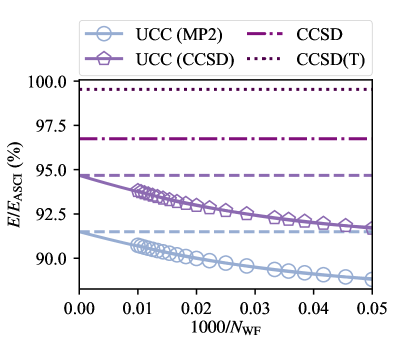
- The authors use a fitting procedure based on correlation energy convergence with respect to the number of determinants (𝑁WF) to estimate UCC energies for large molecules where full configuration interaction (FCI) is intractable.
- Simulations are benchmarked against high-accuracy reference methods including CCSD(T), ASCI (with 10⁶ determinants), and full CI where feasible.
- The sparse wavefunction solver enables efficient simulation of large systems by exploiting sparsity in the many-body wavefunction, reducing computational cost.
Experimental results
Research questions
- RQ1Does CCSD-based initialization of UCC ansatzes yield more accurate ground state energy estimates than MP2-based initialization in VQE simulations?
- RQ2How do the performance characteristics of UCC(MP2) and UCC(CCSD) compare across a range of molecular systems, particularly in large-scale simulations?
- RQ3Can large-scale UCC simulations (up to 64 qubits) be meaningfully performed with current classical solvers to assess VQE performance and circuit design?
- RQ4What is the relationship between classical coupled cluster theory (CCSD) and its quantum analog (UCC(CCSD)) in terms of energy prediction accuracy?
- RQ5Is the conventional use of MP2 for UCC initialization still optimal, or should CCSD be adopted as the standard for future NISQ-era quantum chemistry applications?
Key findings
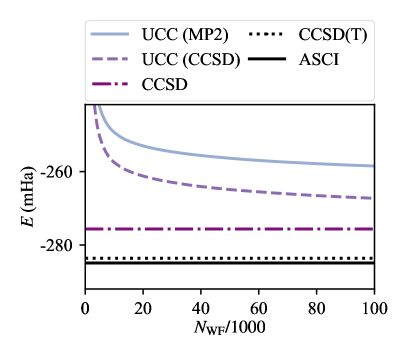
- CCSD-initialized UCC circuits consistently produce more accurate ground state energies than MP2-initialized counterparts across all tested molecules, including CH₂O, H₁₀, and C₂.
- For CH₂O, UCC(CCSD) achieves a correlation energy of 269.73 mH, significantly closer to the CCSD(T) reference of 283.59 mH than UCC(MP2)'s 260.67 mH.
- In the case of strongly correlated systems like stretched H₁₀, the correspondence between CCSD and UCC(CCSD) breaks down, indicating limitations in both classical and quantum approximations.
- The sparse wavefunction solver enables simulations of up to 64 qubits, allowing the first meaningful benchmarking of UCC ansatzes at such scales.
- CCSD parameterization is computationally feasible for moderately large systems (e.g., <100 qubits), with typical calculations running in minutes on a laptop, making it practical for near-term quantum chemistry applications.
- The results strongly suggest that CCSD should replace MP2 as the standard classical pre-parameterization method for UCC-VQE circuits due to its superior accuracy and reasonable classical cost.
Better researchstarts right now
From reading papers to final review, dramatically reduce your research time.
No credit card · Free plan available
This review was created by AI and reviewed by human editors.