
[Paper Review] Beyond Reality: The Pivotal Role of Generative AI in the Metaverse
This paper surveys how generative AI models enable Metaverse content across text, image, video, and 3D domains, discusses applications and ethics, and presents a case study on avatar generation.
Imagine stepping into a virtual world that's as rich, dynamic, and interactive as our physical one. This is the promise of the Metaverse, and it's being brought to life by the transformative power of Generative Artificial Intelligence (AI). This paper offers a comprehensive exploration of how generative AI technologies are shaping the Metaverse, transforming it into a dynamic, immersive, and interactive virtual world. We delve into the applications of text generation models like ChatGPT and GPT-3, which are enhancing conversational interfaces with AI-generated characters. We explore the role of image generation models such as DALL-E and MidJourney in creating visually stunning and diverse content. We also examine the potential of 3D model generation technologies like Point-E and Lumirithmic in creating realistic virtual objects that enrich the Metaverse experience. But the journey doesn't stop there. We also address the challenges and ethical considerations of implementing these technologies in the Metaverse, offering insights into the balance between user control and AI automation. This paper is not just a study, but a guide to the future of the Metaverse, offering readers a roadmap to harnessing the power of generative AI in creating immersive virtual worlds.
Motivation & Objective
- Motivate the study of the Metaverse as a fusion of virtual and physical reality and the need for AI-driven content creation.
- Identify how generative AI can enhance immersion, personalization, and interactivity in Metaverse domains (text, image, video, 3D objects).
- Provide a taxonomy of generative AI models (VAEs, GANs, Transformers, autoregressive models) and map them to Metaverse applications.
- Highlight challenges, ethical considerations, and future directions for responsible deployment of generative AI in the Metaverse.
Proposed method
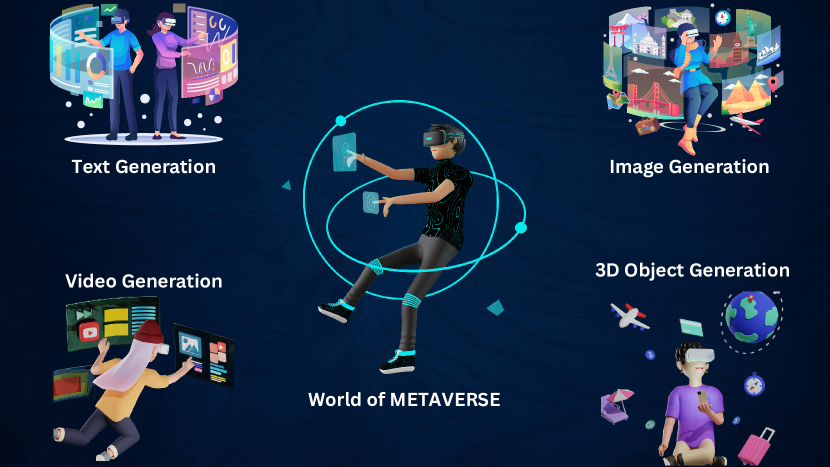
- Classify Metaverse content into four generation domains: text, image, video, and 3D objects.
- Categorize generative models into four families: VAEs, GANs, Transformers, and autoregressive models.
- Present a domain-model mapping with examples (Table I) to illustrate applicability.
- Discuss applications, workflows, and a case study to demonstrate a practical avatar-generation pipeline.
Experimental results
Research questions
- RQ1How do VAEs, GANs, Transformers, and autoregressive models map onto text, image, video, and 3D object generation in the Metaverse?
- RQ2What are the key applications and workflows in each generation domain for immersive Metaverse experiences?
- RQ3What open issues, challenges, and ethical considerations arise in deploying generative AI in the Metaverse, and what future directions are proposed?
- RQ4How does a practical avatar-generation case study illustrate the integration of perception, prompting, and diffusion-based generation?
- RQ5What are the main limitations and opportunities for interoperability and efficiency in generative AI for the Metaverse?
Key findings
- Generative AI enables domain-specific content creation in text, image, video, and 3D object generation for the Metaverse.
- A structured mapping of models to domains highlights where VAEs, GANs, Transformers, and autoregressive models are most effective.
- The paper presents a case study showing diffusion models can translate user skeletons, derived from OpenPose, into plausible avatars with varying prompts and seeds.
- Open issues include data quality, realism, content control, ethics, computational efficiency, and interoperability, guiding future research directions.
Better researchstarts right now
From reading papers to final review, dramatically reduce your research time.
No credit card · Free plan available
This review was created by AI and reviewed by human editors.