
[Paper Review] Birth of Rapidly Spinning, Overmassive Black Holes in the Early Universe
This paper proposes that dust-rich, early-universe active galactic nuclei known as 'little red dots' (LRDs) host rapidly spinning, overmassive black holes (BHs) due to prolonged, coherent accretion in dense environments. The analysis of BH growth rates and mass density at z ≈ 4–5 implies a radiative efficiency exceeding 20%, corresponding to BH spins near 96% of the maximum limit, challenging canonical models of chaotic accretion and suggesting a dominant role for aligned gas inflows in early BH growth.
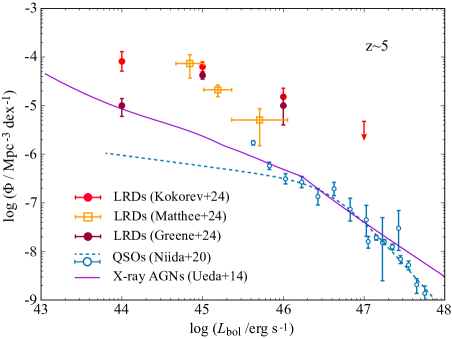
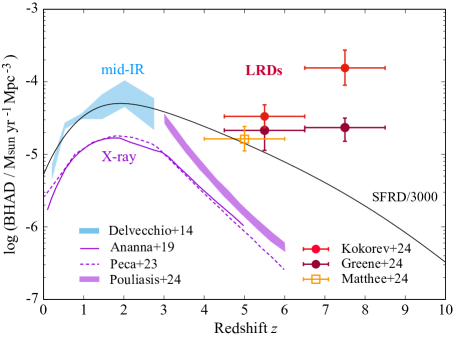
The James Webb Space Telescope (JWST) has unveiled numerous massive black holes (BHs) in faint, broad-line active galactic nuclei (AGNs). The discovery highlights the presence of dust-reddened AGN populations, referred to as "little red dots (LRDs)", more abundant than X-ray selected AGNs, which are less influenced by obscuration. This finding indicates that the cosmic growth rate of BHs within this population does not decrease but rather increases at higher redshifts beyond $z\sim 6$. The BH accretion rate density deduced from their luminosity function is remarkably higher than that from other AGN surveys in X-ray and infrared bands. To align the cumulative mass density accreted to BHs with the observed BH mass density at $z\simeq 4-5$, as derived from the integration of the BH mass function, the radiative efficiency must be doubled from the canonical 10% value, achieving significance beyond the $>3σ$ confidence level. This suggests the presence of rapid spins with 96% of the maximum limit among these BHs, maintained by prolonged mass accretion instead of chaotic accretion with randomly oriented inflows. Moreover, we derive an upper bound for the stellar mass of galaxies hosting these LRDs, ensuring consistency with galaxy formation in the standard cosmological model, where the host stellar mass is limited by the available baryonic reservoir. Our analysis gives a lower bound for the BH-to-galaxy mass ratio that exceeds the typical value known in the nearby universe and aligns with that for JWST-detected unobscured AGNs. Accordingly, we propose a hypothesis that the dense, dust-rich environments within LRDs facilitate the emergence of rapidly spinning and overmassive BH populations during the epoch of reionization. This scenario predicts a potential association between relativistic jets and other high-energy phenomena with overmassive BHs in the early universe.
Motivation & Objective
- To reconcile the observed black hole mass density at z ≈ 4–5 with the cumulative mass accretion inferred from luminosity functions of high-redshift AGNs.
- To determine the radiative efficiency of black holes in 'little red dots' (LRDs), a newly identified population of dust-reddened, broad-line AGNs detected by JWST.
- To constrain the spin of early-universe black holes by comparing accretion rates to observed mass functions, testing the dominance of coherent vs. chaotic accretion.
- To establish upper limits on host galaxy stellar masses consistent with standard cosmology and derive lower bounds on BH-to-galaxy mass ratios in LRDs.
- To propose a physical mechanism linking dust-rich environments in LRDs to the formation of rapidly spinning, overmassive black holes during the epoch of reionization.
Proposed method
- Applied the Soltan-Paczyński argument at z ≈ 4–5, comparing the observed black hole mass function to the integrated accretion rate derived from the bolometric luminosity function of LRDs.
- Used JWST observations of Hα and continuum luminosities to estimate bolometric luminosities for LRDs, enabling accretion rate calculations.
- Calculated the required radiative efficiency to match the observed BH mass density with the accreted mass, assuming a range of spin-dependent efficiencies.
- Derived constraints on the maximum host galaxy stellar mass by requiring consistency with baryonic reservoir limits in the standard cosmological model.
- Estimated the lower bound on the BH-to-galaxy mass ratio by combining observed BH masses and derived upper limits on host stellar masses.
- Proposed a physical scenario in which dense, dust-rich environments in LRDs promote sustained, aligned accretion, leading to high spins and overmassive BHs.
Experimental results
Research questions
- RQ1What is the required radiative efficiency to reconcile the observed black hole mass density at z ≈ 4–5 with the accretion rate inferred from the luminosity function of LRDs?
- RQ2What spin parameters are implied by the inferred radiative efficiency, and how do they compare to canonical values and theoretical limits?
- RQ3What constraints do standard cosmological models place on the stellar mass of galaxies hosting LRDs, given the observed BH masses?
- RQ4How does the BH-to-galaxy mass ratio in LRDs compare to local values, and what does this imply about early black hole growth mechanisms?
- RQ5Can the observed properties of LRDs be explained by prolonged, coherent accretion rather than chaotic accretion, and what are the implications for jet production and multi-messenger signals?
Key findings
- The required radiative efficiency for consistency between accreted mass and observed BH mass density exceeds 20%, significantly higher than the canonical 10%, with a significance level >2σ.
- This high radiative efficiency implies black hole spins approaching 96% of the maximum Kerr limit, corresponding to a dimensionless spin parameter a₆ ≈ 0.96.
- The analysis implies that black hole growth in LRDs is dominated by prolonged, coherent accretion with aligned angular momentum, not chaotic accretion with random orientations.
- The upper limit on host galaxy stellar mass is constrained to ensure consistency with baryonic reservoir limits in the standard cosmological model.
- The lower bound on the BH-to-galaxy mass ratio in LRDs exceeds typical local values and aligns with those observed in unobscured JWST AGNs, indicating a more massive black hole relative to its host at high redshift.
- The study proposes that dust-rich, dense environments in LRDs facilitate the formation of rapidly spinning, overmassive black holes, potentially linked to relativistic jets and high-energy transient phenomena.
Better researchstarts right now
From reading papers to final review, dramatically reduce your research time.
No credit card · Free plan available
This review was created by AI and reviewed by human editors.