
[Paper Review] Bridging Systems: Open Problems for Countering Destructive Divisiveness across Ranking, Recommenders, and Governance
The paper articulates Bridging Systems and an attention-allocation framework across ranking, collective response, and governance, outlining open problems to counter divisiveness.
Divisiveness appears to be increasing in much of the world, leading to concern about political violence and a decreasing capacity to collaboratively address large-scale societal challenges. In this working paper we aim to articulate an interdisciplinary research and practice area focused on what we call bridging systems: systems which increase mutual understanding and trust across divides, creating space for productive conflict, deliberation, or cooperation. We give examples of bridging systems across three domains: recommender systems on social media, collective response systems, and human-facilitated group deliberation. We argue that these examples can be more meaningfully understood as processes for attention-allocation (as opposed to "content distribution" or "amplification") and develop a corresponding framework to explore similarities - and opportunities for bridging - across these seemingly disparate domains. We focus particularly on the potential of bridging-based ranking to bring the benefits of offline bridging into spaces which are already governed by algorithms. Throughout, we suggest research directions that could improve our capacity to incorporate bridging into a world increasingly mediated by algorithms and artificial intelligence.
Motivation & Objective
- Define bridging as a property of attention allocators and articulate its societal goal of increasing mutual understanding across divides.
- Present an interdisciplinary framework linking recommender systems, collective response tools, and human facilitation.
- Propose signals, metrics, and data-modeling approaches to instantiate bridging in algorithmic and human systems.
- Identify evaluation challenges, risks, and implementation limits of bridging systems.
- Offer concrete open research questions to advance cross-domain collaboration and responsible deployment.
Proposed method
- Develop an attention-allocation framework applicable to three domains: recommender systems, collective response systems, and human-facilitated deliberation.
- Formalize allocation and learning processes, including state and predictive models, and the value model guiding allocations.
- Introduce signals and metrics that can be used to optimize for bridging within an optimization stack.
- Discuss evaluation approaches and outline practical assessment considerations for bridging systems.
- Provide a taxonomy of practical examples and actionable research directions, highlighting green and blue box guidance for practitioners and researchers.

Experimental results
Research questions
- RQ1What do systems that reward bridging look like across different domains (ranking, collective response, deliberation) and how can they be designed?
- RQ2How can bridging be operationalized as a property of attention allocators and integrated into their optimization frameworks?
- RQ3What signals, metrics, and data models can reliably instantiate and measure bridging outcomes?
- RQ4What are the evaluation challenges, limitations, and risks in implementing bridging systems, and how can they be mitigated?
- RQ5What open problems can accelerate cross-domain research and safe deployment of bridging systems?
Key findings
- Idea: bridging systems aim to increase mutual understanding and trust across divides rather than eliminate conflict or enforce homogeneity.
- Framework: introduces attention allocation as a unifying lens to compare recommender, collective response, and facilitation systems.
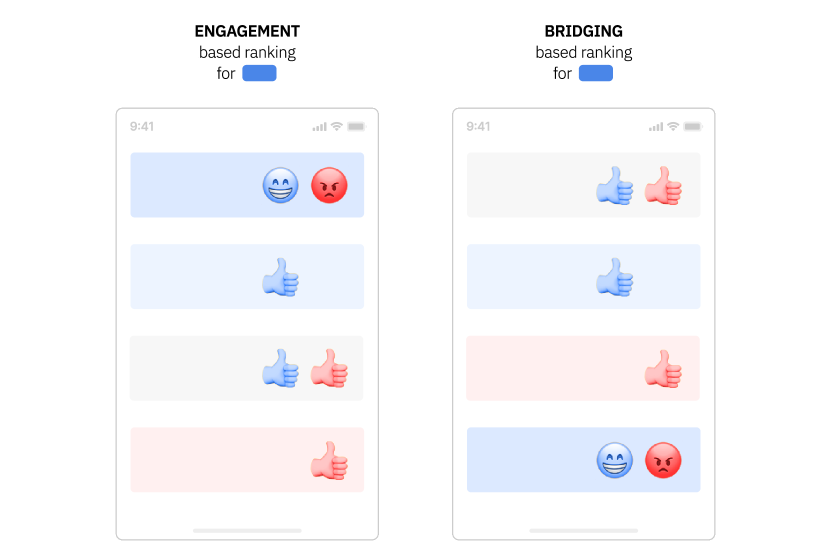
- Concept: bridges can be realized by redesigning ranking and allocation objectives to reward cross-divide alignment (e.g., diverse approval motifs).
- Tooling: proposes signals, metrics, and an optimization stack to guide development and evaluation of bridging in real systems.
- Scope: emphasizes interdisciplinary research directions and identifies challenges, limitations, and risks of bridging implementations.
Better researchstarts right now
From reading papers to final review, dramatically reduce your research time.
No credit card · Free plan available
This review was created by AI and reviewed by human editors.