
[Paper Review] Bright and pure single-photon source in a silicon chip by nanoscale positioning of a color center in a microcavity
This paper demonstrates an all-silicon, on-chip single-photon source by deterministically placing a W center in a circular Bragg grating cavity on SOI, achieving high Purcell-enhanced ZPL emission with excellent single-photon purity under CW and pulsed excitation.
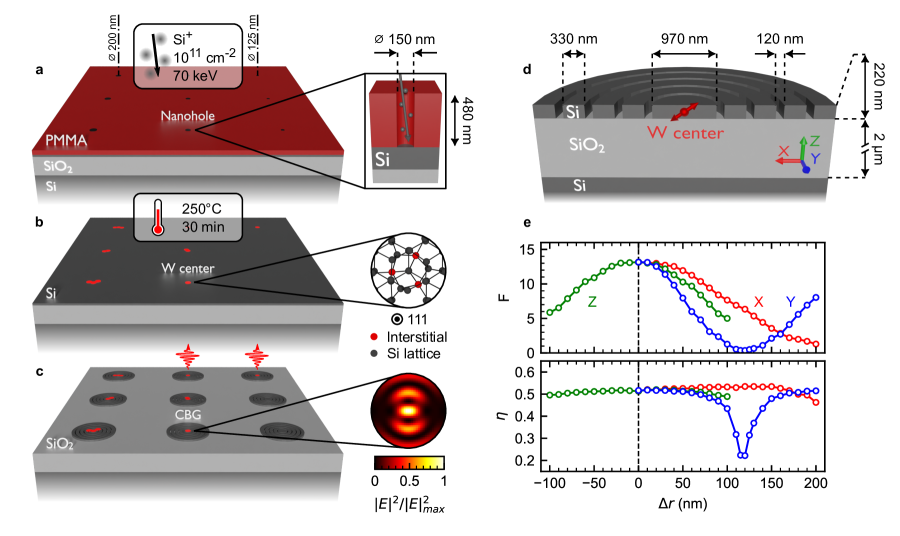
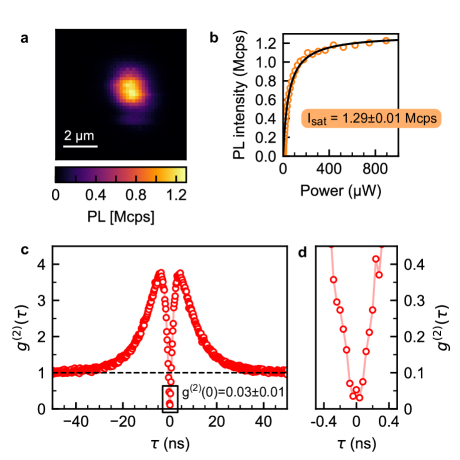
We present an all-silicon source of near-infrared linearly-polarized single photons, fabricated by nanoscale positioning of a color center in a silicon-on-insulator microcavity. The color center consists of a single W center, created at a well-defined position by Si$^{+}$ ion implantation through a 150 nm-diameter nanohole in a mask. A circular Bragg grating cavity resonant with the W's zero-phonon line at 1217 nm is fabricated at the same location as the nanohole. By Purcell enhancement of zero-phonon emission, we obtain a photon count rate of $1.29 \pm 0.01$ Mcounts/s at saturation under above-gap continuous-wave excitation with a Debye-Waller factor of $98.6\pm1.4 \%$. A clean photon antibunching behavior is observed up to pump powers ensuring saturation of the W's emission ($g^{(2)}(0)=0.06\pm0.02$ at $P=9.2P_{sat}$), evidencing that the density of additional parasitic fluorescent defects is very low. We also demonstrate the triggered emission of single photons with $93\pm2 \%$ purity under weak pulsed laser excitation. At high pulsed laser power, we reveal a detrimental effect of repumping processes, that could be mitigated using selective pumping schemes in the future. These results represent a major step towards on-demand sources of indistinguishable near-infrared single photons within silicon photonics chips.
Motivation & Objective
- Demonstrate deterministic on-chip generation of bright, pure single photons in silicon using nanoscale emitter positioning.
- Achieve strong Purcell enhancement of zero-phonon line emission for W centers in circular Bragg grating cavities.
- Assess the single-photon purity, brightness, and polarization properties under CW and pulsed excitation.
- Evaluate the potential and limitations for scalable, indistinguishable on-chip photon sources in silicon photonics.
Proposed method
- Fabricate an array of W centers by Si+ ion implantation through 150 nm nanoholes in a PMMA mask on SOI.
- Create circular Bragg grating (CBG) cavities centered at the nanohole locations and resonant with the W ZPL at 1217–1218 nm.
- Characterize emission by photoluminescence spectroscopy and second-order correlation g(2)(τ) under above-gap CW and pulsed excitation.
- Analyze cavity-emitter coupling via reflectometry to extract the cavity Q factor and Purcell enhancement.
- Estimate zero-phonon line fraction and Purcell-enhanced radiative decay through lifetime measurements under pulsed pumping.
Experimental results
Research questions
- RQ1Can a single W center be deterministically positioned at a cavity antinode to maximize Purcell enhancement in an on-chip silicon photonic structure?
- RQ2What are the resulting brightness, purity (g(2)(0)), and ZPL fraction achievable for a W-center in a SOI CBG cavity under CW and pulsed excitation?
- RQ3How does the emitter-cavity detuning and positioning tolerance affect collection efficiency and Purcell factor in this system?
- RQ4What are the main limitations (blinking, non-radiative channels) and prospects for improving on-chip indistinguishable single-photon emission from silicon color centers?
Key findings
- A W center is deterministically created at a location aligned with the cavity antinode, achieving strong Purcell-enhancement of ZPL emission.
- Observed CW saturation count rate around 1.29 Mcps with g(2)(0) ≈ 0.03–0.06 over the full power range, indicating very low parasitic emission.
- Zero-phonon emission fraction is ~98.6% of the PL, indicating efficient ZPL emission due to cavity Purcell enhancement.
- A polarized, linearly-polarized single-photon source with high purity is demonstrated under weak pulsed pumping, achieving 93% purity for triggered emission.
- Cavity reflectometry yields a mode with Q ≈ 158 (Δλ ≈ 7.7 nm), closely matching simulations and indicating effective spectral alignment of ZPL with the cavity mode.
- Triggered emission under pulsed excitation shows antibunching with a central peak area corresponding to single-photon emission, while blinking (metastable-state dynamics) is observed and analyzed.
- Demonstrated a significant enhancement over unpatterned SOI W centers (enhancement factor ~400 in PL count rate at saturation), highlighting the cavity’s role in brightness.
Better researchstarts right now
From reading papers to final review, dramatically reduce your research time.
No credit card · Free plan available
This review was created by AI and reviewed by human editors.