
[Paper Review] Building population models for large-scale neural recordings: opportunities and pitfalls
A comparative review of fully observed and latent variable models for large-scale neural recordings, detailing methods, limitations, and when each approach is most informative.
Modern recording technologies now enable simultaneous recording from large numbers of neurons. This has driven the development of new statistical models for analyzing and interpreting neural population activity. Here we provide a broad overview of recent developments in this area. We compare and contrast different approaches, highlight strengths and limitations, and discuss biological and mechanistic insights that these methods provide.
Motivation & Objective
- Motivate the need for model-based analysis of population neural activity from high-channel-count recordings.
- Survey fully observed and latent-variable modeling frameworks to understand their assumptions, strengths, and limitations.
- Highlight practical considerations for data extraction, spike sorting, and model fitting in large-scale datasets.
- Discuss how these models yield biological insights and guide decoding and information-theoretic analyses.
Proposed method
- Review of spike extraction and sorting considerations with SpikeInterface and ground-truth benchmarks.
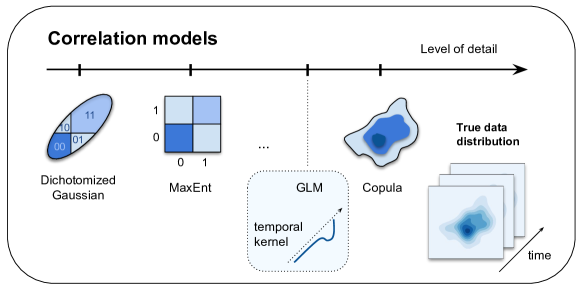
- Comparison of fully observed models (MaxEnt, Dichotomized Gaussian, GLMs, copula-based models) and their scalability, interpretability, and applicability.
- Discussion of latent variable models (state-space and GP-based) including LFADS, GPFA, GPFADS, and related approaches, with emphasis on dynamics, mappings, and observation models.
- Outline of how external covariates and behavior can be integrated to improve interpretability and constrain latent dynamics.
- Provision of guidance on parameter identifiability, uncertainty quantification, and model selection.
- Summary of practical strengths, limitations, and future directions for large-scale neural population modeling.

Experimental results
Research questions
- RQ1What are the trade-offs between fully observed and latent variable population models for large-scale neural recordings?
- RQ2How do different models handle high-dimensional joint activity, and what biological or mechanistic insights can they provide?
- RQ3What are the limitations related to parameter identifiability, data requirements, and computational tractability in these models?
- RQ4In what scenarios do external covariates or behaviorally relevant latent trajectories improve interpretability and decoding performance?
- RQ5How can one robustly validate findings given spike sorting uncertainties and dataset size?
Key findings
- Fully observed models provide access to the full joint activity distribution and can improve decoding and information measures, but often suffer from parameter identifiability and computational scalability in large populations.
- Latent variable models offer a low-dimensional representation of population dynamics, capturing temporal structure and enabling uncertainty quantification, but rely on assumptions about low-dimensionality and can mix multiple sources of variability.
- GLMs and copula-based approaches can scale to large datasets and model external inputs or non-linear dependencies, while MaxEnt variants offer principled maximum-entropy descriptions but may be computationally intensive.
- Non-linear state-space models and RNN-based approaches (e.g., LFADS) can capture complex dynamics but are typically computationally demanding and harder to interpret.
- GP-based latent models (e.g., GPFA, GPFADS) provide uncertainty estimates and principled model selection but must demonstrate capability to capture real neural dynamics beyond linear embeddings.
- Practically, using multiple spike sorters or consensus sorting reduces false positives and biases in downstream modeling; modeling external variables can improve interpretability and reveal robust neural trajectories.
Better researchstarts right now
From reading papers to final review, dramatically reduce your research time.
No credit card · Free plan available
This review was created by AI and reviewed by human editors.