
[Paper Review] Built-in electric field and strain tunable valley-related multiple topological phase transitions in VSiXN$_4$ (X= C, Si, Ge, Sn, Pb) monolayers
The paper reports first-principles study of VSiXN4 (X = C, Si, Ge, Sn, Pb) monolayers, showing that intrinsic built-in electric fields and applied strain drive valley-dependent multiple topological phase transitions via dxy/dx2−y2 and dz2 band inversions at K and K' valleys.
The valley-related multiple topological phase transitions attracted significant attention due to their providing significant opportunities for fundamental research and practical applications. However, unfortunately, to date there is no real material that can realize valley-related multiple topological phase transitions. Here, through first-principles calculations and model analysis, we investigate the structural, magnetic, electronic, and topological properties of VSiXN$_4$ (X = C, Si, Ge, Sn, Pb) monolayers. VSiXN$_4$ monolayers are stable and intrinsically ferrovalley materials. Intriguingly, we found that the built-in electric field and strain can induce valley-related multiple topological phase transitions in the materials from valley semiconductor to valley-half-semimetal, to valley quantum anomalous Hall insulator, to valley-half-semimetal, and to valley semiconductor (or to valley-metal). The nature of topological phase transition is the built-in electric field and strain induce band inversion between the d$_{xy}$/d$_{x2-y2}$ and d$_{z2}$ at obritals at K and K' valleys. Our findings not only reveal the mechanism of multiple topological phase transitions, but also provides an ideal platform for the multi-field manipulating the spin, valley, and topological physics. It will open new perspectives for spintronic, valleytronic, and topological nanoelectronic applications based on these materials.
Motivation & Objective
- Explore structural, magnetic, electronic, and topological properties of VSiXN4 (X = C, Si, Ge, Sn, Pb) monolayers.
- Identify how built-in electric field and strain influence valley polarization and topology.
- Demonstrate multi-field control of spin, valley, and topological states in these 2D materials.
Proposed method
- Perform DFT calculations with GGA-PBE and GGA+U (Ueff = 1–4 eV) using VASP for structural, magnetic, and electronic properties.
- Validate results with HSE06 calculations.
- Compute Berry curvature and edge states using maximally localized Wannier functions and WannierTools.
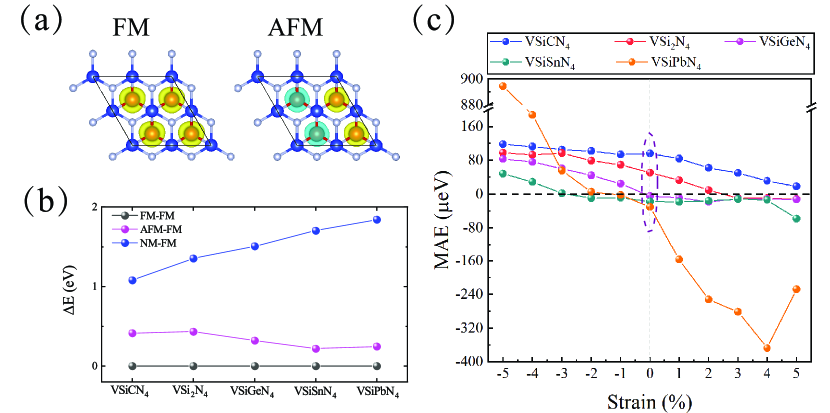
- Extract magnetic anisotropy energy (MAE) and analyze its dependence on built-in field and strain.
- Model SOC effects on valley splitting using an effective H_SOC near K and K' valleys.
Experimental results
Research questions
- RQ1Can VSiXN4 monolayers host ferrovalley behavior with intrinsic magnetism?
- RQ2How do built-in electric field and strain drive valley-dependent band inversions and topological phase transitions?
- RQ3What are the resulting valley splittings, Berry curvatures, and edge states under different X species, fields, and strains?
- RQ4Is there a strain range where valley quantum anomalous Hall insulation (VQAHI) or valley-metal/valley-semimetal phases emerge?
- RQ5How universal is the band-inversion mechanism across the VSiXN4 family?
Key findings
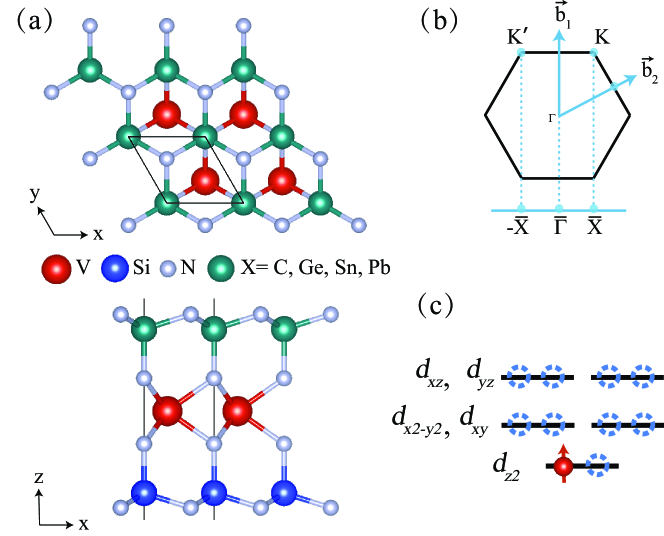
- VSiXN4 monolayers are dynamically stable and intrinsically ferrovalley with FM ground state for X = C, Si, Ge, Sn; VSiPbN4 shows a slightly larger magnetic moment (1.09 μB).
- Built-in electric fields differ per X, e.g., VSiCN4 ≈ 0.36 V/Å, VSiGeN4 ≈ 0.00 V/Å, VSiSnN4 ≈ 0.26 V/Å, VSiPbN4 ≈ 0.31 V/Å, and these fields correlate with magnetic anisotropy energy trends.
- Without SOC, K and K′ valleys host spin-up bands; with SOC, valley splitting occurs in valence bands for several compositions, with E_v^K − E_v^K′ up to 70.17 meV and E_c^K − E_c^K′ up to 72.45 meV (varies by X).
- VSiGeN4 is a critical point where VBM and CBM form a Dirac cone, and SOC-induced band inversions under built-in field lead to valley-related topological transitions.
- Strain can drive a sequence: valley semiconductor → valley-half-semimetal → valley quantum anomalous Hall insulator (VQAHI) → valley-half-semimetal → valley semiconductor; the K and K′ Berry curvatures switch signs during these transitions.
- Edge-state analysis shows only VSiGeN4 can be topologically non-trivial (single edge state between bands).
- Under specific strain, a valley-polarized Hall conductivity appears, enabling valley- and spin-polarized transport and potential valleytronic device applications.
Better researchstarts right now
From reading papers to final review, dramatically reduce your research time.
No credit card · Free plan available
This review was created by AI and reviewed by human editors.