
[Paper Review] Calibrating baryonic feedback with weak lensing and fast radio bursts
This paper proposes using fast radio bursts (FRBs) as a cosmological probe to calibrate baryonic feedback in large-scale structure surveys by cross-correlating their dispersion measures (DM) with weak gravitational lensing signals from a Euclid-like survey. With ~10⁴ FRBs, the method improves constraints on baryonic feedback by an order of magnitude and enhances neutrino mass constraints by 50–100 %, breaking degeneracies between cosmological and feedback parameters.
One of the key limitations of large-scale structure surveys of the current and future generation, such as Euclid, LSST-Rubin or Roman, is the influence of feedback processes on the distribution of matter in the Universe. This effect, called baryonic feedback, modifies the matter power spectrum on non-linear scales much stronger than any cosmological parameter of interest. Constraining these modifications is therefore key to unlocking the full potential of the upcoming surveys, and we propose to do so with the help of Fast Radio Bursts (FRBs). FRBs are short, astrophysical radio transients of extragalactic origin. Their burst signal is dispersed by the free electrons in the large-scale structure, leading to delayed arrival times at different frequencies characterised by the dispersion measure (DM). Since the dispersion measure is sensitive to the integrated line-of-sight electron density, it is a direct probe of the baryonic content of the Universe. We investigate how FRBs can break the degeneracies between cosmological and feedback parameters by correlating the observed Dispersion Measure with the weak gravitational lensing signal of a Euclid-like survey. In particular, we use a simple one-parameter model controlling baryonic feedback, but we expect similar findings for more complex models. Within this model, we find that $\sim 5 imes 10^4$ FRBs are sufficient to constrain the baryonic feedback significantly better than cosmic shear alone, tightening the constraints considerably (roughly by a factor of five). We also expect a 1.5-fold improvement in the sum of neutrino masses.
Motivation & Objective
- To address the major uncertainty in cosmological constraints from future weak lensing surveys caused by baryonic feedback effects on non-linear matter power spectra.
- To break degeneracies between cosmological parameters and feedback model parameters that currently limit precision in large-scale structure surveys.
- To demonstrate that FRBs, via their dispersion measure (DM) correlations, provide a novel, independent probe of the electron distribution in the large-scale structure.
- To quantify the improvement in parameter constraints when combining cosmic shear with FRB DM data, especially for feedback strength and neutrino mass.
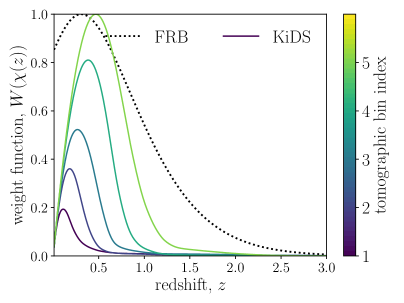
- To show that FRBs offer a complementary, low-redshift probe with different systematics than the tSZ effect, enhancing robustness in cosmological inference.
Proposed method
- The study uses a one-parameter feedback model to simulate the impact of baryonic feedback on the matter power spectrum, electron density, and cross-correlation with weak lensing.
- It models the dispersion measure (DM) of FRBs as an integrated line-of-sight probe of free electron density, sensitive to the baryonic content of the large-scale structure.
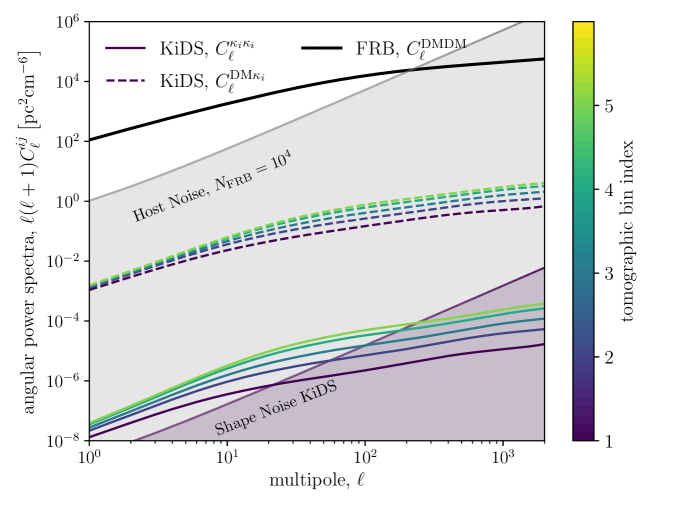
- The authors cross-correlate the DM angular power spectrum from FRBs with cosmic shear power spectra from a Euclid-like survey to break degeneracies in parameter space.
- They employ a Fisher matrix forecast with a noiseless data vector and MCMC sampling via emcee to estimate posterior distributions for cosmological and feedback parameters.
- Priors are imposed on cosmological parameters to avoid extrapolation beyond simulation calibration ranges, ensuring robustness in parameter estimation.
- The analysis compares constraints from cosmic shear alone versus cosmic shear combined with FRB DM correlations, focusing on feedback strength, Hubble constant, baryon density, and neutrino mass.
Experimental results
Research questions
- RQ1Can FRB dispersion measures break degeneracies between cosmological and baryonic feedback parameters in weak lensing surveys?
- RQ2How much does adding FRB DM data improve constraints on feedback strength compared to cosmic shear alone?
- RQ3To what extent can FRB-based DM correlations enhance constraints on the sum of neutrino masses?
- RQ4How do the redshift-weighting functions of FRB DM correlations differ from those of the tSZ effect, and what does this imply for systematics and complementarity?
- RQ5Can FRBs serve as an independent, low-redshift probe of baryonic structure without relying on CMB priors?
Key findings
- With approximately 10⁴ FRBs, the constraints on baryonic feedback strength improve by an order of magnitude compared to cosmic shear alone.
- The addition of FRB data reduces uncertainty on the neutrino mass sum by 50–100 %, significantly tightening constraints on this key cosmological parameter.
- FRB DM correlations break degeneracies between feedback parameters and cosmological parameters such as the Hubble constant and baryon density.
- The method provides a complementary probe to the tSZ effect, with different redshift sensitivity and systematics, enhancing robustness in cosmological inference.
- Even with conservative priors and a simple feedback model, the inclusion of FRB data yields substantial improvements, particularly in the feedback and neutrino mass parameters.
- The signal-to-noise ratio used in the forecast is achievable within the next decade, given current and planned FRB surveys like CHIME, ASKAP, and SKA.
Better researchstarts right now
From reading papers to final review, dramatically reduce your research time.
No credit card · Free plan available
This review was created by AI and reviewed by human editors.