
[Paper Review] Can supercooled phase transitions explain the gravitational wave background observed by pulsar timing arrays?
This paper investigates whether supercooled first-order phase transitions (FOPTs) can explain the nHz stochastic gravitational wave background (SGWB) detected by pulsar timing arrays. It demonstrates two critical obstacles: vacuum domination during supercooling hinders bubble percolation and transition completion, and reheating to the scale of the FOPT physics makes SGWB spectrum calculations intractable, ruling out simple supercooled FOPT explanations for the observed signal.
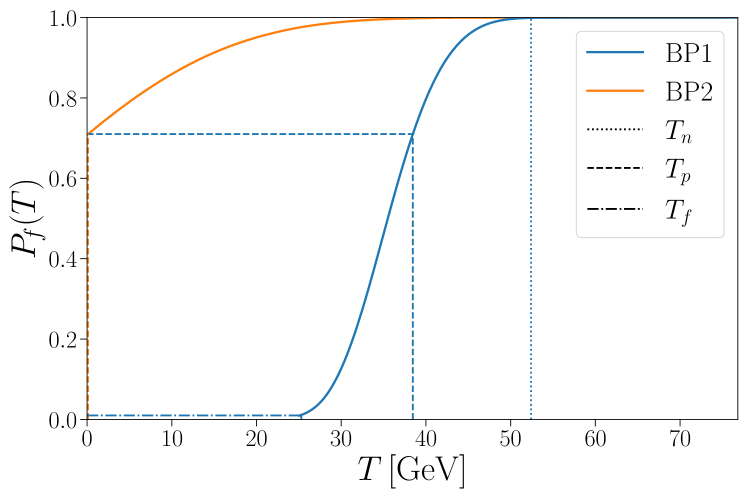
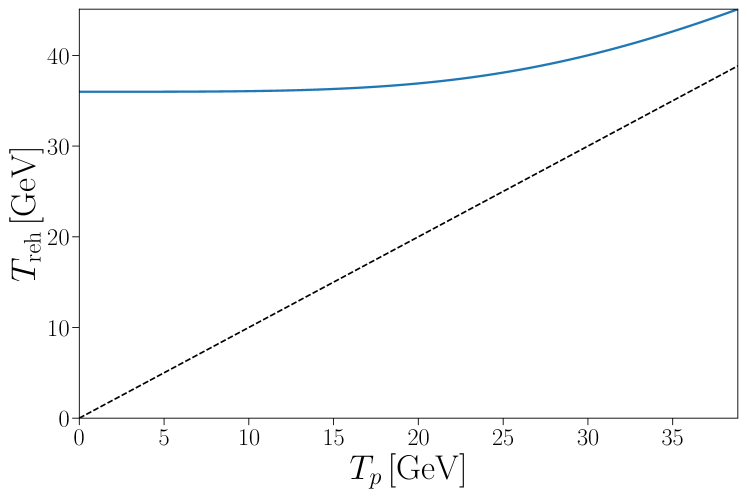
Several pulsar timing array collaborations recently reported evidence of a stochastic gravitational wave background (SGWB) at nHz frequencies. Whilst the SGWB could originate from the merger of supermassive black holes, it could be a signature of new physics near the 100 MeV scale. Supercooled first-order phase transitions (FOPTs) that end at the 100 MeV scale are intriguing explanations, because they could connect the nHz signal to new physics at the electroweak scale or beyond. Here, however, we provide a clear demonstration that it is not simple to create a nHz signal from a supercooled phase transition, due to two crucial issues that could rule out many proposed supercooled explanations and should be checked. As an example, we use a model based on non-linearly realized electroweak symmetry that has been cited as evidence for a supercooled explanation. First, we show that a FOPT cannot complete for the required transition temperature of around 100 MeV. Such supercooling implies a period of vacuum domination that hinders bubble percolation and transition completion. Second, we show that even if completion is not required or if this constraint is evaded, the Universe typically reheats to the scale of any physics driving the FOPT. The hierarchy between the transition and reheating temperature makes it challenging to compute the spectrum of the SGWB.
Motivation & Objective
- To assess whether supercooled first-order phase transitions (FOPTs) can produce the stochastic gravitational wave background (SGWB) observed at nHz by pulsar timing arrays.
- To investigate the viability of FOPTs ending at the 100 MeV scale as a source of the nHz signal, given constraints from cosmology and particle physics.
- To identify and analyze two fundamental obstacles—vacuum domination and reheating—that undermine the feasibility of supercooled FOPT explanations.
- To test the robustness of a specific model with non-linearly realized electroweak symmetry as a candidate for supercooled FOPTs.
Proposed method
- The authors analyze the dynamics of supercooled FOPTs using cosmological and gravitational wave (GW) emission models, focusing on bubble nucleation, percolation, and transition completion.
- They employ redshifted GW amplitude and spectral shape fits for collision, sound wave, and turbulence sources, using updated parameters from recent literature.
- The redshift factors $ \mathcal{R}_{ ext{f}} $ and $ \mathcal{R}_{ ext{\Omega}} $ are derived from cosmological evolution to correctly account for frequency and amplitude redshifting.
- The model uses the sound wave source fit from Hindmarsh et al. with $ \tilde{\Omega}_{\text{gw}} = 0.01 $, $ b = 1 $, and $ z_p = 10 $, and the turbulence fit with $ \kappa_{\text{turb}} = 0.05 $.
- They reverse standard mappings (e.g., $ R_* \propto v_w/\beta $) to generalize GW fits beyond original assumptions, enabling broader parameter exploration.
- The analysis evaluates whether the required 100 MeV transition temperature can be achieved without violating cosmological constraints, particularly vacuum domination and reheating dynamics.
Experimental results
Research questions
- RQ1Can a supercooled first-order phase transition at ~100 MeV produce a stochastic gravitational wave background detectable at nHz frequencies by pulsar timing arrays?
- RQ2Does vacuum domination during supercooling prevent the completion of a first-order phase transition, thereby disrupting bubble percolation and GW emission?
- RQ3To what extent does reheating to the scale of the phase transition physics invalidate the computation of the gravitational wave spectrum in supercooled FOPT scenarios?
- RQ4Is the model with non-linearly realized electroweak symmetry, previously cited as a viable supercooled FOPT explanation, consistent with cosmological constraints on phase transition completion and reheating?
Key findings
- A supercooled first-order phase transition at ~100 MeV cannot complete due to vacuum domination, which suppresses bubble percolation and prevents the formation of a sustained GW signal.
- Even if transition completion is evaded, reheating to the scale of the FOPT physics introduces a hierarchy between the transition and reheating temperatures that makes the gravitational wave spectrum computationally intractable.
- The model based on non-linearly realized electroweak symmetry, previously proposed as a viable explanation, fails under the same cosmological constraints, particularly due to vacuum domination.
- The redshifted GW amplitude and spectral shape calculations show that the required nHz signal cannot be generated under realistic supercooled FOPT dynamics.
- The study concludes that simple supercooled FOPT explanations for the nHz SGWB are ruled out by fundamental cosmological dynamics.
- The authors emphasize that any viable explanation must avoid both vacuum domination and the reheating hierarchy, which are inherent in supercooled FOPTs.
Better researchstarts right now
From reading papers to final review, dramatically reduce your research time.
No credit card · Free plan available
This review was created by AI and reviewed by human editors.