
[Paper Review] Canonical Hubble-Tension-Resolving Early Dark Energy Cosmologies are Inconsistent with the Lyman-$α$ Forest
This paper demonstrates that canonical early dark energy (EDE) models—proposed to resolve the Hubble tension— are inconsistent with Lyman-α forest data. Using Lyman-α forest flux power spectrum measurements from SDSS eBOSS and X-Shooter/MIKE, it finds that EDE models require a higher scalar spectral index $n_s$ than preferred by Lyman-α data, leading to $H_0 = 67.9^{+0.4}_{-0.4}$ km/s/Mpc (68% CL), in >4σ tension with the SH0ES measurement.
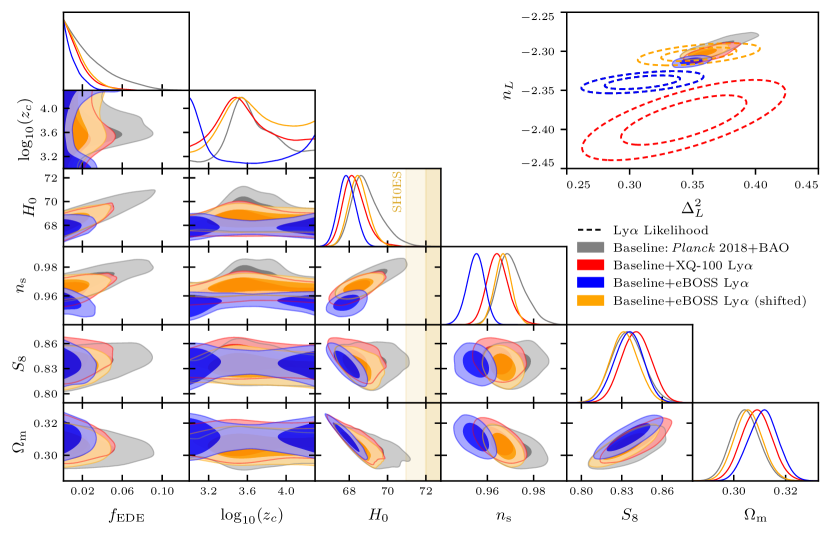
Current cosmological data exhibit discordance between indirect and some direct inferences of the present-day expansion rate, $H_0$. Early dark energy (EDE), which briefly increases the cosmic expansion rate prior to recombination, is a leading scenario for resolving this "Hubble tension" while preserving a good fit to cosmic microwave background (CMB) data. However, this comes at the cost of changes in parameters that affect structure formation in the late-time universe, including the spectral index of scalar perturbations, $n_s$. Here, we present the first constraints on axion-like EDE using data from the Lyman-$α$ forest, i.e., absorption lines imprinted in background quasar spectra by neutral hydrogen gas along the line of sight. We consider two independent measurements of the one-dimensional Ly$α$ forest flux power spectrum, from the Sloan Digital Sky Survey (SDSS eBOSS) and from the MIKE/HIRES and X-Shooter spectrographs. We combine these with a baseline dataset comprised of Planck CMB data and baryon acoustic oscillation (BAO) measurements. Combining the eBOSS Ly$α$ data with the CMB and BAO dataset reduces the 95% confidence level (CL) upper bound on the maximum fractional contribution of EDE to the cosmic energy budget, $f_{ m EDE}$, from 0.07 to 0.03 and constrains $H_0=67.9_{-0.4}^{+0.4}$ km/s/Mpc (68% CL), with maximum a posteriori value $H_0=67.9$ km/s/Mpc. Similar results are obtained for the MIKE/HIRES and X-Shooter Ly$α$ data. Our Ly$α$-based EDE constraints yield $H_0$ values that are in $>4σ$ tension with the SH0ES distance-ladder measurement and are driven by the preference of the Ly$α$ forest data for $n_s$ values lower than those required by EDE cosmologies that fit Planck CMB data. Taken at face value, the Ly$α$ forest severely constrains canonical EDE models that could resolve the Hubble tension.
Motivation & Objective
- To test whether canonical early dark energy (EDE) models, which resolve the Hubble tension by boosting the expansion rate before recombination, are consistent with Lyman-α forest data.
- To constrain the maximum fractional energy contribution of EDE, $f_{\text{EDE}}$, using high-precision Lyman-α forest flux power spectrum measurements.
- To assess whether the preference of Lyman-α data for lower $n_s$ values conflicts with the higher $n_s$ required by EDE models to fit Planck CMB data.
- To evaluate the tension between EDE-favored $H_0$ values and the SH0ES direct measurement in light of Lyman-α data.
Proposed method
- Model EDE using an axion-like potential with $n=3$, parametrized by $f_{\text{EDE}}$, $z_c$, and $\theta_i$, using the CLASS_EDE code to compute background and linear perturbation evolution.
- Use a compressed likelihood based on the amplitude $\Delta_L^2$ and slope $n_L$ of the linear power spectrum at pivot $k_p = 0.009$ s/km and $z_p = 3$, marginalized over astrophysical uncertainties.
- Combine Lyman-α data from eBOSS and X-Shooter/MIKE with Planck 2018 CMB data (TTTEEE, lowl+lowE, lensing) and BAO measurements from BOSS, SDSS MGS, and 6dFGS.
- Perform Bayesian parameter inference using Markov Chain Monte Carlo to derive posterior constraints on $f_{\text{EDE}}$, $H_0$, $n_s$, and other cosmological parameters.
- Quantify tension between datasets using posterior comparisons and statistical metrics, particularly focusing on $n_s$ and $H_0$ discrepancies.
![Figure 1: Comparison of the best-fit linear matter power spectrum at $z_{p}=3$ from the EDE (grey) and $\Lambda$ CDM (orange) fits to the baseline CMB + BAO dataset with the best-fit $\Lambda$ CDM cosmologies for the eBOSS (blue) [ 30 ] and XQ-100 (red) Ly $\alpha$ forest datasets. Shaded bands indi](https://ar5iv.labs.arxiv.org/html/2303.00746/assets/x1.png)
Experimental results
Research questions
- RQ1Can canonical EDE models that resolve the Hubble tension be consistent with Lyman-α forest data?
- RQ2What is the upper bound on $f_{\text{EDE}}$ when Lyman-α forest data are included in the cosmological analysis?
- RQ3Does the Lyman-α forest data prefer a scalar spectral index $n_s$ that conflicts with the higher $n_s$ required by EDE models to fit CMB data?
- RQ4How does the inclusion of Lyman-α data affect the inferred value of $H_0$ and its tension with the SH0ES measurement?
Key findings
- The inclusion of eBOSS Lyman-α forest data reduces the 95% CL upper bound on $f_{\text{EDE}}$ from 0.07 to 0.03.
- The marginalized $H_0$ constraint is $67.9^{+0.4}_{-0.4}$ km/s/Mpc (68% CL), with a maximum a posteriori value of 67.9 km/s/Mpc.
- The same constraints are obtained using MIKE/HIRES and X-Shooter Lyman-α data, confirming robustness across independent datasets.
- The Lyman-α data prefer a lower $n_s$ than required by EDE models to fit Planck CMB data, creating a fundamental tension.
- The resulting $H_0$ value is in $>4\sigma$ tension with the SH0ES direct measurement of $73.04 \pm 1.04$ km/s/Mpc.
- The bimodal posterior in $\log_{10}(z_c)$ for the eBOSS analysis arises from a trade-off between $n_s$ and $f_{\text{EDE}}$, with low $z_c$ values better accommodating low $n_s$.
Better researchstarts right now
From reading papers to final review, dramatically reduce your research time.
No credit card · Free plan available
This review was created by AI and reviewed by human editors.