
[Paper Review] CANOS: A Fast and Scalable Neural AC-OPF Solver Robust To N-1 Perturbations
CANOS is a Graph Neural Network-based neural solver for AC-Optimal Power Flow (AC-OPF) that achieves near-optimal solutions within 1% of the true AC-OPF cost while running in 33–65 ms, even under N-1 topology perturbations. It is scalable to grids with up to 10,000 buses and maintains feasibility and accuracy across topological changes, enabling robust deployment in real-time and security-constrained power system operations.
Optimal Power Flow (OPF) refers to a wide range of related optimization problems with the goal of operating power systems efficiently and securely. In the simplest setting, OPF determines how much power to generate in order to minimize costs while meeting demand for power and satisfying physical and operational constraints. In even the simplest case, power grid operators use approximations of the AC-OPF problem because solving the exact problem is prohibitively slow with state-of-the-art solvers. These approximations sacrifice accuracy and operational feasibility in favor of speed. This trade-off leads to costly "uplift payments" and increased carbon emissions, especially for large power grids. In the present work, we train a deep learning system (CANOS) to predict near-optimal solutions (within 1% of the true AC-OPF cost) without compromising speed (running in as little as 33--65 ms). Importantly, CANOS scales to realistic grid sizes with promising empirical results on grids containing as many as 10,000 buses. Finally, because CANOS is a Graph Neural Network, it is robust to changes in topology. We show that CANOS is accurate across N-1 topological perturbations of a base grid typically used in security-constrained analysis. This paves the way for more efficient optimization of more complex OPF problems which alter grid connectivity such as unit commitment, topology optimization and security-constrained OPF.
Motivation & Objective
- To address the computational infeasibility of solving exact AC-OPF in real-time for large power grids.
- To overcome the trade-off between speed and accuracy in traditional approximations like DC-OPF, which lead to costly uplift payments and higher emissions.
- To develop a machine learning model that maintains feasibility and accuracy under topological perturbations, such as line outages (N-1 contingencies).
- To enable scalable deployment of neural solvers on realistic grid sizes (up to 10,000 buses) while preserving constraint satisfaction.
- To provide a foundation for solving more complex OPF variants, including security-constrained OPF, unit commitment, and optimal transmission switching.
Proposed method
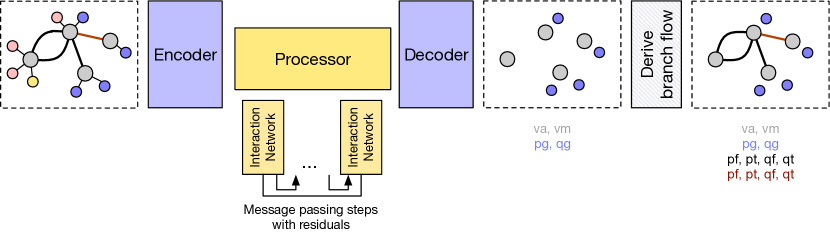
- CANOS employs a deep Graph Neural Network (GNN) with an Encode-Process-Decode architecture, using 36–60 message-passing steps to model power grid topology and power flows.
- The model is trained end-to-end on synthetic data generated by perturbing load values across different grid configurations, including N-1 line outage scenarios.
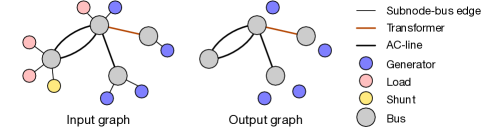
- It predicts optimal generation dispatch and voltage profiles directly from grid parameters, bypassing iterative optimization.
- Constraint satisfaction is enforced through a differentiable post-processing step that applies power flow equations to verify and refine predictions.
- A loss function includes a penalty term for constraint violations, with potential for improvement via Lagrangian or zero-gradient techniques.
- The model is robust to topological changes because GNNs naturally generalize across graph structures, enabling inference on modified grids without retraining.
Experimental results
Research questions
- RQ1Can a deep learning model achieve near-optimal AC-OPF solutions with sub-65ms inference time on large-scale power grids?
- RQ2How well does a GNN-based solver maintain feasibility and accuracy under N-1 topology perturbations such as line outages?
- RQ3To what extent can a neural AC-OPF solver scale to realistic grid sizes (e.g., 10,000 buses) while preserving solution quality?
- RQ4Can a neural solver replace traditional solvers in real-time and security-constrained OPF applications without sacrificing operational feasibility?
- RQ5How does the model generalize to unseen topological changes, such as new lines or contingencies, without retraining?
Key findings
- CANOS achieves solutions within 1% of the true AC-OPF cost on test cases, demonstrating high optimality for a neural solver.
- The model runs in 33–65 ms per inference, enabling real-time deployment in dynamic power system operations.
- CANOS maintains high constraint satisfaction (mean of 99.8% for N-1 perturbations) across 10,000-bus systems, showing strong robustness to topology changes.
- The model generalizes well to unseen N-1 contingencies, with no significant drop in performance, indicating strong generalization beyond training perturbations.
- Performance improves with increased message-passing steps, suggesting that deeper GNNs enhance solution quality.
- CANOS enables practical deployment in complex OPF variants like SC-OPF, unit commitment, and optimal transmission switching due to its topological robustness.
Better researchstarts right now
From reading papers to final review, dramatically reduce your research time.
No credit card · Free plan available
This review was created by AI and reviewed by human editors.