
[Paper Review] Cavity-Induced Strong Magnon-Magnon Coupling in Altermagnets
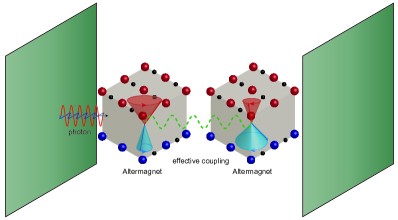
This paper proposes cavity-mediated long-distance strong magnon-magnon coupling in altermagnets via virtual photon exchange, leveraging chiral magnon splitting induced by a perpendicular magnetic field. The key result is a highly anisotropic, effective magnon-magnon coupling strength of up to 0.49 meV in RuO₂, achievable in the highly dispersive regime, enabling nonlocal quantum magnonic interactions.
Long-distance strong coupling between short-wavelength magnons remains an outstanding challenge in quantum magnonics, an emerging interdiscipline between magnonics and quantum information science. Recently, altermagnets are identified as the third elementary class of magnets that break the time-reversal symmetry without magnetization and thus combine characteristics of conventional collinear ferromagnets and antiferromagnets. In this work, we show that cavity photons can mediate the long-distance strong coupling of exchange magnons with opposite chiralities in altermagnets, manifesting as an anticrossing of the magnon-polariton spectrum in the extremely dispersive regime. The predicted effective magnon-magnon coupling strongly depends on the magnon propagation direction, and is thus highly anisotropic. Our findings are intimately connected to the intrinsic nature of altermagnetic magnons, i.e., chirality-splitting-induced crossing of exchange magnons, which has no counterpart in conventional ferromagnets or antiferromagnets, and may open a new path way for magnon-based quantum information processing in altermagnets.
Motivation & Objective
- To address the challenge of long-distance strong coupling between short-wavelength magnons in quantum magnonics.
- To explore the unique properties of altermagnets—breaking time-reversal symmetry without net magnetization—as a platform for nonlocal magnonic coupling.
- To demonstrate that cavity photons can mediate strong, nonlocal coupling between exchange magnons with opposite chiralities in altermagnets.
- To derive and validate an analytical formula for the effective magnon-magnon coupling mediated by virtual photons in the dispersive regime.
- To reveal the anisotropic nature of the coupling due to the intrinsic anisotropy of exchange interactions in altermagnets.
Proposed method
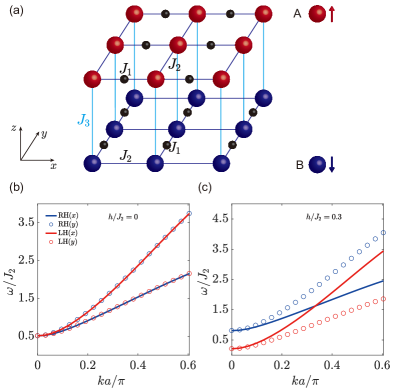
- Modeling a two-sublattice altermagnet with anisotropic intralayer exchange interactions and applying a perpendicular magnetic field to shift the degeneracy point of chiral magnons from k=0 to finite k.
- Using second-order perturbation theory to derive the effective magnon-magnon coupling strength from the dispersive magnon-photon coupling rate λₖ.
- Solving a transcendental equation involving the wavevector k_c and propagation angle φ to determine the anticrossing point in the magnon-polariton spectrum.
- Employing numerical simulations to validate the analytical predictions of the effective coupling strength g_eff as a function of magnetic field h, exchange ratio J₁/J₂, and propagation direction φ.
- Analyzing the role of the anisotropy constant K and dipole-dipole interactions, showing they have negligible impact on g_eff due to large frequency mismatch and 1/d³ decay.
- Calculating cooperativity to confirm strong coupling regime (up to 100) for realistic parameters in RuO₂ with α = 1.0×10⁻³.
Experimental results
Research questions
- RQ1Can cavity photons mediate long-distance strong coupling between short-wavelength exchange magnons in altermagnets?
- RQ2How does the application of a perpendicular magnetic field affect the magnon degeneracy point and enable nonlocal coupling?
- RQ3What is the analytical form of the effective magnon-magnon coupling induced by virtual photon exchange in the dispersive regime?
- RQ4How does the effective coupling strength depend on the magnon propagation direction, and what causes its anisotropy?
- RQ5To what extent do dipole-dipole interactions or magnetic anisotropy influence the effective coupling compared to cavity-mediated virtual processes?
Key findings
- A perpendicular magnetic field shifts the magnon degeneracy from k=0 to a finite wavevector k_c ≠ 0, enabling strong coupling in the exchange region.
- The cavity-induced magnon-magnon coupling manifests as an anticrossing in the magnon-polariton spectrum, even though the photon frequency is orders of magnitude higher than the magnon frequency.
- The effective coupling strength g_eff reaches up to 0.49 meV in RuO₂ under realistic conditions (N/V ~ 10²³ cm⁻³, h = 0.6 meV), indicating strong coupling in the highly dispersive regime.
- The coupling strength g_eff is highly anisotropic and depends nonlinearly on the magnetic field h and the exchange ratio J₁/J₂, with maximum values at φ = 0 or π due to maximal group velocity difference.
- The effective coupling is insensitive to the anisotropy constant K due to the large frequency mismatch between magnons and cavity photons.
- Numerical results for g_eff as a function of propagation angle φ show excellent agreement with the analytical formula derived from second-order perturbation theory.
Better researchstarts right now
From reading papers to final review, dramatically reduce your research time.
No credit card · Free plan available
This review was created by AI and reviewed by human editors.