
[Paper Review] Chained Quantile Morphing with Normalizing Flows
This paper introduces a deep learning-based method called Chained Quantile Morphing with Normalizing Flows (CQM-NF) to correct Monte Carlo simulations in high-energy physics by transforming simulated event distributions to better match real data. Using invertible normalizing flows to model continuous conditional cumulative distribution functions, the method iteratively corrects observables while preserving complex correlations, outperforming reweighting in regions with poor MC coverage and offering a robust alternative to traditional morphing in high-dimensional particle-level data.
Accounting for inaccuracies in Monte Carlo simulations is a crucial step in any high energy physics analysis. It becomes especially important when training machine learning models, which can amplify simulation inaccuracies and introduce large discrepancies and systematic uncertainties when the model is applied to data. In this paper, we introduce a method to transform simulated events to better match data using normalizing flows, a class of deep learning-based density estimation models. Our proposal uses a technique called chained quantile morphing, which corrects a set of observables by iteratively shifting each entry according to a conditonal cumulative density function. We demonstrate the technique on a realistic particle physics dataset, and compare it to a neural network-based reweighting method. We also introduce a new contrastive learning technique to correct high dimensional particle-level inputs, which naively cannot be efficiently corrected with morphing strategies.
Motivation & Objective
- To address systematic uncertainties in high-energy physics analyses caused by inaccuracies in Monte Carlo simulations, especially when training machine learning models.
- To develop a continuous, differentiable, and precise alternative to discrete chained quantile morphing for correcting simulated event distributions.
- To enable effective correction of high-dimensional particle-level inputs—previously intractable with standard morphing—using normalizing flows.
- To compare the performance of the proposed CQM-NF method against traditional reweighting and morphing techniques in terms of distribution matching and invariant quantity preservation.
Proposed method
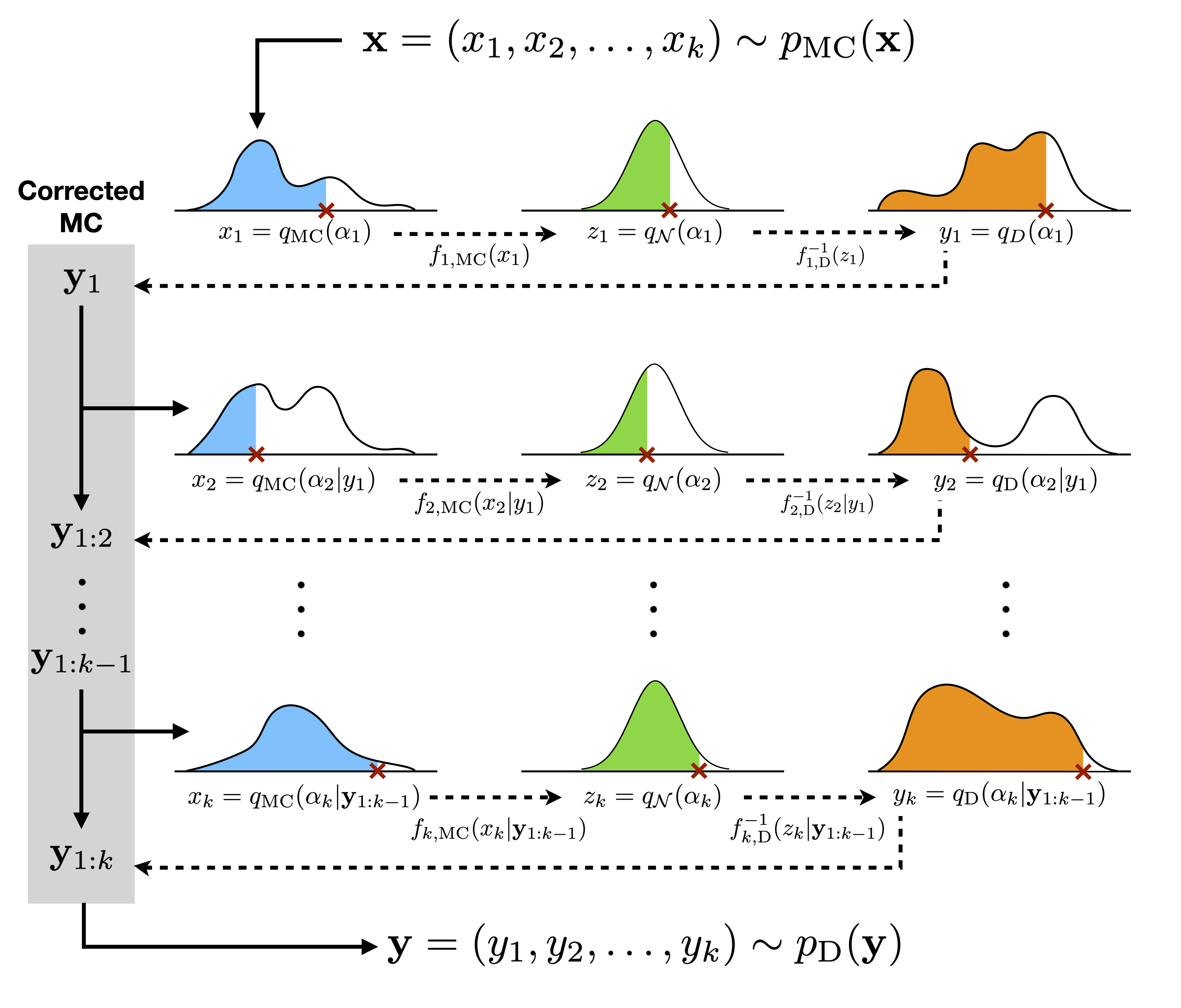
- The method uses normalizing flows to learn continuous, invertible transformations between the conditional cumulative distribution functions (CDFs) of Monte Carlo (MC) and data distributions.
- It applies chained quantile morphing by iteratively transforming each observable using the conditional CDFs $ F_i^{\text{MC}}(x_i|\mathbf{x}_{1:i-1}) $ and $ F_i^{\text{Data}}(x_i|\mathbf{x}_{1:i-1}) $, ensuring correct marginal and conditional dependencies.
- The normalizing flow architecture enables end-to-end training to model complex, high-dimensional joint distributions with invertible, differentiable transformations.
- A contrastive learning technique is introduced to improve the correction of high-dimensional particle-level inputs where standard morphing fails due to sparsity and complexity.
- The approach preserves the structure of the original MC sample while shifting it toward the data distribution, minimizing distortion of physical invariants.
- The method is evaluated on a realistic particle physics dataset and compared to a neural network-based reweighting method, demonstrating superior performance in under-sampled regions.
Experimental results
Research questions
- RQ1Can normalizing flows provide a continuous and precise alternative to discrete chained quantile morphing for correcting Monte Carlo simulations in high-energy physics?
- RQ2How does the proposed CQM-NF method perform in correcting high-dimensional particle-level inputs where traditional morphing strategies fail?
- RQ3In regions of phase space poorly covered by the MC sample, does CQM-NF outperform reweighting techniques that rely on event weights?
- RQ4To what extent does the method preserve invariant quantities such as reconstructed particle masses, compared to reweighting?
- RQ5Can contrastive learning improve the training and generalization of morphing models on complex, high-dimensional particle physics data?
Key findings
- The CQM-NF method successfully corrects simulated event distributions to better match data, particularly in regions with low MC coverage, where reweighting fails due to lack of training examples.
- In a 5D toy model with a missing correlation in the MC sample, CQM-NF accurately recovers the data distribution, while reweighting fails to reproduce the data in the under-covered region.
- In a resonance decay toy model, reweighting perfectly preserves the reconstructed invariant mass distribution, while CQM-NF introduces smearing due to imperfect learning of the complex momentum-$\delta\phi$ relationship.
- Despite the smearing in invariant mass, CQM-NF still provides a more robust correction than reweighting in regions where the MC distribution does not overlap with data.
- The contrastive learning technique enables effective correction of high-dimensional particle-level inputs, which are otherwise infeasible to correct with standard morphing approaches.
- The method demonstrates that normalizing flows can effectively model complex, conditional CDFs for morphing, enabling precise and differentiable corrections in high-energy physics applications.
Better researchstarts right now
From reading papers to final review, dramatically reduce your research time.
No credit card · Free plan available
This review was created by AI and reviewed by human editors.